
We read your photo as:
The data represent the capacity of fruit juice (in litres) in 8 different Containers arranged in ascending order: Pt 4, 11, 12, 15, 3p-1, 1p-2, 27, P2-6. a) If the range is 20, find the i) value of P, ii) Mean of Distribution.
ScanSolve AI Answer
Step-by-step solution
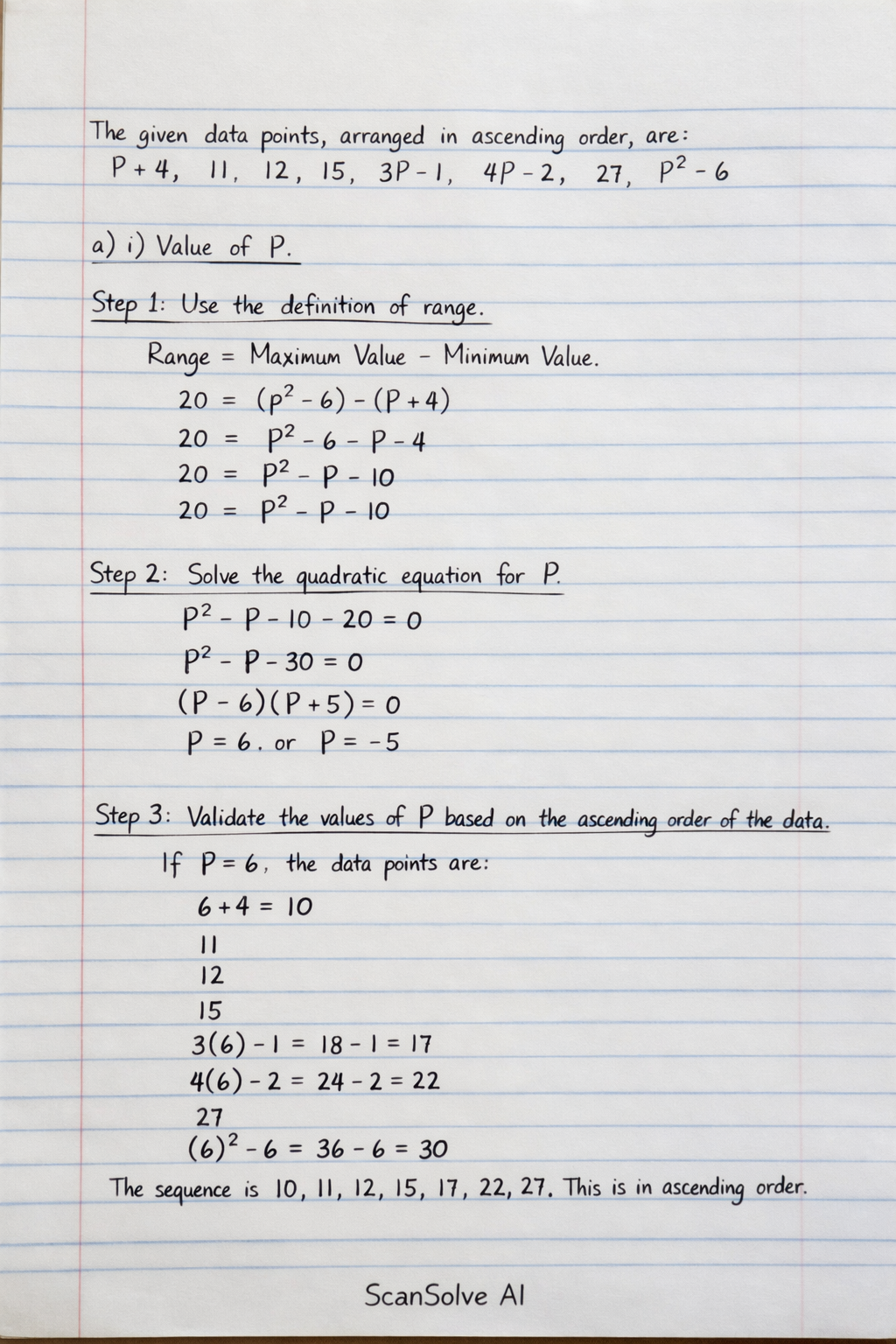
6 stepsThe given data points, arranged in ascending order, are:
a) i) Value of P
Use the definition of range.
The range is the difference between the maximum and minimum values. Since the data is in ascending order, the minimum value is and the maximum value is . The given range is 20.
Solve the quadratic equation for P.
Rearrange the equation to form a standard quadratic equation:
Factor the quadratic equation:
This gives two possible values for P: or .
Validate the values of P based on the ascending order of the data.
If , the data points are:
11
12
15
27
The sequence is . This is in ascending order.If , the data points are:
11
12
15
27
The sequence is . This is not in ascending order (e.g., ).
Therefore, is not a valid solution.The value of P is .
a) ii) Mean of distribution
List the data points using the valid value of .
The data points are: .
The number of data points is .Calculate the sum of the data points.
Calculate the mean of the distribution.
The mean of the distribution is .
Still stuck on this one?
Ask a follow-up, and the answer starts from this question.
More Mathematics Questions
Handwritten Step-by-Step Solution
Get this as a handwritten image on WhatsApp — like a tutor wrote it for you.
Try on WhatsApp