
We read your photo as:
The data shows the mass (in kilograms) of 20 fruits in a basket. Mass (x): 1, 2, 3, 4, 5. Frequency (f): 3, m/2, m, 3, 2. Total number of fruits = 20. a) Calculate the value of m. b) Find the Mode, Me
ScanSolve AI Answer
Answers
5 partsStep-by-step solution
11 stepsHere is the solution to your question:
The data shows the mass (in kilograms) of 20 fruits in a basket.
Mass (x): 1, 2, 3, 4, 5
Frequency (f): 3, m/2, m, 3, 2
Total number of fruits = 20.
Part a· 5 steps
Calculate the value of m
Sum all the frequencies and set them equal to the total number of fruits.
Combine the constant terms and the terms involving .
Subtract 8 from both sides.
Multiply both sides by 2.
Divide by 3 to find the value of .
Now, update the frequency table with :
Mass (x): 1, 2, 3, 4, 5
Frequency (f): 3, , 8, 3, 2
Frequency (f): 3, 4, 8, 3, 2
Part b(i)
Mode
Find the Mode, Median, and Mean
The mode is the value with the highest frequency.
The frequencies are 3, 4, 8, 3, 2. The highest frequency is 8, which corresponds to a mass of 3 kg.
The mode is .
Part b(ii)
Median
There are 20 fruits, so the median is the average of the and values.
Let's list the cumulative frequencies:
- Mass 1 kg: 3 fruits (1st to 3rd)
- Mass 2 kg: 4 fruits (4th to 7th)
- Mass 3 kg: 8 fruits (8th to 15th)
- Mass 4 kg: 3 fruits (16th to 18th)
- Mass 5 kg: 2 fruits (19th to 20th)
The value falls within the mass 3 kg category.
The value also falls within the mass 3 kg category.
The median is .
Part b(iii)
Mean
The mean is calculated using the formula .
Calculate .
The total frequency .
Calculate the mean.
Part c
Find the probability of picking a fruit that has a mass more than 3 kg
Identify the fruits with mass more than 3 kg.
These are fruits with mass 4 kg and 5 kg.
Find the total frequency for these masses.
Frequency for 4 kg = 3
Frequency for 5 kg = 2
Total fruits with mass > 3 kg = .Calculate the probability.
Part d
Draw a bar graph for the data
To draw a bar graph:
- Draw a horizontal axis (x-axis) and label it "Mass (kg)". Mark points for 1, 2, 3, 4, and 5.
- Draw a vertical axis (y-axis) and label it "Frequency". Scale it from 0 up to at least 8 (the maximum frequency).
- For each mass value, draw a vertical bar with a height corresponding to its frequency:
- For Mass 1 kg, draw a bar of height 3.
- For Mass 2 kg, draw a bar of height 4.
- For Mass 3 kg, draw a bar of height 8.
- For Mass 4 kg, draw a bar of height 3.
- For Mass 5 kg, draw a bar of height 2.
- Ensure the bars are of equal width and typically have small gaps between them.
Still stuck on this one?
Ask a follow-up, and the answer starts from this question.
More Mathematics Questions
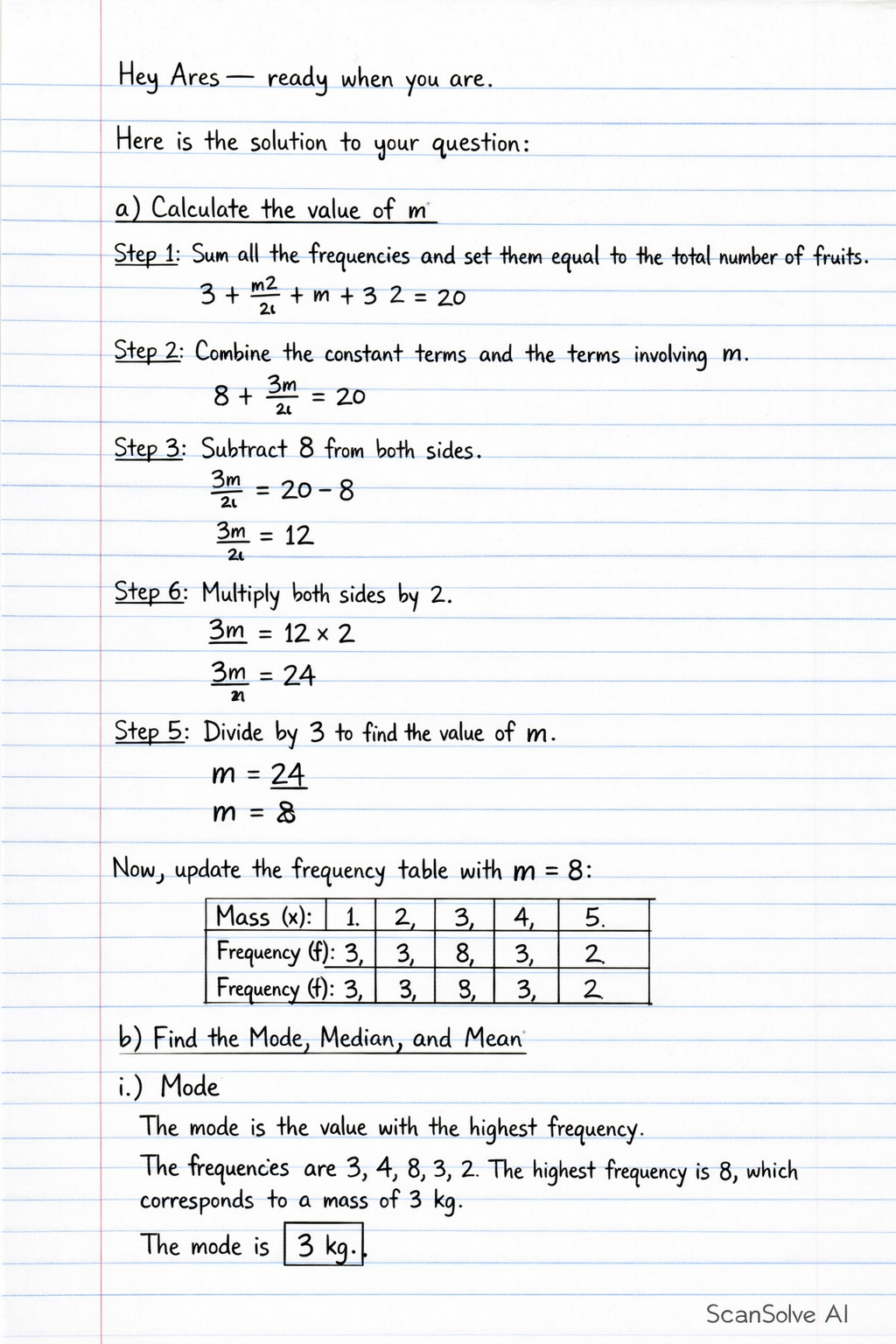
Handwritten Step-by-Step Solution
Get this as a handwritten image on WhatsApp — like a tutor wrote it for you.
Try on WhatsApp