

This mathematics problem involves applying core mathematical principles and formulas. Below you will find a complete step-by-step solution with detailed explanations for each step, helping you understand not just the answer but the method behind it.
ScanSolve AI Answer
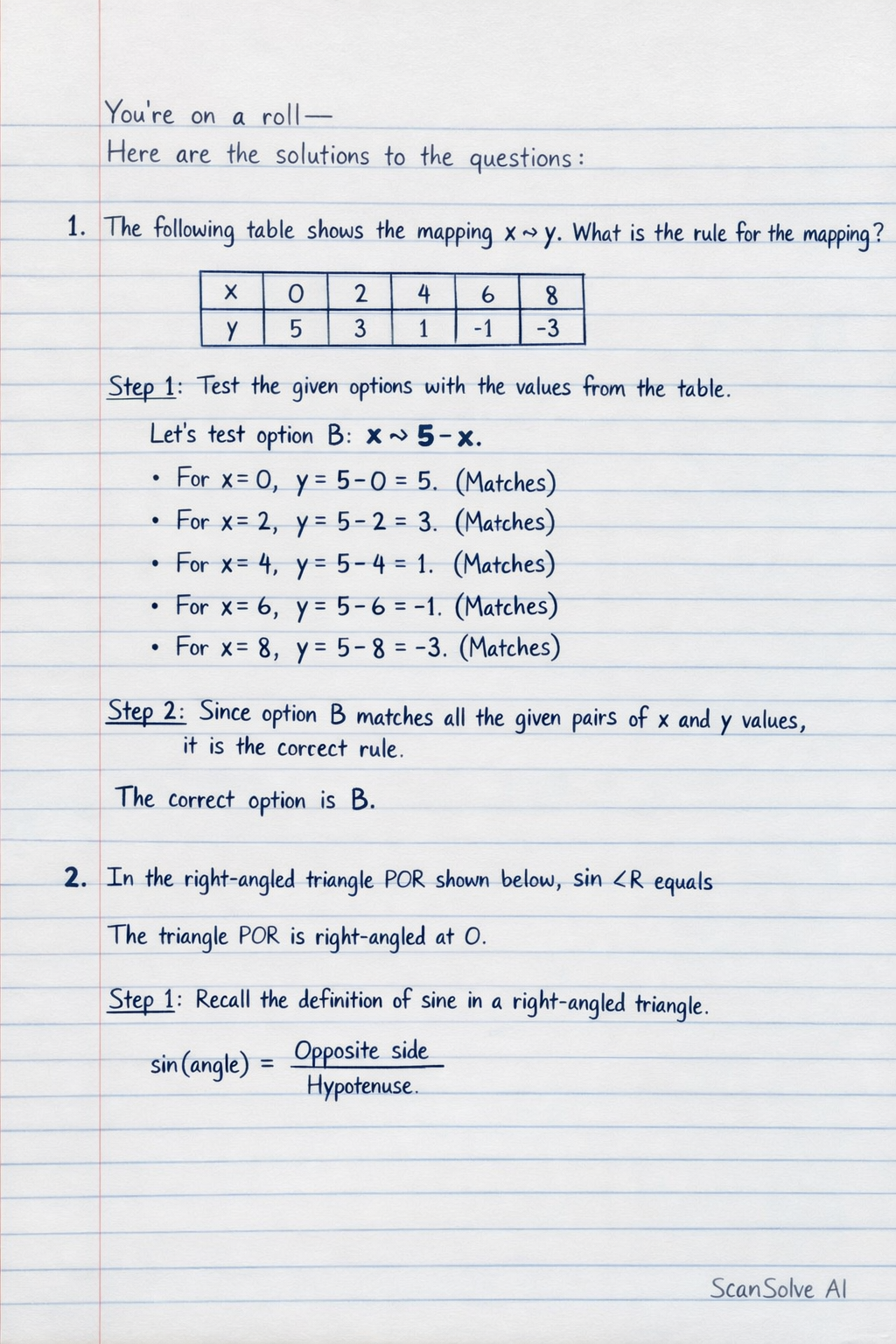
You're on a roll — Here are the solutions to the questions: 1. The following table shows the mapping x y. What is the rule for the mapping? |c|c|c|c|c|c| x & 0 & 2 & 4 & 6 & 8 \\ y & 5 & 3 & 1 & -1 & -3 \\ Step 1: Test the given options with the values from the table. Let's test option B: x 5-x. • For x=0, y = 5-0 = 5. (Matches) • For x=2, y = 5-2 = 3. (Matches) • For x=4, y = 5-4 = 1. (Matches) • For x=6, y = 5-6 = -1. (Matches) • For x=8, y = 5-8 = -3. (Matches) Step 2: Since option B matches all the given pairs of x and y values, it is the correct rule. The correct option is B. 2. In the right-angled triangle POR shown below, R equals The triangle POR is right-angled at O. Step 1: Recall the definition of sine in a right-angled triangle. (angle) = Opposite sideHypotenuse Step 2: Identify the opposite side and hypotenuse for angle R. • The side opposite to angle R is OP. • The hypotenuse is PR. Therefore, R = (OP)/(PR). Step 3: Compare this with the given options. Let's evaluate P: (angle) = Adjacent sideHypotenuse • The side adjacent to angle P is OP. • The hypotenuse is PR. Therefore, P = (OP)/(PR). Step 4: Conclude the equivalence. Since R = (OP)/(PR) and P = (OP)/(PR), it follows that R = P. The correct option is B. 3. Express 75882 to three significant figures. Step 1: Identify the first three significant figures. The first three significant figures in 75882 are 7, 5, and 8. Step 2: Look at the fourth digit to determine rounding. The fourth digit is 8. Since 8 is 5 or greater, we round up the third significant figure. Step 3: Round up the third significant figure and replace subsequent digits with zeros. The third significant figure is 8, which rounds up to 9. The digits after the third significant figure become zeros to maintain the place value. So, 75882 rounded to three significant figures is 75900. The correct option is C. 4. Find the vector which translates the point (2, 4) to the point (5, 3). Step 1: Define the initial point, final point, and the translation vector. Let the initial point be A = (2, 4). Let the final point be B = (5, 3). Let the translation vector be v = x \\ y . Step 2: Set up the vector addition equation. The translation means A + v = B. 2 \\ 4 + x \\ y = 5 \\ 3 Step 3: Solve for the components of the translation vector. For the x-component: 2 + x = 5 x = 5 - 2 x = 3 For the y-component: 4 + y = 3 y = 3 - 4 y = -1 Step 4: Write the translation vector. The translation vector is 3 \\ -1 . The options for this question are not visible in the image, but the vector is 3 \\ -1 . What's next? Send 'em 📸