
We read your photo as:
The homework contains three questions: 1. The construction below is required in constructing angle POQ. What is the size of angle POQ? 2. A car travels 160 miles on 4 gallons of diesel. Find the avera
ScanSolve AI Answer
This answer stops before the end.
It was cut off when it was first written. Ask ScanSolve this question again for the full working.
Here are the solutions to the questions.
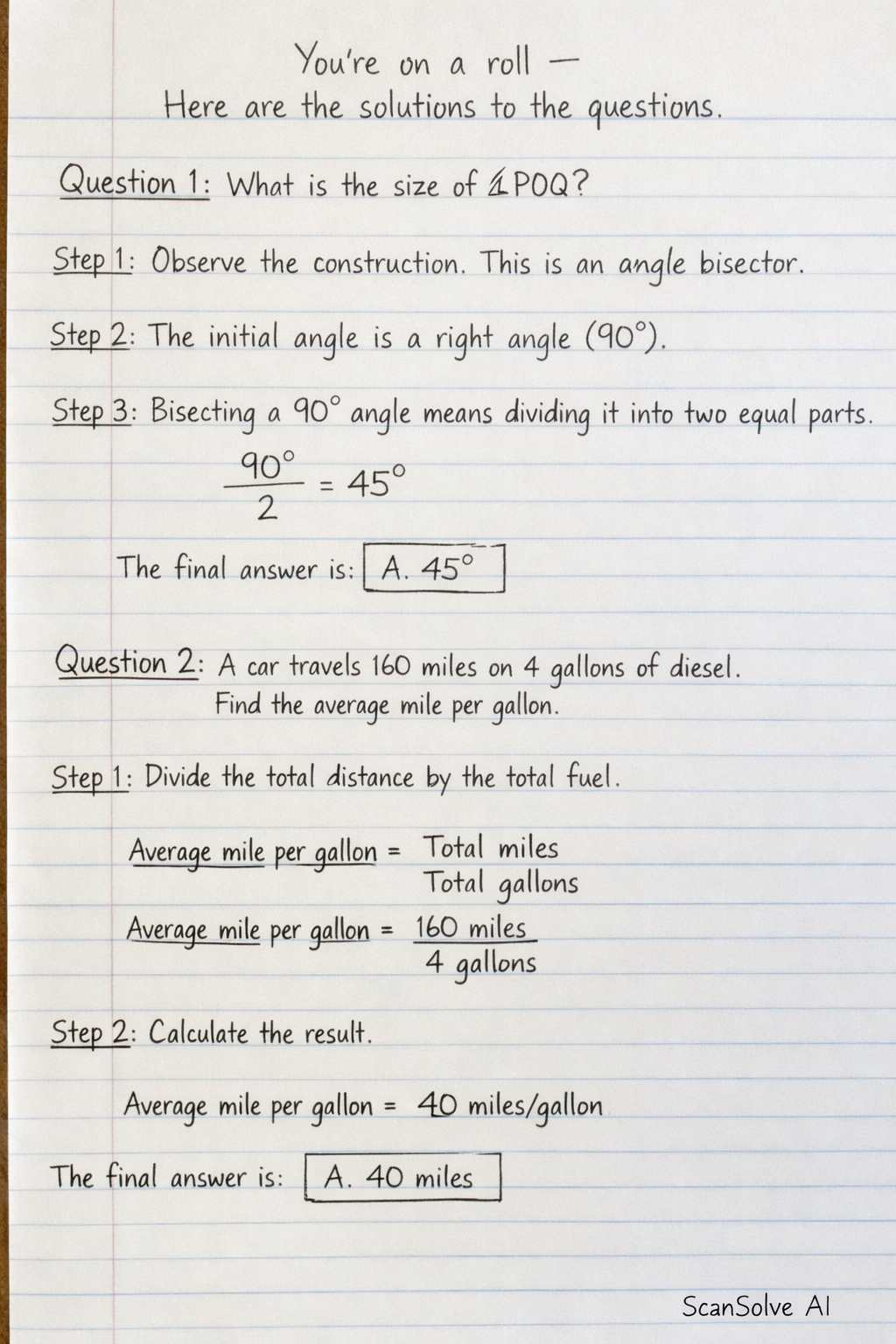
Question 1: The construction below is required in constructing angle POQ. What is the size of angle POQ?
Step 1: Observe the construction. The construction shows a method to bisect an angle.
Step 2: The initial angle being bisected is a right angle (), indicated by the perpendicular construction marks.
Step 3: Bisecting a angle means dividing it into two equal parts.
The final answer is .
Question 2: A car travels 160 miles on 4 gallons of diesel. Find the average mile per gallon.
Step 1: Divide the total distance by the total fuel consumed.
Step 2: Calculate the result.
The final answer is .
Question 3: Find the gradient of the line in the equation .
Step 1: Rearrange the equation into the slope-intercept form .
Step 2: Divide all terms by 4.
Step 3: Identify the gradient (), which is the coefficient of .
The gradient is .
The final answer is .
Question 4: Simplify .
Step 1: Use the distributive property (FOIL method) to multiply the binomials.
Step 2: Perform the multiplications.
The final answer is .
Question 5: At what distance did the bus driver drove from Town A to Town B?
Step 1: Locate Town A and Town B on the distance axis of the graph.
Town A is at 0 km.
Town B is at 4 km.
Step 2: The distance driven from Town A to Town B is the difference between their distances from the origin.
The final answer is .
Question 6: The bus driver drove from Town A to Town B within how many hours?
Step 1: Identify the time the bus left Town A and arrived at Town B from the graph.
Left Town A (0 km) at 8:00 a.m.
Arrived at Town B (4 km) at 9:00 a.m.
Step 2: Calculate the duration of the journey.
The final answer is .
Question 7: The bus driver drove from Town C back to Town A in what time?
Step 1: Identify the time the bus left Town C and arrived back at Town A from the graph.
Left Town C (6 km) at 9:30 a.m.
Arrived back at Town A (0 km) at 11:00 a.m.
Step 2: Calculate the duration of the journey.
The final answer is .
Question 8: Find the value of when .
Step 1: Substitute into the expression.
Step 2: Simplify each term.
Step 3: Add the values.
The final answer is .
Question 9: The equation of a straight line is . What is the gradient?
Step 1: Rearrange the equation into the slope-intercept form .
Step 2: Identify the gradient (), which is the coefficient of .
The gradient is .
The final answer is .
Question 10: Factorize .
Step 1: Identify the greatest common factor (GCF) of the terms.
The numerical GCF of and is .
The variable GCF of and is .
So, the GCF is .
Step 2: Factor out the GCF from each term.
Still stuck on this one?
Ask a follow-up, and the answer starts from this question.
More Mathematics Questions
Handwritten Step-by-Step Solution
Get this as a handwritten image on WhatsApp — like a tutor wrote it for you.
Try on WhatsApp