
We read your photo as:
The image shows graphs of the functions k(x) = ax2 and p(x) = mx + c. a) Determine the range of k. b) Determine the domain of p. c) Given that the gradient of AD is 1, determine the equation of AD in
ScanSolve AI Answer
Answers
3 partsStep-by-step solution
9 stepsPart 4.1· 2 steps
Determine the range of k.
Identify the type of graph and its vertex.
The graph is a parabola with its vertex at the origin . From the diagram, the parabola opens downwards.
Determine the possible y-values.
Since the parabola opens downwards from the vertex , the maximum y-value is 0, and all other y-values are less than or equal to 0.
The range of k is .
Part 4.2
The domain of p.
Identify the type of graph.
The graph p is a straight line, given by .
Determine the possible x-values.
A straight line extends infinitely in both the positive and negative x-directions.
The domain of p is .
Part 4.3
Given that the gradient of AD is 1, determine the equation of AD in the form of .
Identify the gradient (m) and a point on the line.
The gradient of line AD (which is line p) is given as .
The line p passes through point C(0, -6). This is the y-intercept, so .Write the equation of the line.
Substitute and into the equation :
The equation of AD is .
Part 4.4· 3 steps
Determine the equation of k in the form of if B is equidistant from A to C.
Use the equidistant property to find a relationship between the coordinates of B.
Let B be . A is and C is .
Since B is equidistant from A and C, .Use the fact that B lies on line p to find its coordinates.
From 4.3, the equation of line p is .
Substitute into the line equation:Now find :
So, the coordinates of B are .
Use the coordinates of B to find the value of 'a' for .
Point B(3, -3) lies on the parabola $k(
Try one yourself
A new problem that tests the same skill.
Still stuck on this one?
Ask a follow-up, and the answer starts from this question.
More Mathematics Questions
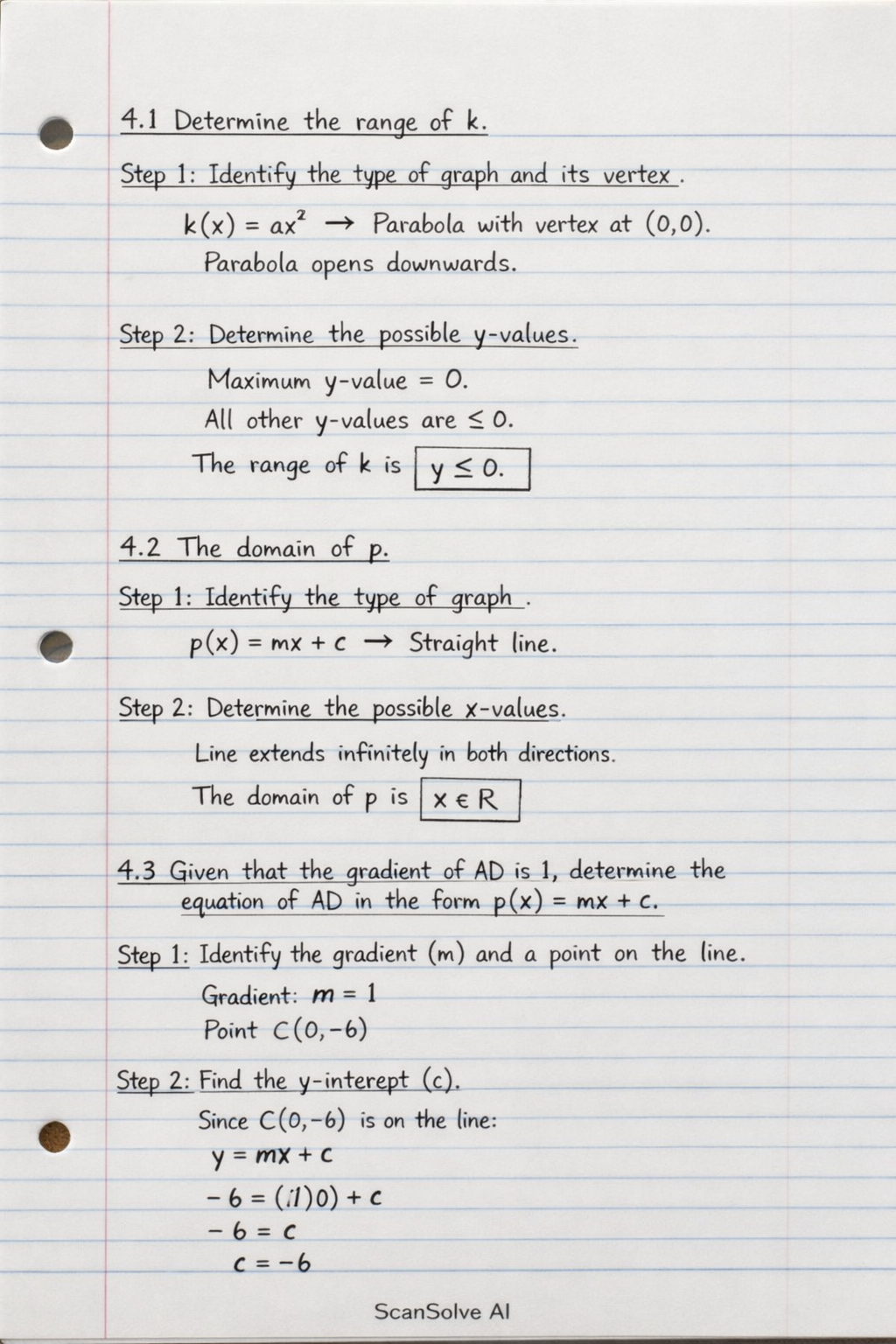
Handwritten Step-by-Step Solution
Get this as a handwritten image on WhatsApp — like a tutor wrote it for you.
Try on WhatsApp