
We read your photo as:
The interior angle of a regular polygon is 20^ exto more than three times the exterior angle. Find the number of sides of the polygon. 5. Simplify the expression (x2 - 5xy + 6y2)/(18y2 - 2x2).
ScanSolve AI Answer
Step-by-step solution
15 steps4. The interior angle of a regular polygon is more than three times the exterior angle. Find the number of sides of the polygon.
Define the interior and exterior angles.
Let be the number of sides of the regular polygon.
Let be the interior angle and be the exterior angle.
The relationship between the interior and exterior angles is .
The given condition is .Solve for the exterior angle .
Substitute into the given condition:
Find the number of sides .
The formula for the exterior angle of a regular polygon is .
Substitute the value of :The number of sides of the polygon is .
5. Simplify the expression.
Factor the numerator.
The numerator is a quadratic expression:
Factor the denominator.
The denominator is . Factor out the common term 2:
Recognize the difference of squares pattern, , where and :
To match a term in the numerator, we can rewrite as :
Substitute the factored forms into the expression and simplify.
Cancel the common factor :
This can also be written as:
The simplified expression is .
6. Solve for x given.
Rewrite the equation in terms of a common base.
Notice that .
Let . Substitute into the equation:Rearrange into a standard quadratic equation.
Solve the quadratic equation for .
Factor the quadratic expression. We need two numbers that multiply to 81 and add to -82. These numbers are -1 and -81.
This gives two possible values for :
Substitute back and solve for .
Case 1:
Since , then .
Case 2:
Since , then .
The solutions for are .7. A man on top of a tower 300m sees two cars P and Q on a straight level road. The angle of depression of P was and that of Q was . Calculate the distance between the two cars. (Give your answer to 2.d.p)
Draw a diagram and identify the relevant right-angled triangles.
Let the height of the tower be m.
Let be the base of the tower and be the top.
The angles of depression are measured from the horizontal line at .
The angle of depression to P is , so the angle of elevation from P to T is .
The angle of depression to Q is , so the angle of elevation from Q to T is .
We have two right-angled triangles: and .Calculate the horizontal distance from the base of the tower to car P (BP).
In :
Calculate the horizontal distance from the base of the tower to car Q (BQ).
In :
Calculate the distance between the two cars (PQ).
Since P and Q are on a straight level road and P is closer to the tower than Q (because ), the distance between the cars is the difference between BQ and BP.
Round the answer to 2 decimal places.
The distance between the two cars is .
Still stuck on this one?
Ask a follow-up, and the answer starts from this question.
More Mathematics Questions
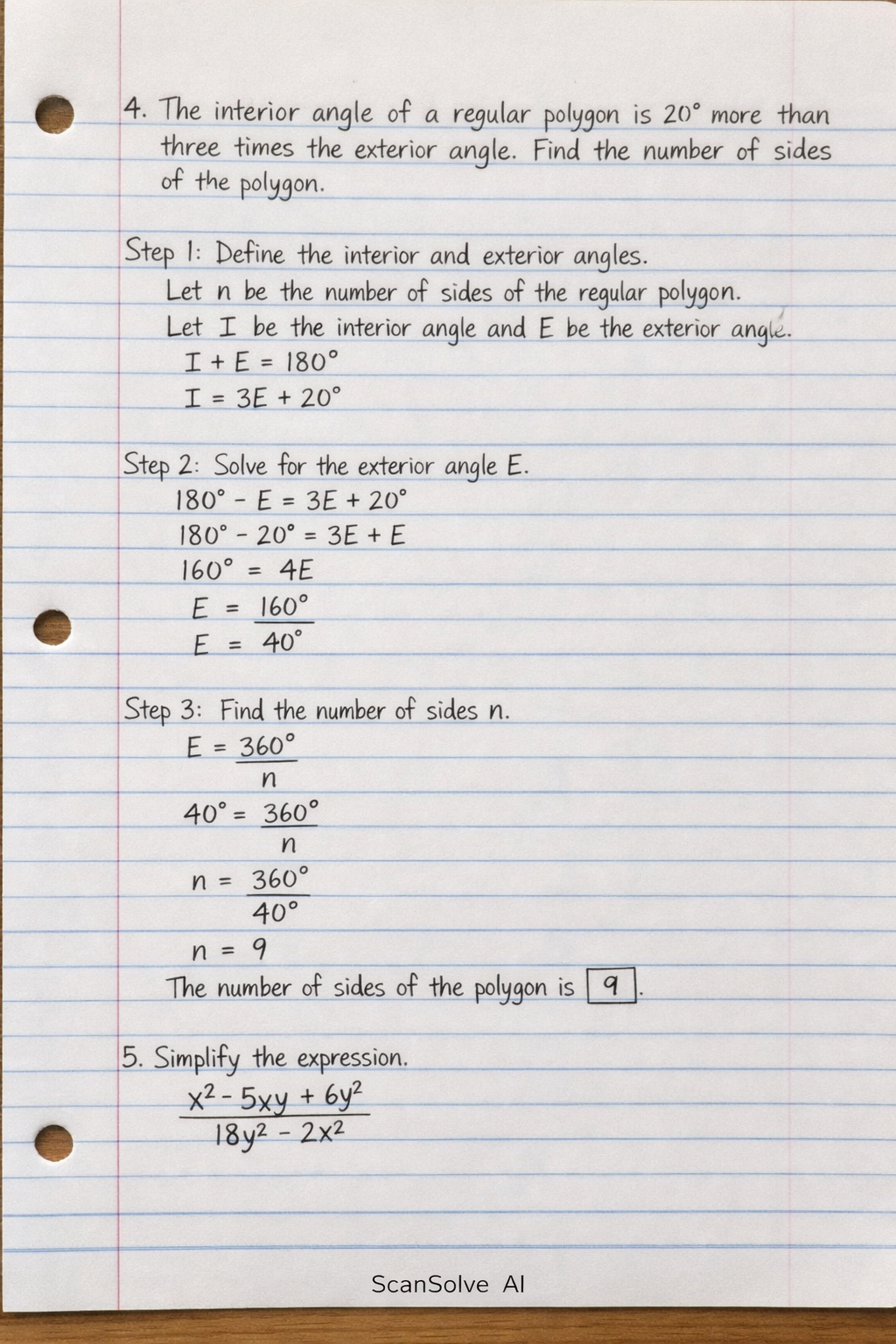
Handwritten Step-by-Step Solution
Get this as a handwritten image on WhatsApp — like a tutor wrote it for you.
Try on WhatsApp