
We read your photo as:
What is the negation of the compound statement (p q)?
Mathematics
ScanSolve AI Answer
Step-by-step solution
2 stepsHere are the solutions to the questions:
1. The negation of the compound statement is
Apply De Morgan's Law.
The negation of is . According to De Morgan's Law, .
Simplify the double negation.
The negation of a negation is the original statement, so .
The negation of the compound statement
Was this helpful?
Still stuck on this one?
Ask a follow-up, and the answer starts from this question.
Got a different question?Ask your own question
More Mathematics Questions
QConstruct the truth table for the negation of a conjunction, (p q).QShow that eg(p o q) and p ext and not q are logically equivalent.QShow that (p q) and p q are logically equivalent.QDraw the truth table for the compound statement (p q) and write A B and (A B) in simple English.QProve that p (p q) is a tautology using a truth table.
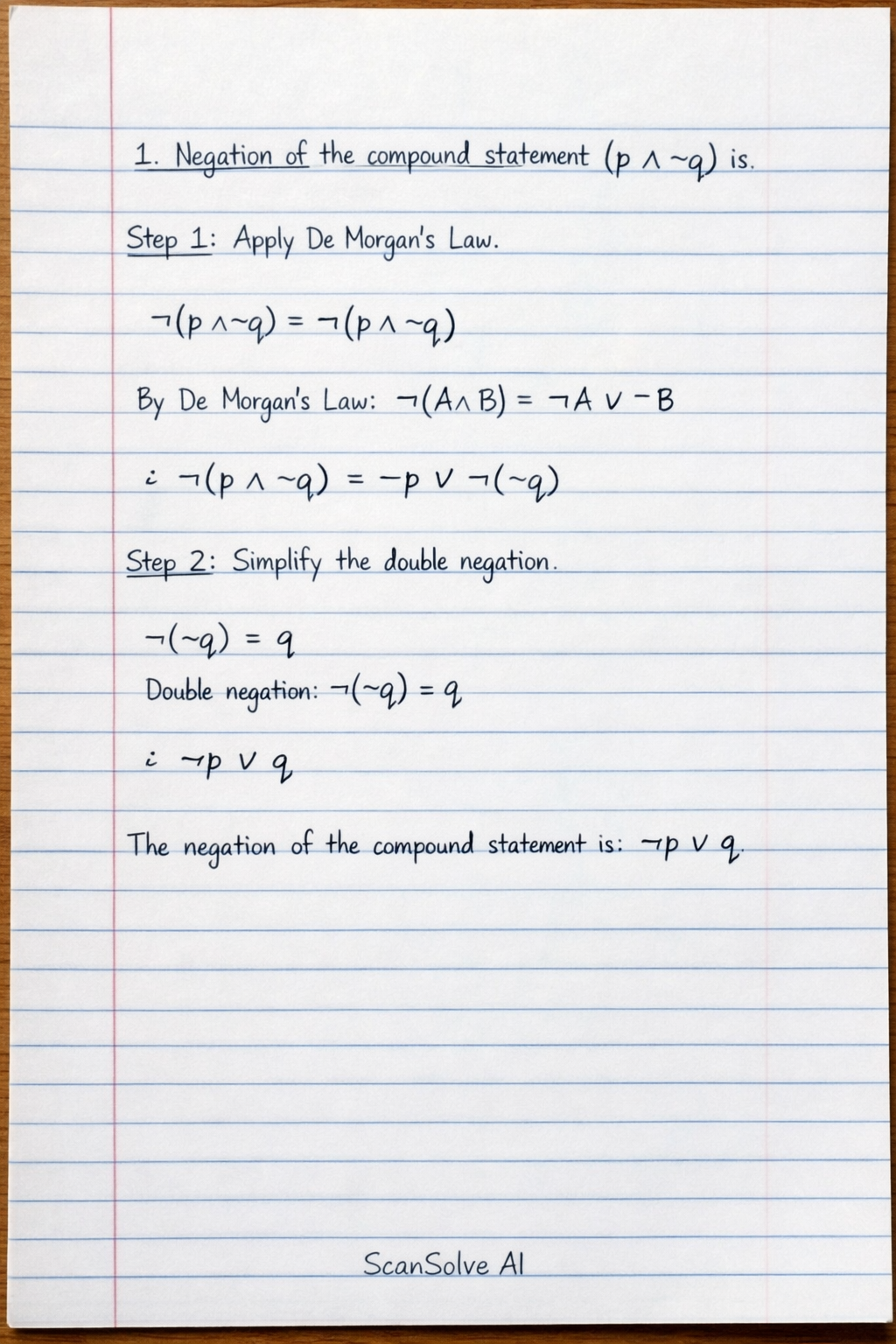
Handwritten Step-by-Step Solution
Get this as a handwritten image on WhatsApp — like a tutor wrote it for you.
Try on WhatsApp