
We read your photo as:
What is the probability distribution when a fair die is rolled once?
ScanSolve AI Answer
Answer
Step-by-step solution
4 stepsIdentify the sample space.
When a fair die is rolled once, the possible outcomes for the up-turned face are the integers from 1 to 6.
The sample space .
The total number of possible outcomes is 6.Define the random variable.
Let be the random variable representing the number on the up-turned face. The possible values for are .
Calculate the probability for each outcome.
Since the die is fair, each outcome has an equal probability of occurring.
The probability of any specific outcome is given by:For each value of from 1 to 6, there is only one favorable outcome (e.g., rolling a 1, rolling a 2, etc.).
Therefore, for each :Present the probability distribution.
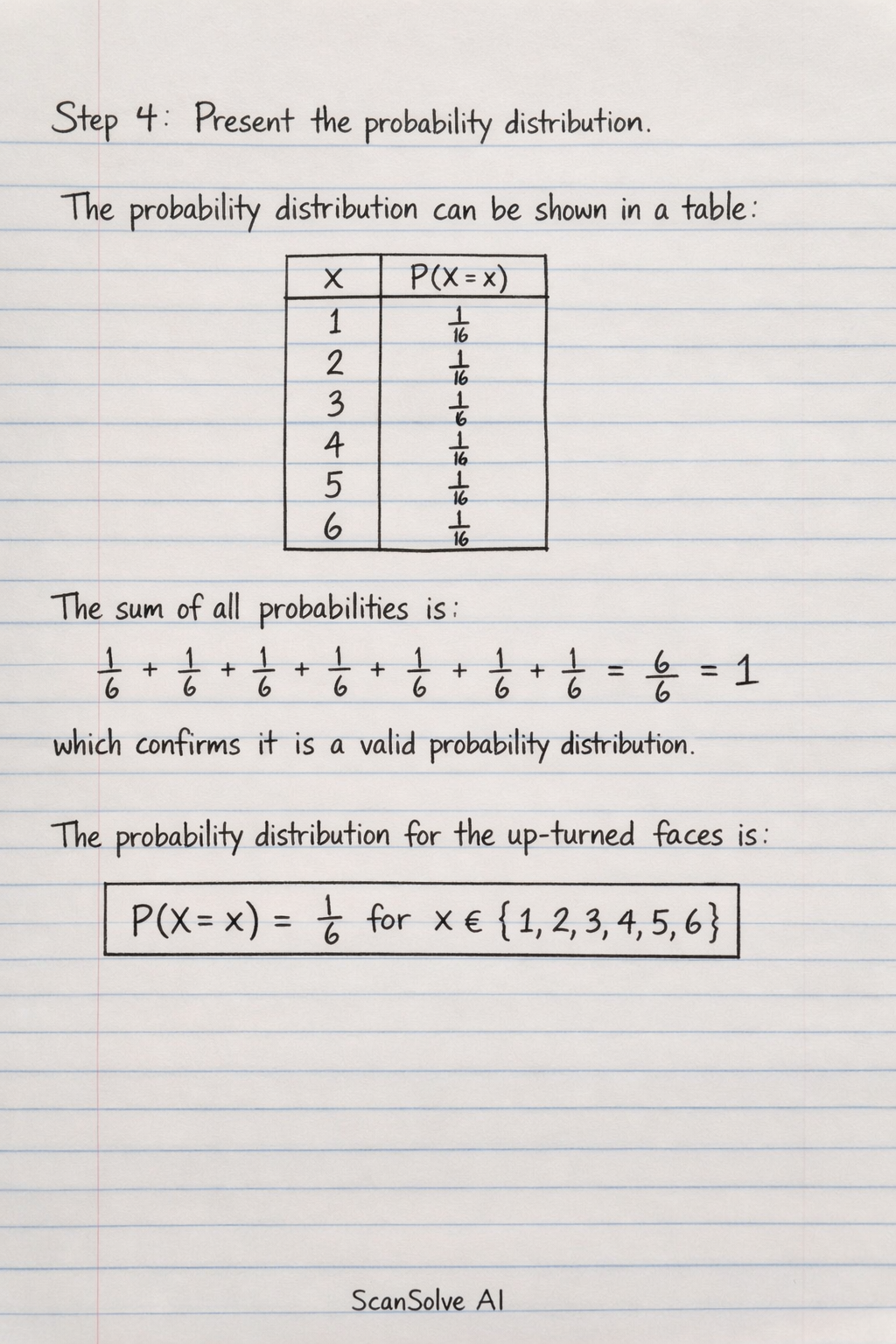
The probability distribution can be shown in a table:
The sum of all probabilities is , which confirms it is a valid probability distribution.
The probability distribution for the up-turned faces is:
Try one yourself
A new problem that tests the same skill.
Still stuck on this one?
Ask a follow-up, and the answer starts from this question.
More Mathematics Questions
Handwritten Step-by-Step Solution
Get this as a handwritten image on WhatsApp — like a tutor wrote it for you.
Try on WhatsApp