
![An object of mass 20kg slides down an inclined plane at an angle of 30° to the horizontal. The coefficient of static friction is ....[g = 10ms⁻²]](/_next/image?url=https%3A%2F%2Fohijasnjvprzodcmxltt.supabase.co%2Fstorage%2Fv1%2Fobject%2Fpublic%2Fwhatsapp-images%2F1774258957153-628a29fcb3a8dccf.png&w=3840&q=75)
This physics problem tests your understanding of fundamental physical laws and their applications. The step-by-step solution below breaks down the problem using relevant equations and physical reasoning.
ScanSolve AI Answer
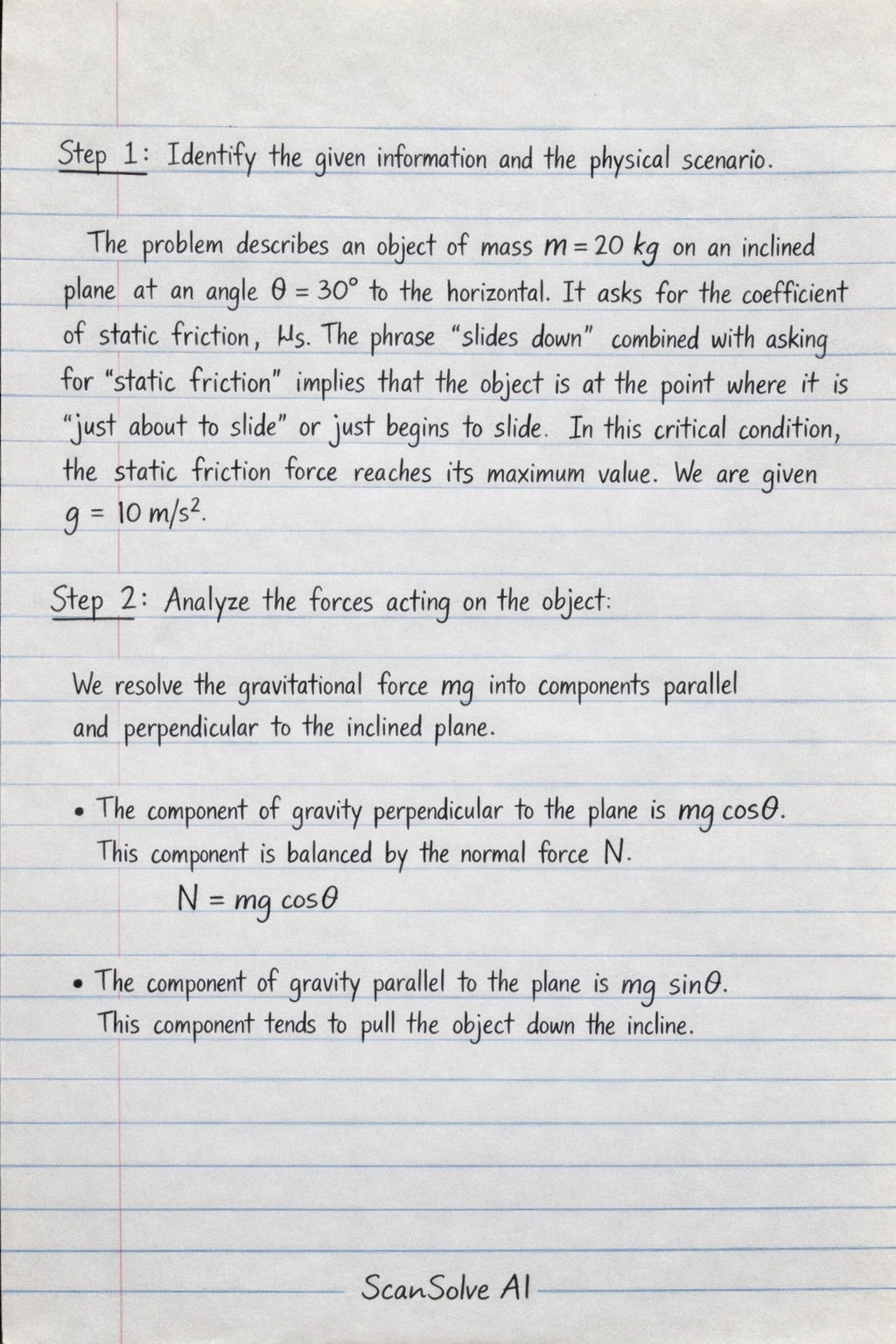
Step 1: Identify the given information and the physical scenario. The problem describes an object of mass m = 20 kg on an inclined plane at an angle = 30^ to the horizontal. It asks for the coefficient of static friction, _s. The phrase "slides down" combined with asking for "static friction" implies that the object is at the point where it is just about to slide or just begins to slide. In this critical condition, the static friction force reaches its maximum value. We are given g = 10 m/s^2. Step 2: Analyze the forces acting on the object. We resolve the gravitational force mg into components parallel and perpendicular to the inclined plane. • The component of gravity perpendicular to the plane is mg . This component is balanced by the normal force N. N = mg • The component of gravity parallel to the plane is mg . This component tends to pull the object down the incline. Step 3: Apply the condition for impending motion. When the object is just about to slide, the maximum static friction force f_s,max is equal to the component of gravity pulling the object down the incline. f_s,max = mg The maximum static friction force is also defined as: f_s,max = _s N where _s is the coefficient of static friction. Step 4: Substitute the expression for the normal force into the friction equation. Substitute N = mg into the equation for f_s,max: f_s,max = _s (mg ) Step 5: Equate the two expressions for f_s,max and solve for _s. _s (mg ) = mg Divide both sides by mg : _s = (mg )/(mg ) _s = ()/() _s = Step 6: Substitute the given angle and calculate the value of _s. _s = (30^) We know that (30^) = (1)/(sqrt(3)). _s = (1)/(sqrt(3)) ≈ 0.57735 Step 7: Compare the result with the given options. The calculated value _s ≈ 0.57735 is closest to 0.6. The final answer is 0.6.