
We read your photo as:
The problem describes drawing two balls without replacement from a bag containing 7 red (R), 4 white (W), and 6 blue (B) balls, for a total of 7+4+6=17 balls.
ScanSolve AI Answer
Answers
4 partsStep-by-step solution
13 stepsHere are the solutions for the probability problem:
Part a
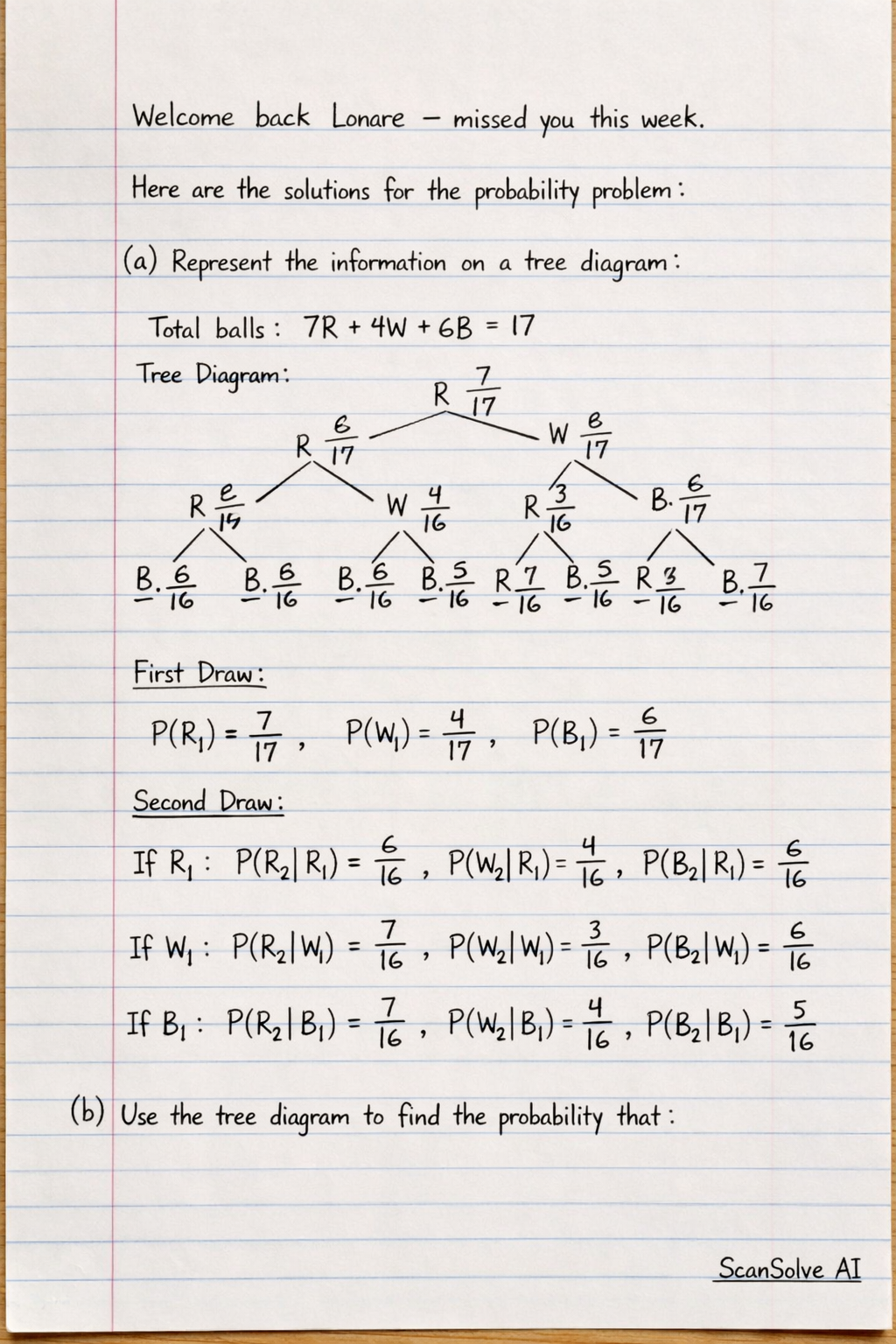
Represent the information above on a tree diagram
The problem describes drawing two balls without replacement from a bag containing 7 red (R), 4 white (W), and 6 blue (B) balls, for a total of balls.
The tree diagram shows the probabilities for the first draw and the conditional probabilities for the second draw.
First Draw:
Second Draw (without replacement):
- If : , ,
- If : , ,
- If : , ,
The tree diagram in the image correctly illustrates these probabilities.
Part b(i)
The second ball drawn is red
Use the tree diagram to find the probability that
This occurs if the sequence of draws is (Red, Red), (White, Red), or (Blue, Red).
Identify the probabilities for each path.
Sum these probabilities.
Simplify the fraction.
The probability that the second ball drawn is red is .
Part b(ii)
The two balls are of the same colour
This occurs if the sequence of draws is (Red, Red), (White, White), or (Blue, Blue).
Identify the probabilities for each path.
Sum these probabilities.
Simplify the fraction.
The probability that the two balls are of the same colour is .
Part b(iii)
No white ball is drawn
This means both balls drawn are either red or blue. The possible sequences are (Red, Red), (Red, Blue), (Blue, Red), or (Blue, Blue).
Identify the probabilities for each path.
Sum these probabilities.
Simplify the fraction.
The probability that no white ball is drawn is .
Part b(iv)
At least one ball is blue
It is easier to calculate the complement: .
"No blue ball" means both balls drawn are either red or white. The possible sequences are (Red, Red), (Red, White), (White, Red), or (White, White).
Identify the probabilities for each path where no blue ball is drawn.
Sum these probabilities to find .
Simplify the fraction.
Calculate .
The probability that at least one ball is blue is .
Try one yourself
A new problem that tests the same skill.
Still stuck on this one?
Ask a follow-up, and the answer starts from this question.
More Mathematics Questions
Handwritten Step-by-Step Solution
Get this as a handwritten image on WhatsApp — like a tutor wrote it for you.
Try on WhatsApp