This mathematics problem involves applying core mathematical principles and formulas. Below you will find a complete step-by-step solution with detailed explanations for each step, helping you understand not just the answer but the method behind it.
ScanSolve AI Answer
You're on a roll —
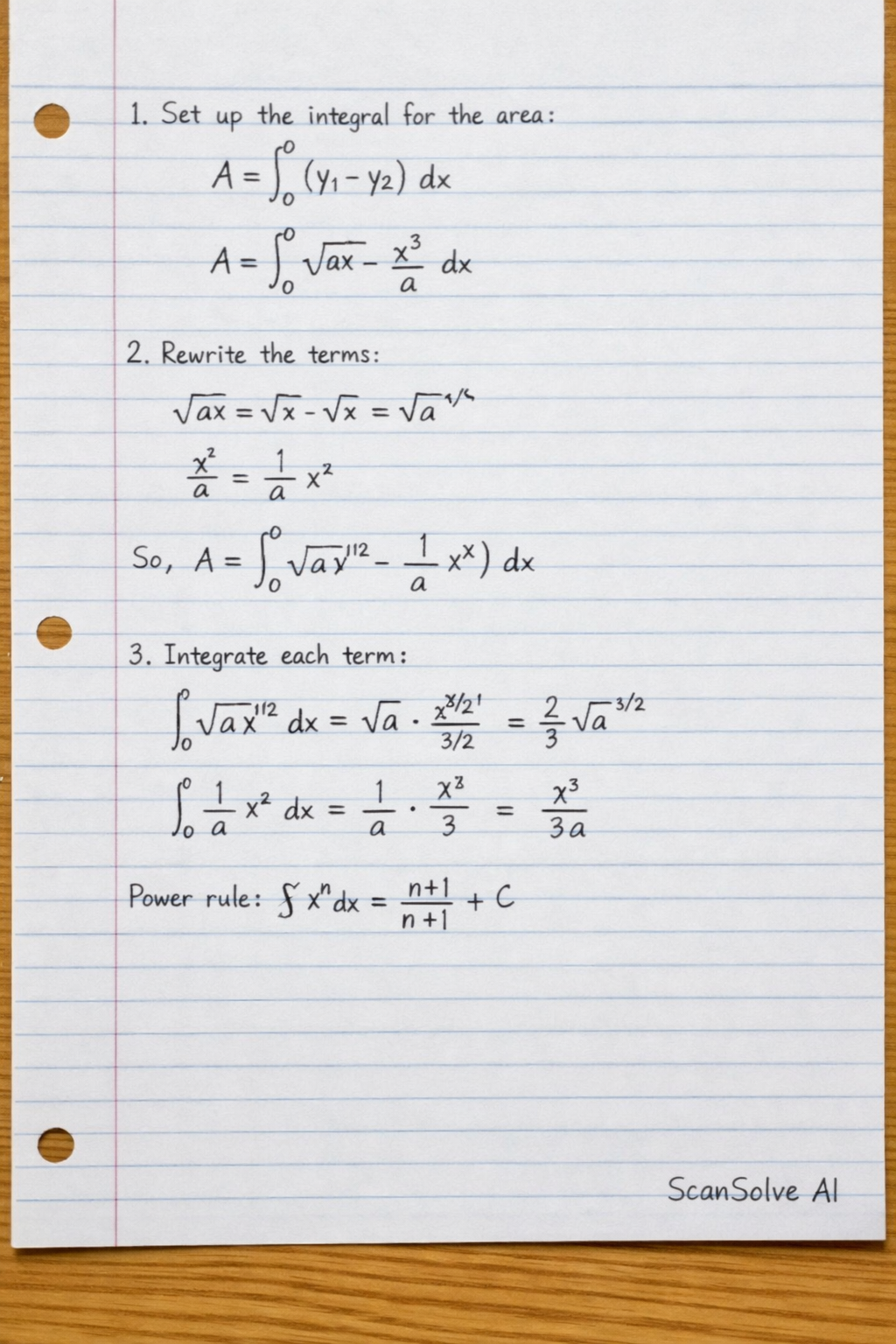
Step 1: Set up the integral for the area between the curves.
The problem provides the equations for the two curves, $y_1 = \sqrt{ax}$ and $y_2 = \frac{x^2}{a}$, and the integral setup:
$$ A = \int_{0}^{a} (y_1 - y_2) \,dx $$
Substitute the expressions for $y_1$ and $y_2$:
$$ A = \int_{0}^{a} \left(\sqrt{ax} - \frac{x^2}{a}\right) \,dx $$
Step 2: Rewrite the terms for easier integration.
$$ \sqrt{ax} = \sqrt{a} \cdot \sqrt{x} = \sqrt{a} x^{1/2} $$
$$ \frac{x^2}{a} = \frac{1}{a} x^2 $$
So the integral becomes:
$$ A = \int_{0}^{a} \left(\sqrt{a} x^{1/2} - \frac{1}{a} x^2\right) \,dx $$
Step 3: Integrate each term.
Recall the power rule for integration: $\int x^n \,dx = \frac{x^{n+1}}{n+1} + C$.
$$ \int \sqrt{a} x^{1/2} \,dx = \sqrt{a} \frac{x^{1/2+1}}{1/2+1} = \sqrt{a} \frac{x^{3/2}}{3/2} = \frac{2}{3} \sqrt{a} x^{3/2} $$
$$ \int \frac{1}{a} x^2 \,dx = \frac{1}{a} \frac{x^{2+1}}{2+1} = \frac{1}{a} \frac{x^3}{3} = \frac{x^3}{3a} $$
Step 4: Evaluate the definite integral from $0$ to $a$.
$$ A = \left[ \frac{2}{3} \sqrt{a} x^{3/2} - \frac{x^3}{3a} \right]_{0}^{a} $$
Substitute the upper limit $x=a$:
$$ \left( \frac{2}{3} \sqrt{a} (a)^{3/2} - \frac{(a)^3}{3a} \right) $$
Simplify the terms:
$$ \frac{2}{3} a^{1/2} a^{3/2} - \frac{a^3}{3a} = \frac{2}{3} a^{(1/2 + 3/2)} - \frac{a^2}{3} = \frac{2}{3} a^{4/2} - \frac{a^2}{3} = \frac{2}{3} a^2 - \frac{a^2}{3} $$
Substitute the lower limit $x=0$:
$$ \left( \frac{2}{3} \sqrt{a} (0)^{3/2} - \frac{(0)^3}{3a} \right) = 0 - 0 = 0 $$
Subtract the lower limit value from the upper limit value:
$$ A = \left( \frac{2}{3} a^2 - \frac{a^2}{3} \right) - 0 $$
$$ A = \frac{2a^2 - a^2}{3} = \frac{a^2}{3} $$
The final answer is $\boxed{\frac{a^2}{3}}$.
What's next?
The problem provides the equations for the two curves, y1 = sqrt(ax) and y2 = (x^2)/(a), and the integral setup:
|Mathematics
The problem provides the equations for the two curves, y1 = sqrt(ax) and y2 = (x^2)/(a), and the integral setup:
ScanSolve AI Answer
You're on a roll —
Step 1: Set up the integral for the area between the curves.
The problem provides the equations for the two curves, y1=ax and y2=ax2, and the integral setup:
A=∫0a(y1−y2)dx
Substitute the expressions for y1 and y2:
A=∫0a(ax−ax2)dx
Step 2: Rewrite the terms for easier integration.
ax=a⋅x=ax1/2ax2=a1x2
So the integral becomes:
A=∫0a(ax1/2−a1x2)dx
Step 3: Integrate each term.
Recall the power rule for integration: ∫xndx=n+1xn+1+C.
∫ax1/2dx=a1/2+1x1/2+1=a3/2x3/2=32ax3/2∫a1x2dx=a12+1x2+1=a13x3=3ax3
Step 4: Evaluate the definite integral from 0 to a.
A=[32ax3/2−3ax3]0a
Substitute the upper limit x=a:
(32a(a)3/2−3a(a)3)
Simplify the terms:
32a1/2a3/2−3aa3=32a(1/2+3/2)−3a2=32a4/2−3a2=32a2−3a2
Substitute the lower limit x=0:
(32a(0)3/2−3a(0)3)=0−0=0
Subtract the lower limit value from the upper limit value:
A=(32a2−3a2)−0A=32a2−a2=3a2
The final answer is 3a2.
What's next?
Need help with your own homework?
Get instant step-by-step solutions to any question. Free to start.