

This mathematics problem involves applying core mathematical principles and formulas. Below you will find a complete step-by-step solution with detailed explanations for each step, helping you understand not just the answer but the method behind it.
ScanSolve AI Answer
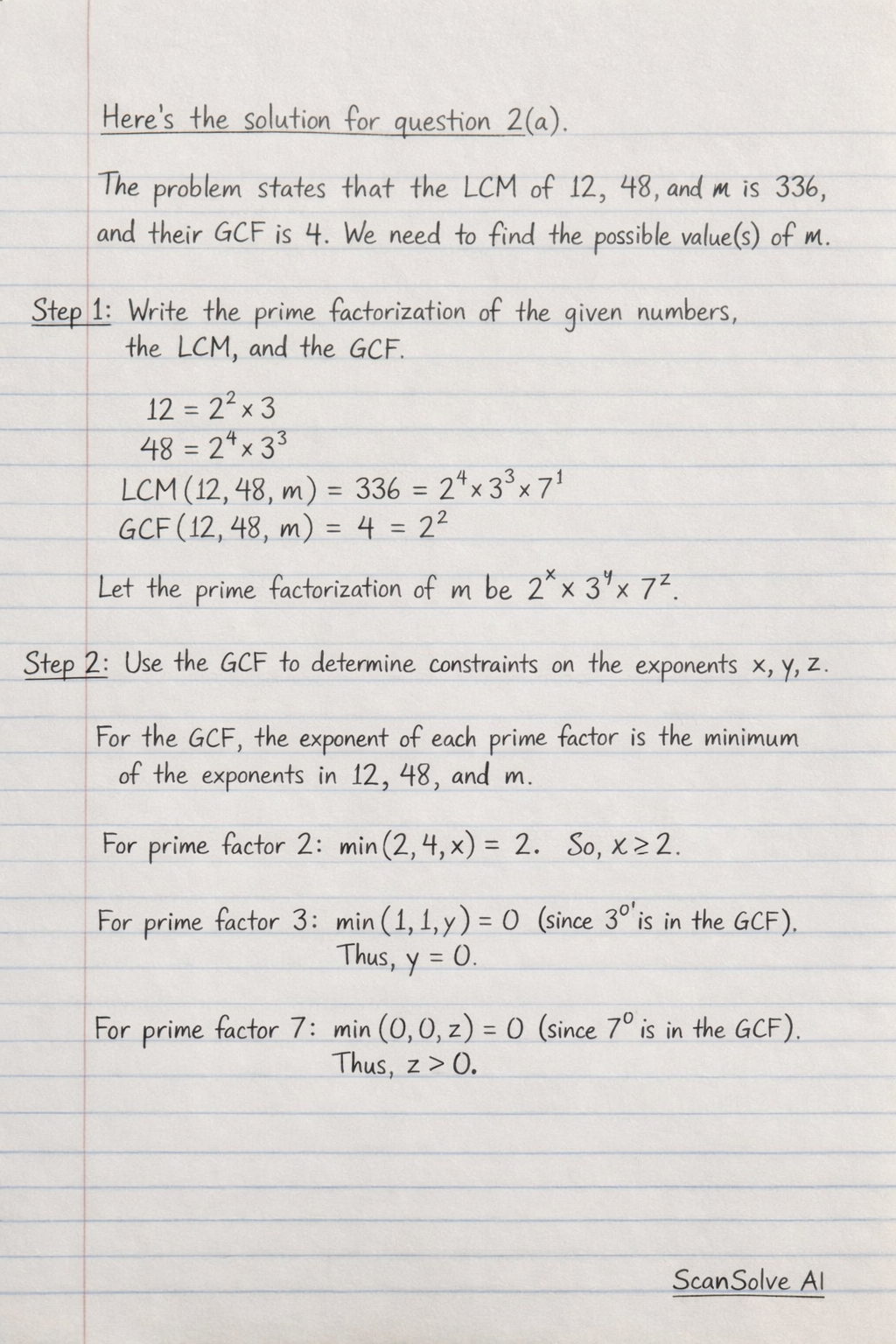
Here's the solution for question 2(a). The problem states that the LCM of 12, 48, and m is 336, and their GCF is 4. We need to find the possible value(s) of m. Step 1: Write the prime factorization of the given numbers, the LCM, and the GCF. 12 = 2^2 × 3^1 48 = 2^4 × 3^1 LCM(12, 48, m) = 336 = 2^4 × 3^1 × 7^1 GCF(12, 48, m) = 4 = 2^2 Let the prime factorization of m be 2^x × 3^y × 7^z. Step 2: Use the GCF to determine constraints on the exponents x, y, z. For the GCF, the exponent of each prime factor is the minimum of the exponents in 12, 48, and m. For prime factor 2: (2, 4, x) = 2. This implies x 2. For prime factor 3: (1, 1, y) = 0 (since 3^0 is in the GCF). This implies y = 0. For prime factor 7: (0, 0, z) = 0 (since 7^0 is in the GCF). This implies z 0. Step 3: Use the LCM to determine constraints on the exponents x, y, z. For the LCM, the exponent of each prime factor is the maximum of the exponents in 12, 48, and m. For prime factor 2: (2, 4, x) = 4. This implies x 4. For prime factor 3: (1, 1, y) = 1. This implies y 1. For prime factor 7: (0, 0, z) = 1. This implies z = 1.