
We read your photo as:
Determine the equation that Mr. Kheswa will use to calculate his total monthly costs.
ScanSolve AI Answer
This answer stops before the end.
It was cut off when it was first written. Ask ScanSolve this question again for the full working.
Step-by-step solution
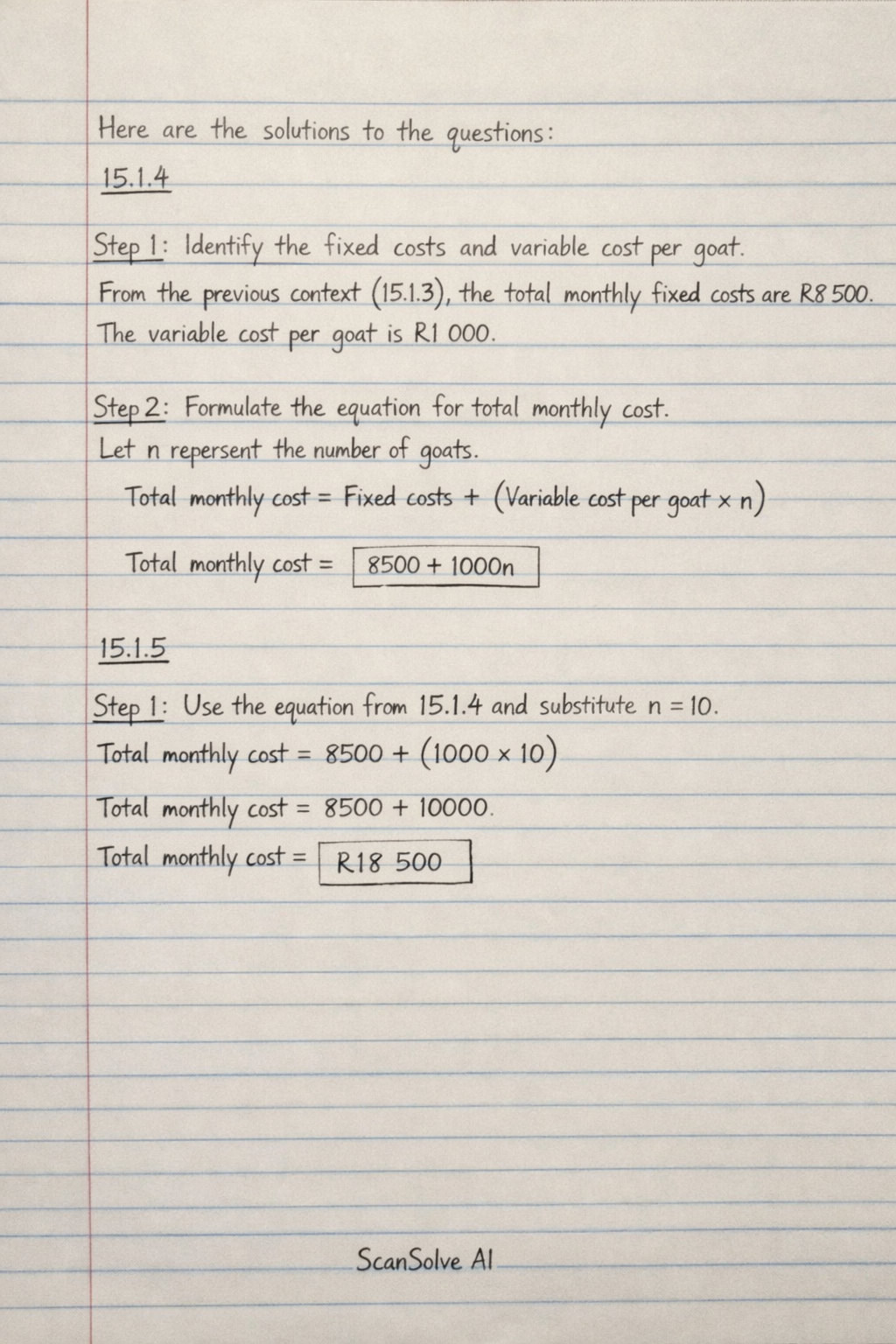
10 stepsHere are the solutions to the questions:
15.1.4
Identify the fixed costs and variable cost per goat.
From the previous context (15.1.3), the total monthly fixed costs are R8 500.
The variable cost per goat is R1 000 (as stated in the problem's context, typically from TABLE 1).Formulate the equation for total monthly cost.
Let represent the number of goats.
15.1.5
The value A is not visible in the provided image. Assuming A refers to the total monthly cost for 10 goats (a common value in such tables):Use the equation from 15.1.4 and substitute .
15.2.1
Break-even in this context refers to the point where Mr. Kheswa's total monthly income from selling goats is exactly equal to his total monthly costs. At this point, he makes zero profit and incurs zero loss.15.2.2
The formula for income is given as: , where is the number of goats sold.Determine the missing value B.
For B, the number of goats sold () is 6.
Determine the missing value C.
For C, the total monthly income is R54 000.
15.2.3
We need to calculate the profit for 9 goats (normal cost) and 14 goats (reduced cost) and then verify the claim.
Assumption: The problem does not specify the "reduced cost price" when buying in bulk. We will assume a 10% reduction from the normal cost price of R1 000 per goat, making the reduced cost price R900 per goat.Calculate the profit for selling 9 goats at normal cost price.
Normal cost price per goat = R1 000.
Total monthly fixed costs = R8 500.
Income for 9 goats = .
Cost for 9 goats = .
Profit for 9 goats = Income - Cost = . (This indicates a loss).Calculate the profit for selling 14 goats at a reduced cost price.
Reduced cost price per goat = R900 (based on assumption).
Income for 14 goats = .
Cost for 14 goats = .
Profit for 14 goats = Income - Cost = .Verify the claim
Is Profit (9 goats) = 6.9% of Profit (14 goats)?
The claim states: Profit (9 goats) = Profit (14 goats).
Substitute the calculated profits:
Since , the claim is incorrect.
The claim is .15.2.4
To draw the graph for the monthly income, you would plot the points from TABLE 2 on the same answer sheet where the monthly cost graph is provided.
The points to plot for monthly income (Number of goats sold, Total monthly Income) are:- (using value B from 15.2.2)
- (using value C from 15.2.2) Connect these points with a straight line, starting from , as the income increases linearly with the number of goats sold.
15.2.5
The break-even point occurs when Total monthly cost = Total monthly income.Set the cost and income equations equal to each other.
Total monthly cost:
Total monthly income:Solve for (number of goats).
Since you cannot sell a fraction of a goat, the break-even point is reached when selling the
Still stuck on this one?
Ask a follow-up, and the answer starts from this question.
More Mathematics Questions
Handwritten Step-by-Step Solution
Get this as a handwritten image on WhatsApp — like a tutor wrote it for you.
Try on WhatsApp