

This mathematics problem involves applying core mathematical principles and formulas. Below you will find a complete step-by-step solution with detailed explanations for each step, helping you understand not just the answer but the method behind it.
ScanSolve AI Answer
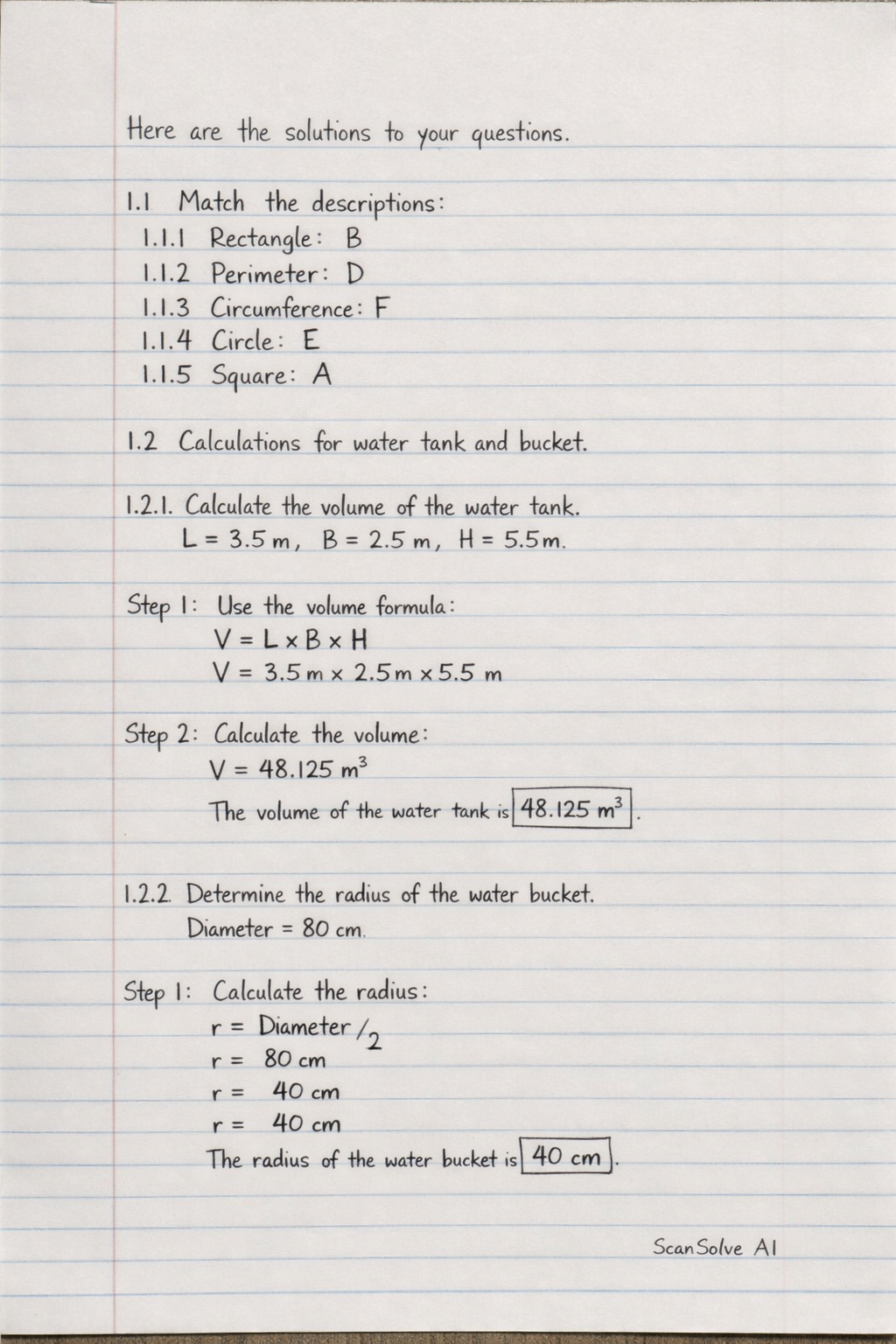
Here are the solutions to your questions. 1.1 Choose the description in COLUMN B that matches the term in COLUMN A. 1.1.1 Rectangle: B 1.1.2 Perimeter: D 1.1.3 Circumference: F 1.1.4 Circle: E 1.1.5 Square: A 1.2 Calculations for water tank and bucket 1.2.1 Calculate the volume of the water tank. The water tank is a rectangular prism with length L = 3.5 m, breadth B = 2.5 m, and height H = 5.5 m. Step 1: Substitute the given dimensions into the volume formula. V = L × B × H V = 3.5 m × 2.5 m × 5.5 m Step 2: Calculate the volume. V = 48.125 m^3 The volume of the water tank is 48.125 m^3. 1.2.2 Determine the radius of the water bucket. The water bucket has a diameter of 80 cm. Step 1: Calculate the radius by dividing the diameter by 2. r = Diameter2 r = 80 cm2 r = 40 cm The radius of the water bucket is 40 cm. 1.2.3 Calculate the volume of the cylindrical bucket in cubic metres. The water bucket is a cylinder with radius r = 40 cm (from 1.2.2) and height h = 100 cm. Use = 3.14. Step 1: Convert the radius and height to meters. r = 40 cm = 0.4 m h = 100 cm = 1 m Step 2: Substitute the values into the volume formula for a cylinder. V = × r^2 × h V = 3.14 × (0.4 m)^2 × 1 m Step 3: Calculate the volume. V = 3.14 × 0.16 m^2 × 1 m V = 0.5024 m^3 The volume of the cylindrical bucket is 0.5024 m^3. 1.2.4 How many full water buckets are needed to fill the water tank? Volume of water tank = 48.125 m^3 (from 1.2.1) Volume of one water bucket = 0.5024 m^3 (from 1.2.3) Step 1: Divide the volume of the water tank by the volume of one water bucket. Number of buckets = Volume of water tankVolume of one water bucket Number of buckets = 48.125 m^30.5024 m^3 Step 2: Calculate the number of buckets and round up to the nearest whole number since only full buckets are used. Number of buckets ≈ 95.799 Number of buckets = 96 96 full water buckets are needed to fill the water tank. Send me the next one 📸