
We read your photo as:
Calculate the volumes of the cylinder, rectangular prism, and hexagonal prism shown in the image.
ScanSolve AI Answer
Answer
Step-by-step solution
8 stepshere are the calculations for the volumes of the shapes:
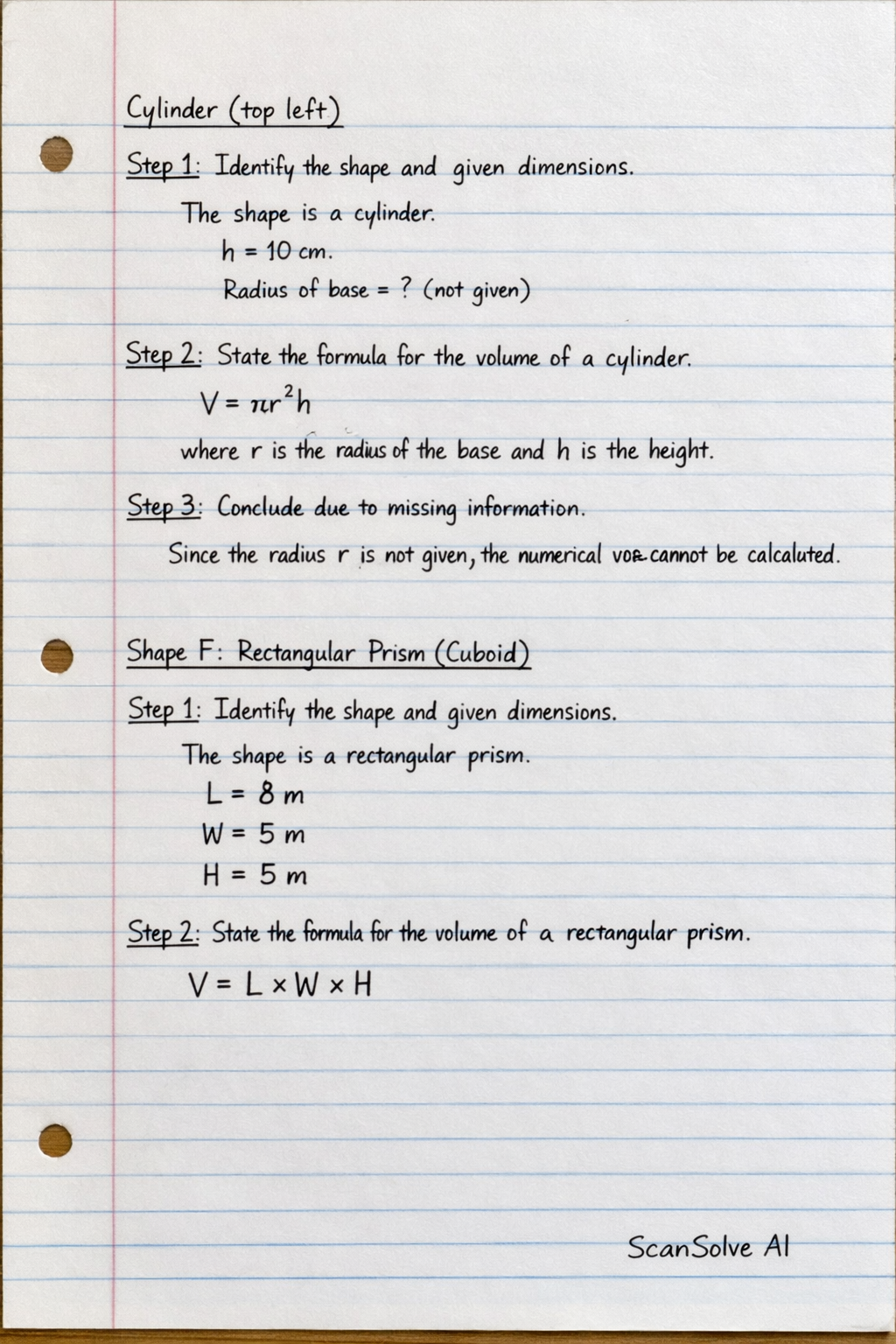
Cylinder (top left)
Identify the shape and given dimensions.
The shape is a cylinder.
The height of the cylinder is cm.
The radius or diameter of the circular base is not provided in the image.State the formula for the volume of a cylinder.
The volume of a cylinder is given by the formula:
where is the radius of the base and is the height.
Conclude due to missing information.
Since the radius is not given, the numerical volume cannot be calculated.
Shape F: Rectangular Prism (Cuboid)
Identify the shape and given dimensions.
The shape is a rectangular prism (cuboid).
The length is m.
The width is m.
The height is m (inferred from the tick marks matching the width).State the formula for the volume of a rectangular prism.
The volume of a rectangular prism is given by the formula:
Substitute the values and calculate the volume.
The volume of Shape F is .
Shape G: Hexagonal Prism
Identify the shape and given dimensions.
The shape is a hexagonal prism.
The height of the prism is cm.
The base is a regular hexagon with side length cm.Calculate the area of the regular hexagonal base.
The area of a regular hexagon with side length is given by:
Substitute
Try one yourself
A new problem that tests the same skill.
Still stuck on this one?
Ask a follow-up, and the answer starts from this question.
More Mathematics Questions
Handwritten Step-by-Step Solution
Get this as a handwritten image on WhatsApp — like a tutor wrote it for you.
Try on WhatsApp