

This mathematics problem involves applying core mathematical principles and formulas. Below you will find a complete step-by-step solution with detailed explanations for each step, helping you understand not just the answer but the method behind it.
ScanSolve AI Answer
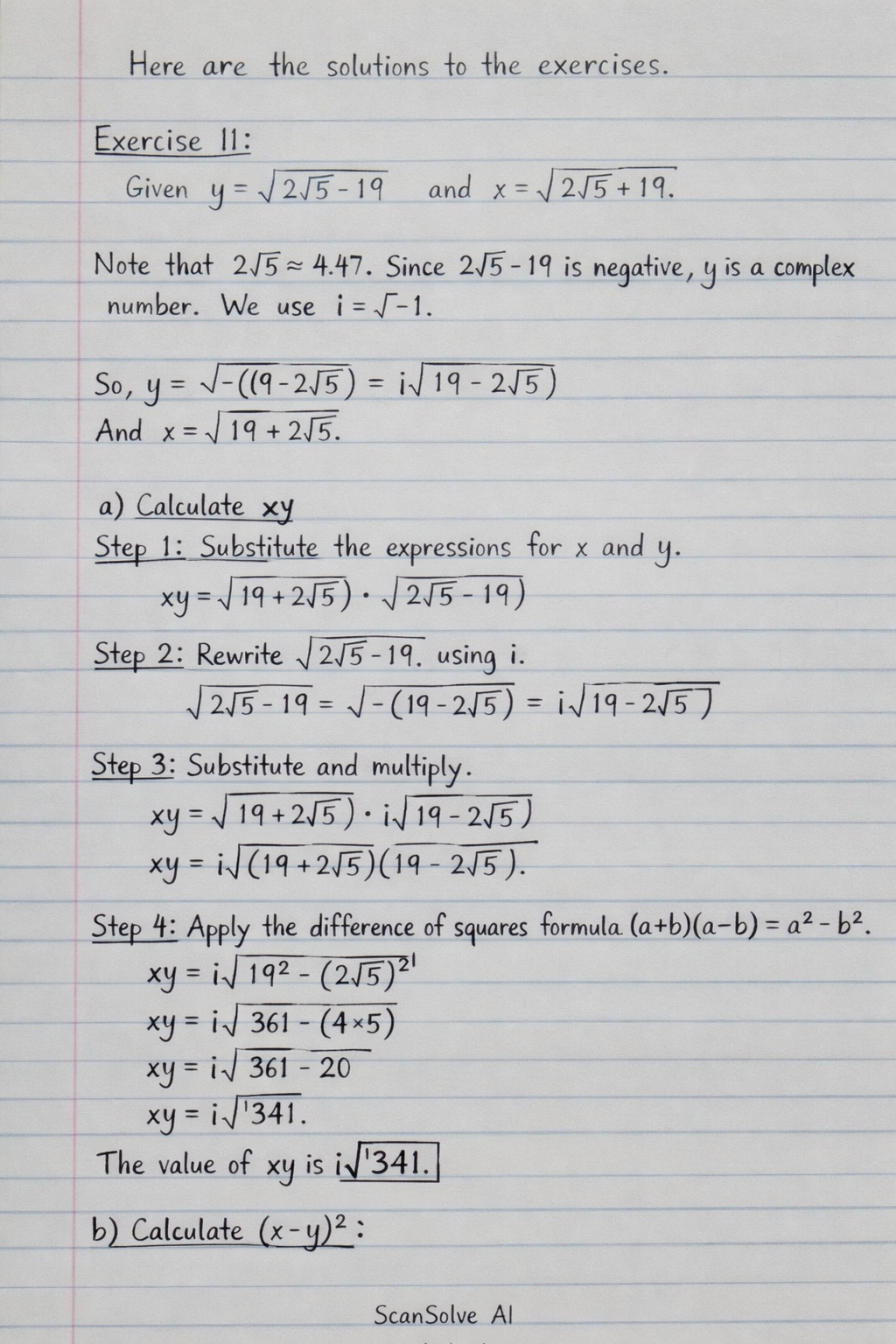
Here are the solutions to the exercises. Exercise 11: Given y = sqrt(25)-19 and x = sqrt(25)+19. Note that 2sqrt(5) ≈ 4.47. Since 2sqrt(5)-19 is negative, y is a complex number. We use i = sqrt(-1). So, y = sqrt(-(19-25)) = isqrt(19-25). And x = sqrt(19+25). a) Calculate xy Step 1: Substitute the expressions for x and y. xy = sqrt(19+25) · sqrt(25)-19 Step 2: Rewrite sqrt(25)-19 using i. sqrt(25)-19 = sqrt(-(19-25)) = isqrt(19-25) Step 3: Substitute and multiply. xy = sqrt(19+25) · isqrt(19-25) xy = i sqrt((19+25))(19-2sqrt(5)) Step 4: Apply the difference of squares formula (a+b)(a-b) = a^2-b^2. xy = i sqrt(19^2 - (25))^2 xy = i sqrt(361 - (4 · 5)) xy = i sqrt(361 - 20) xy = i sqrt(341) The value of xy is isqrt(341). b) Calculate (x-y)^2 Step 1: Expand (x-y)^2. (x-y)^2 = x^2 - 2xy + y^2 Step 2: Substitute x^2, y^2, and xy. x^2 = (sqrt(19+25))^2 = 19+2sqrt(5) y^2 = (sqrt(25)-19)^2 = 2sqrt(5)-19 xy = isqrt(341) (x-y)^2 = (19+2sqrt(5)) - 2(isqrt(341)) + (2sqrt(5)-19) Step 3: Simplify the expression. (x-y)^2 = 19+2sqrt(5) - 2isqrt(341) + 2sqrt(5)-19 (x-y)^2 = (19-19) + (2sqrt(5)+2sqrt(5)) - 2isqrt(341) (x-y)^2 = 4sqrt(5) - 2isqrt(341) The value of (x-y)^2 is 4sqrt(5) - 2isqrt(341). c) Calculate (x+y)^2 Step 1: Expand (x+y)^2. (x+y)^2 = x^2 + 2xy + y^2 Step 2: Substitute x^2, y^2, and xy. (x+y)^2 = (19+2sqrt(5)) + 2(isqrt(341)) + (2sqrt(5)-19) Step 3: Simplify the expression. (x+y)^2 = 19+2sqrt(5) + 2isqrt(341) + 2sqrt(5)-19 (x+y)^2 = (19-19) + (2sqrt(5)+2sqrt(5)) + 2isqrt(341) (x+y)^2 = 4sqrt(5) + 2isqrt(341) The value of (x+y)^2 is 4sqrt(5) + 2isqrt(341). d) Calculate (x+y)/(x-y) Step 1: Express (x+y)/(x-y) using the squared terms. (x+y)/(x-y) = sqrt(((x+y)^2)/((x-y)^2)) Step 2: Substitute the values of (x+y)^2 and (x-y)^2. (x+y)/(x-y) = sqrt(45) + 2isqrt(341)4sqrt(5) - 2isqrt(341) Step 3: Rationalize the denominator inside the square root by multiplying the numerator and denominator by the conjugate of the denominator, which is 4sqrt(5) + 2isqrt(341). (x+y)/(x-y) = sqrt((45) + 2isqrt(341))(4sqrt(5) + 2isqrt(341))(4sqrt(5) - 2isqrt(341))(4sqrt(5) + 2isqrt(341)) (x+y)/(x-y) = sqrt((45) + 2isqrt(341))^2(4sqrt(5))^2 - (2isqrt(341))^2 Calculate the denominator: (4sqrt(5))^2 - (2isqrt(341))^2 = (16 · 5) - (4 · i^2 · 341) = 80 - (4 · (-1) · 341) = 80 - (-1364) = 80 + 1364 = 1444. (x+y)/(x-y) = sqrt((45) + 2isqrt(341))^21444 Step 4: Simplify the square root. (x+y)/(x-y) = 4sqrt(5) + 2isqrt(341)sqrt(1444) Since sqrt(1444) = 38: (x+y)/(x-y) = 4sqrt(5) + 2isqrt(341)38 (x+y)/(x-y) = 2(2sqrt(5) + isqrt(341))38 (x+y)/(x-y) = 2sqrt(5) + isqrt(341)19 The value of (x+y)/(x-y) is 2sqrt(5) + isqrt(341)19. Exercise 12: a) Prove (a+b)^2 - (a-b)^2 = 4ab Step 1: Expand (a+b)^2 and (a-b)^2. (a+b)^2 = a^2+2ab+b^2 (a-b)^2 = a^2-2ab+b^2 Step 2: Substitute the expanded forms into the expression. (a+b)^2 - (a-b)^2 = (a^2+2ab+b^2) - (a^2-2ab+b^2) Step 3: Simplify the expression. = a^2+2ab+b^2 - a^2+2ab-b^2 = (a^2-a^2) + (b^2-b^2) + (2ab+2ab) = 0 + 0 + 4ab = 4ab Thus, (a+b)^2 - (a-b)^2 = 4ab is proven. b) Calculate 1000.001^2 - 999.999^2 Step 1: Use the identity (a+b)^2 - (a-b)^2 = 4ab. Let a+b = 1000.001 and a-b = 999.999. Step 2: Solve for a and b. Adding the two equations: (a+b) + (a-b) = 1000.001 + 999.999 2a = 2000 a = 1000 Subtracting the second equation from the first: (a+b) - (a-b) = 1000.001 - 999.999 2b = 0.002 b = 0.001 Step 3: Substitute the values of a and b into the identity. 1000.001^2 - 999.999^2 = 4 · a · b = 4 · (1000) · (0.001) Step 4: Calculate the result. = 4 · (1000 · (1)/(1000)) = 4 · 1 = 4 The value of 1000.001^2 - 999.999^2 is 4. Last free one today — make it count tomorrow, or type /upgrade for unlimited.