
We read your photo as:
What is the rule for the pattern of triangles, and how many triangles are in the tenth pattern?
ScanSolve AI Answer
Step-by-step solution
6 stepsHere are the extended patterns and their descriptions:
Patterns in a sequence (Triangles)
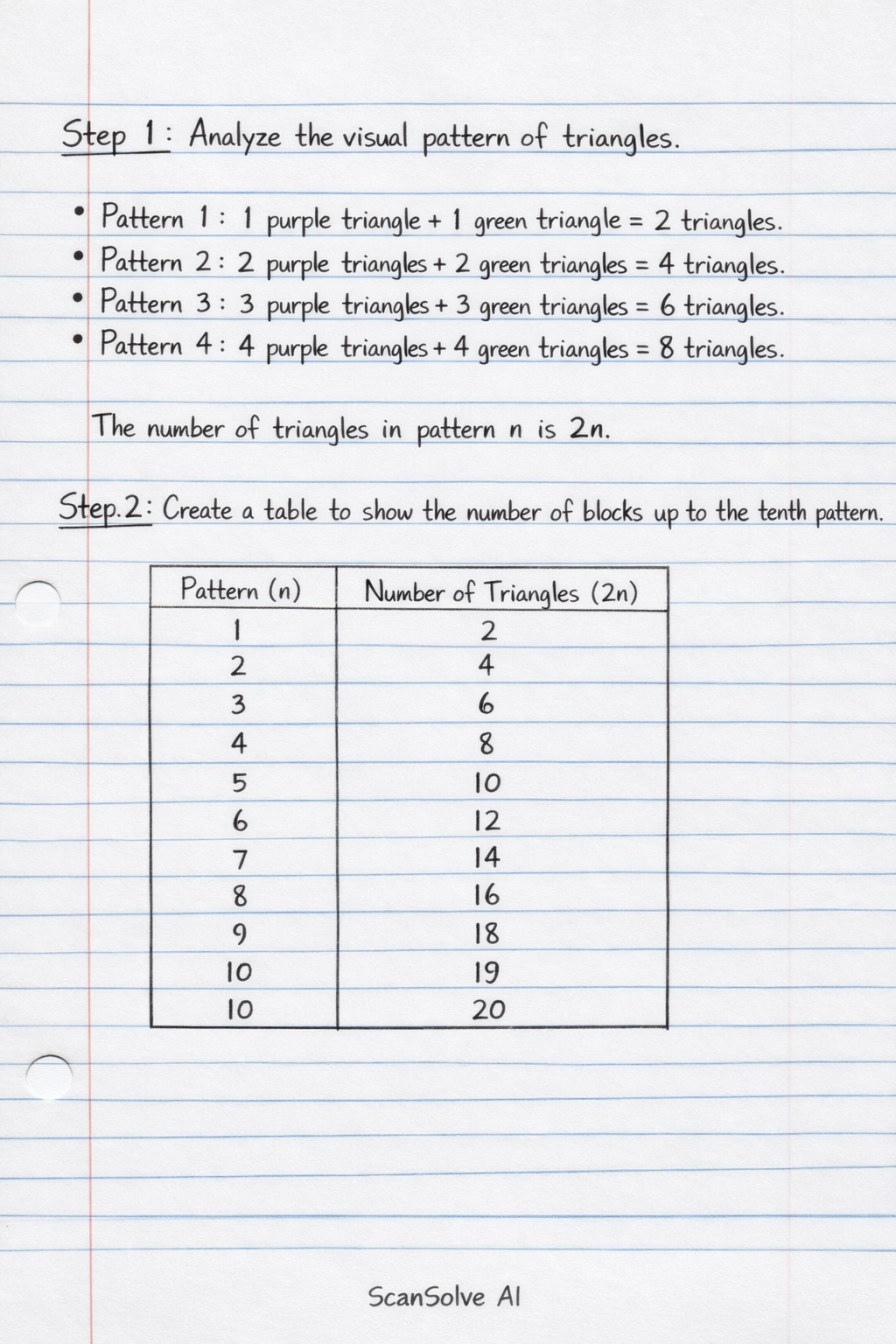
Step 1: Analyze the visual pattern of triangles.
- Pattern 1: 1 purple triangle + 1 green triangle = 2 triangles.
- Pattern 2: 2 purple triangles + 2 green triangles = 4 triangles.
- Pattern 3: 3 purple triangles + 3 green triangles = 6 triangles.
- Pattern 4: 4 purple triangles + 4 green triangles = 8 triangles. The number of triangles in pattern is .
Step 2: Create a table to show the number of blocks up to the tenth pattern.
| Pattern Number () | Number of Blocks () |
|---|---|
| 1 | 2 |
| 2 | 4 |
| 3 | 6 |
| 4 | 8 |
| 5 | 10 |
| 6 | 12 |
| 7 | 14 |
| 8 | 16 |
| 9 | 18 |
| 10 | 20 |
Step 3: State the tenth pattern.
The tenth pattern will have triangles.
The answer is .
Part e· 2 steps
Pattern of dots
Analyze the pattern of dots.
- Pattern 1: 3 dots
- Pattern 2: 6 dots
- Pattern 3: 10 dots
- Pattern 4: 15 dots This is a sequence of triangular numbers. The number of dots in pattern is given by the formula .
Extend the pattern to the 5th pattern.
For the 5th pattern ():
Number of dots .
The 5th pattern will have 21 dots arranged in a triangle with 6 dots on each side.
Part f· 2 steps
Pattern of houses
Analyze the pattern of houses.
- Pattern 1: 1 triangle, 3 squares. Total = 4 blocks.
- Pattern 2: 2 triangles, 6 squares. Total = 8 blocks.
- Pattern 3: 3 triangles, 9 squares. Total = 12 blocks.
- Pattern 4: 4 triangles, 12 squares. Total = 16 blocks. The number of blocks in pattern is .
Extend the pattern to the 5th pattern.
For the 5th pattern ():
Number of blocks .
The 5th pattern will consist of 5 houses, each with 1 triangle and 3 squares, for a total of 5 triangles and 15 squares.2. Extend the patterns.
Part a· 2 steps
Analyze the pattern of colored squares.
- Pattern 1: A square, total 4 small squares.
- Pattern 2: A square, total 16 small squares. The side length of the square is . The total number of small squares is .
Extend the pattern to the 3rd pattern.
For the 3rd pattern ():
Side length .
Total number of small squares .
The 3rd pattern will be an *$8
Still stuck on this one?
Ask a follow-up, and the answer starts from this question.
More Mathematics Questions
Handwritten Step-by-Step Solution
Get this as a handwritten image on WhatsApp — like a tutor wrote it for you.
Try on WhatsApp