
What are the rules of trianglenometrry
Mathematics
ScanSolve AI Answer
Answer
The rules of trigonometry for triangles primarily involve relationships between the sides and angles.
For right-angled triangles, the basic trigonometric ratios are used:
For any triangle (not just right-angled), the following rules apply:
The Sine Rule relates the ratio of a side length to the sine of its opposite angle:
The Cosine Rule is used to find a side when two sides and the included angle are known, or to find an angle when all three sides are known:
The Area Rule allows you to calculate the area of a triangle using two sides and the included angle:
Was this helpful?
Still stuck on this one?
Ask a follow-up, and the answer starts from this question.
Got a different question?Ask your own question
More Mathematics Questions
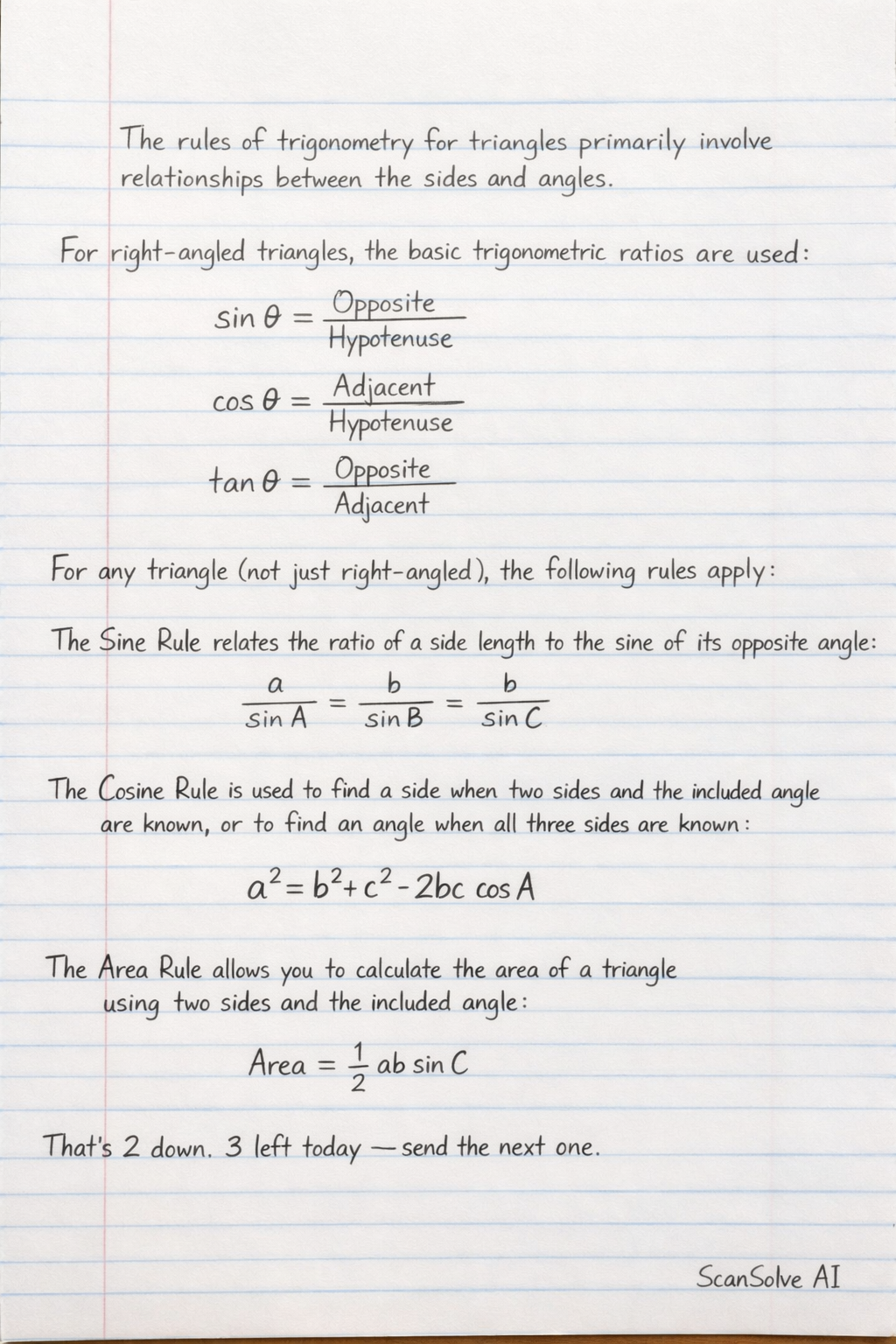
Handwritten Step-by-Step Solution
Get this as a handwritten image on WhatsApp — like a tutor wrote it for you.
Try on WhatsApp