
We read your photo as:
The set G=0, 1, 2. Define the composition + on G, for any a, b ∈ G by a + b = c where c is the least non-negative remainder obtained by dividing a + b by 3. Show that G forms an Abelian group under this composition.
ScanSolve AI Answer
Step-by-step solution
5 stepsTo show that forms an Abelian group under the composition where is the least non-negative remainder obtained by dividing by 3 (i.e., ), we must verify the five group axioms: closure, associativity, identity element, inverse elements, and commutativity.
Closure
For any , the result of the operation must also be in .
The operation is defined as addition modulo 3. The possible sums for range from to .
When these sums are taken modulo 3:- Since all possible results are elements of , the set is closed under the given operation.
Associativity
For any , we must show that .
Since the operation is addition modulo 3, and integer addition is associative, we have:Therefore, holds for all .
Identity Element
An identity element must exist such that for all , and .
Let's test :
For any , .
Similarly, .
Since , the identity element is 0.Inverse Elements
For each element , there must exist an inverse element such that (the identity element).
- For : . So, .
- For : . So, .
- For : . So, . Every element in has an inverse within .
Commutativity
For any , we must show that .
Since integer addition is commutative, .
Therefore, .
Thus, holds for all .Since all five properties (closure, associativity, identity, inverses, and commutativity) are satisfied, forms an Abelian group under the given composition.
Still stuck on this one?
Ask a follow-up, and the answer starts from this question.
More Mathematics Questions
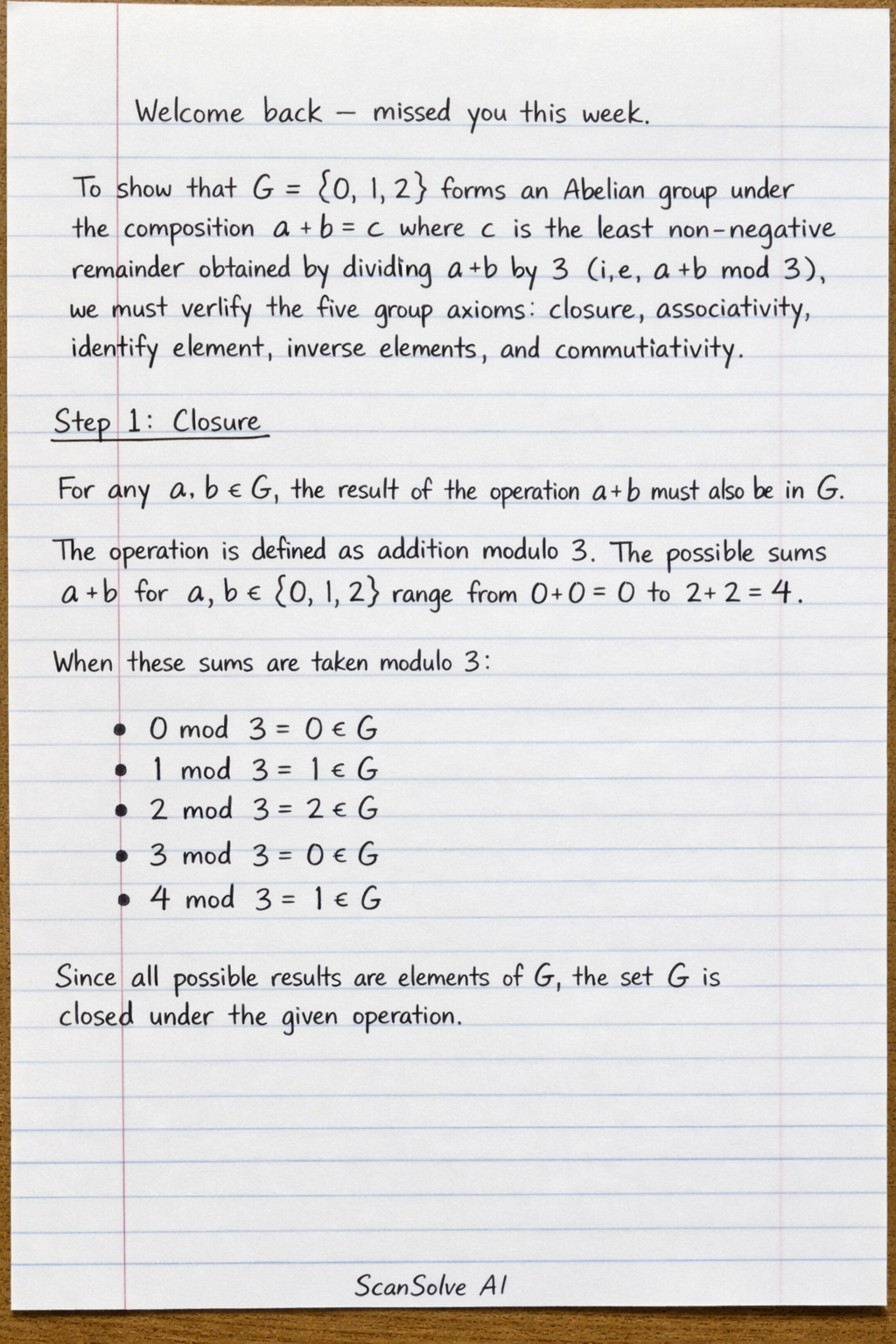
Handwritten Step-by-Step Solution
Get this as a handwritten image on WhatsApp — like a tutor wrote it for you.
Try on WhatsApp