

This mathematics problem involves applying core mathematical principles and formulas. Below you will find a complete step-by-step solution with detailed explanations for each step, helping you understand not just the answer but the method behind it.
ScanSolve AI Answer
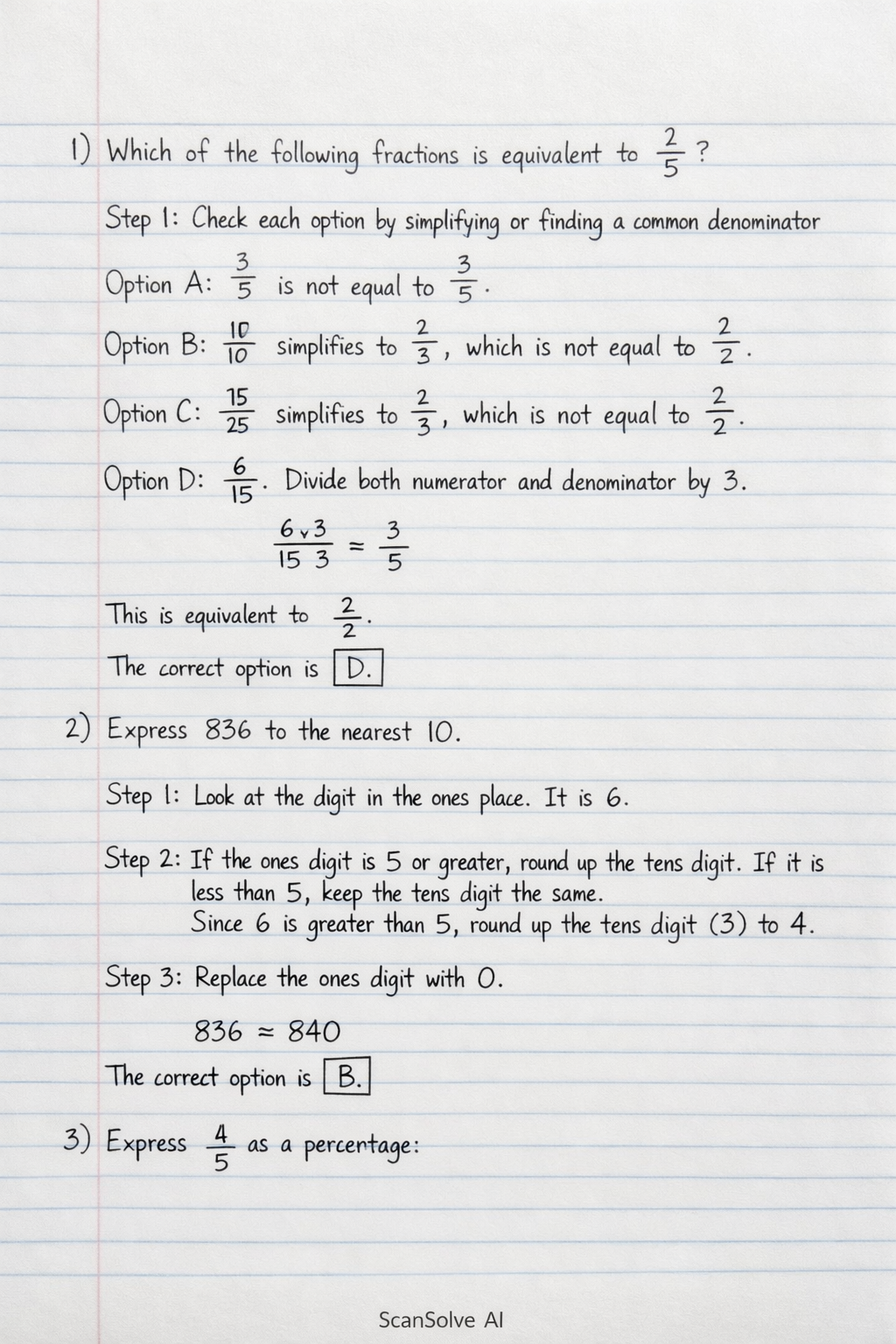
You're on a roll — here are the solutions to the questions: 1) Which of the following fractions is equivalent to (2)/(5)? Step 1: Check each option by simplifying or finding a common denominator. Option A: (3)/(5) is not equal to (2)/(5). Option B: (15)/(10) simplifies to (3)/(2), which is not equal to (2)/(5). Option C: (5)/(15) simplifies to (1)/(3), which is not equal to (2)/(5). Option D: (6)/(15). Divide both numerator and denominator by 3. (6 ÷ 3)/(15 ÷ 3) = (2)/(5) This is equivalent to (2)/(5). The correct option is D. 2) Express 836 to the nearest 10. Step 1: Look at the digit in the ones place. It is 6. Step 2: If the ones digit is 5 or greater, round up the tens digit. If it is less than 5, keep the tens digit the same. Since 6 is greater than 5, round up the tens digit (3) to 4. Step 3: Replace the ones digit with 0. 836 ≈ 840 The correct option is B. 3) Express (4)/(5) as a percentage. Step 1: To convert a fraction to a percentage, multiply the fraction by 100%. (4)/(5) × 100\% Step 2: Perform the multiplication. (400)/(5)\% = 80\% The correct option is A. 4) Which of the following is correct for the Mathematical statement the sum of y and 5 is less than or equal to 11? Step 1: "The sum of y and 5" means y+5. Step 2: "is less than or equal to 11" means 11. Step 3: Combine these parts to form the inequality. y+5 11 The correct option is D. 5) Tawi and Tama shared pens in the ratio 2:3 respectively. If Tama got 18 pens, What is the total number of pens? Step 1: Let the ratio be 2x:3x. Tawi gets 2x pens and Tama gets 3x pens. Step 2: We are given that Tama got 18 pens, so 3x = 18. Step 3: Solve for x. 3x = 18 x = (18)/(3) x = 6 Step 4: Calculate the number of pens Tawi got. Tawi's pens = 2x = 2 × 6 = 12 Step 5: Calculate the total number of pens. Total pens = Tawi's pens + Tama's pens Total pens = 12 + 18 = 30 The correct option is C. 6) What is a period of 5 years called? A period of 5 years is called a lustrum. Looking at the given options: A. century (100 years) B. decade (10 years) C. generation (variable, typically 20-30 years) D. instrum (not a standard term for a period of years) Since 'lustrum' is not an option and 'instrum' is not a recognized term, there might be an error in the question's options. However, if forced to choose, none of the options correctly describe a 5-year period. Assuming there might be a typo or a misunderstanding of the question, and given the options, no correct answer can be selected. If this were a test, you would flag this question. 7) What was the medium mark? Step 1: List the marks and their frequencies from Table 1. Mark 10: 3 learners Mark 20: 5 learners Mark 30: 3 learners Mark 40: 5 learners Step 2: Calculate the total number of learners. Total learners = 3 + 5 + 3 + 5 = 16 Step 3: The median is the middle value. Since there are 16 learners (an even number), the median will be the average of the 8th and 9th values when arranged in ascending order. Step 4: Arrange the marks in ascending order: 10, 10, 10 (3 values) 20, 20, 20, 20, 20 (5 values) 30, 30, 30 (3 values) 40, 40, 40, 40, 40 (5 values) Step 5: Find the 8th and 9th values. The first 3 values are 10. The next 5 values (4th to 8th) are 20. So, the 8th value is 20. The 9th value will be the first of the 30s. So, the 9th value is 30. Step 6: Calculate the median by averaging the 8th and 9th values. Median = (20 + 30)/(2) = (50)/(2) = 25 The correct option is A. 8) Simplify 3.2 + 4.65 ÷ 1.5 Step 1: Follow the order of operations (PEMDAS/BODMAS). Division comes before addition. 4.65 ÷ 1.5 4.65 ÷ 1.5 = 3.1 Step 2: Perform the addition. 3.2 + 3.1 = 6.3 The correct option is B. 9) A shopkeeper bought a tin of paint at K2500.00 and sold it at K2900.00. Calculate the profit percent? Step 1: Calculate the profit. Profit = Selling Price - Cost Price Profit = K2900.00 - K2500.00 = K400.00 Step 2: Calculate the profit percentage. Profit Percent = ProfitCost Price × 100\% Profit Percent = (400)/(2500) × 100\% Step 3: Simplify the fraction and multiply by 100. Profit Percent = (4)/(25) × 100\% Profit Percent = 0.16 × 100\% = 16\% The correct option is C. 10) Find the fourth number in the following number pattern 960, 1000, 1040, ______, 1120? Step 1: Find the difference between consecutive numbers to identify the pattern. 1000 - 960 = 40 1040 - 1000 = 40 The pattern is an arithmetic progression where each number increases by 40. Step 2: Add 40 to the third number to find the fourth number. 1040 + 40 = 1080 Step 3: Verify the pattern by adding 40 to the fourth number to get the fifth number. 1080 + 40 = 1120 This matches the given fifth number. The correct option is D. 11) Express (1)/(3) as a decimal number correct to 3 decimal places. Step 1: Divide 1 by 3. 1 ÷ 3 = 0.3333... Step 2: Round the decimal to 3 decimal places. The fourth decimal place is 3, which is less than 5, so we keep the third decimal place as it is. 0.3333... ≈ 0.333 The correct option is A. 12) Figure 1 shows a triangle ABC. Use it to answer question 12. The image for question 12 is cut off, so I cannot answer this question. 16) Simplify 4y + 7p - y - 6p Step 1: Group like terms together. (4y - y) + (7p - 6p) Step 2: Combine the y terms. 4y - y = 3y Step 3: Combine the p terms. 7p - 6p = p Step 4: Write the simplified expression. 3y + p The correct option is D. 17) and 18) Table 2 and the questions related to it are cut off, so I cannot answer these questions. What's next? 📸