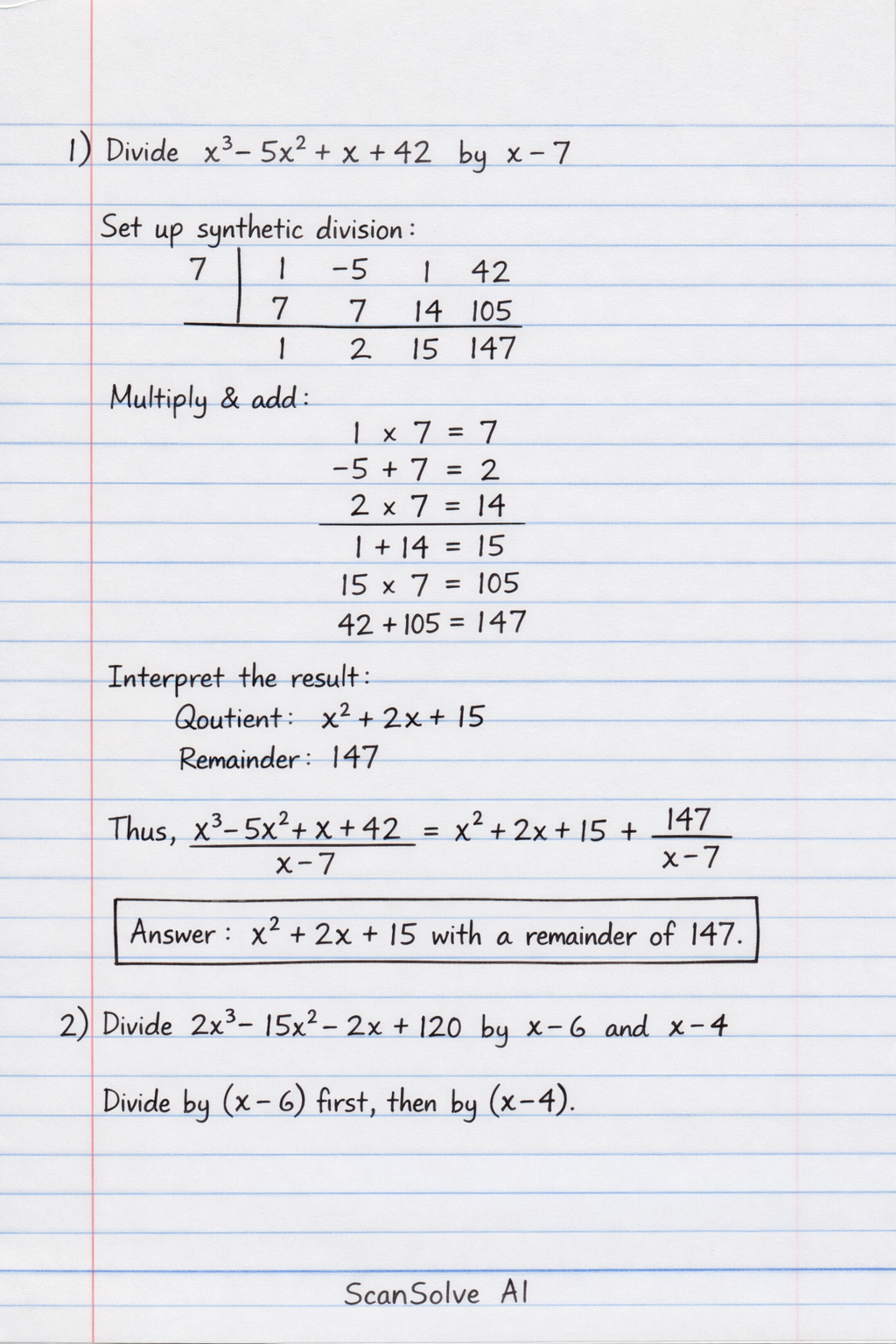
We read your photo as:

What are the solutions to these polynomial division problems?

Mathematics

ScanSolve AI Answer

Answer

x2+2x+15 with a remainder of 147x^2 + 2x + 15 \text{ with a remainder of } 147

2x + 5

6x3+25x2+14x−156x^3 + 25x^2 + 14x - 15

Step-by-step solution

6 steps

Here are the solutions to your polynomial division problems:

1. Divide x3−5x2+x+42x^3 - 5x^2 + x + 42 by (x−7)(x-7)

  1. Set up synthetic division.

    The divisor is (x−7)(x-7), so we use k=7k=7. The coefficients of the dividend are 1,−5,1,421, -5, 1, 42.

    71−51427141051215147\begin{array}{c|cccc} 7 & 1 & -5 & 1 & 42 \\ & & 7 & 14 & 105 \\ \hline & 1 & 2 & 15 & 147 \\ \end{array}
  2. Interpret the result.

    The last number, 147, is the remainder. The other numbers, 1,2,151, 2, 15, are the coefficients of the quotient, starting with x2x^2.

    The quotient is x2+2x+15x^2 + 2x + 15 with a remainder of 147.
    So, x3−5x2+x+42x−7=x2+2x+15+147x−7\frac{x^3 - 5x^2 + x + 42}{x-7} = x^2 + 2x + 15 + \frac{147}{x-7}.

    The result of the division is x2+2x+15 with a remainder of 147\boxed{x^2 + 2x + 15 \text{ with a remainder of } 147}.

    2. Divide 2x3−15x2−2x+1202x^3 - 15x^2 - 2x + 120 by (x−6)(x-6) and (x−4)(x-4)

    This means dividing by (x−6)(x−4)(x-6)(x-4). We can perform two successive synthetic divisions.

  3. Divide 2x3−15x2−2x+1202x^3 - 15x^2 - 2x + 120 by (x−6)(x-6).

    Use k=6k=6.

    62−15−212012−18−1202−3−200\begin{array}{c|cccc} 6 & 2 & -15 & -2 & 120 \\ & & 12 & -18 & -120 \\ \hline & 2 & -3 & -20 & 0 \\ \end{array}

    The remainder is 0. The quotient is 2x2−3x−202x^2 - 3x - 20.

  4. Divide the new quotient 2x2−3x−202x^2 - 3x - 20 by (x−4)(x-4).

    Use k=4k=4.

    42−3−20820250\begin{array}{c|ccc} 4 & 2 & -3 & -20 \\ & & 8 & 20 \\ \hline & 2 & 5 & 0 \\ \end{array}

    The remainder is 0. The final quotient is 2x+52x + 5.

    The result of the division is 2x+5\boxed{2x + 5}.

    3. Divide 6x4+13x3−36x2−43x+306x^4 + 13x^3 - 36x^2 - 43x + 30 by (x−2)(x-2)

  5. Set up synthetic division.

    The divisor is (x−2)(x-2), so we use k=2k=2. The coefficients of the dividend are 6,13,−36,−43,306, 13, -36, -43, 30.

    2613−36−4330125028−3062514−150\begin{array}{c|ccccc} 2 & 6 & 13 & -36 & -43 & 30 \\ & & 12 & 50 & 28 & -30 \\ \hline & 6 & 25 & 14 & -15 & 0 \\ \end{array}
  6. Interpret the result.

    The last number, 0, is the remainder. The other numbers, 6,25,14,−156, 25, 14, -15, are the coefficients of the quotient, starting with x3x^3.

    The quotient is 6x3+25x2+14x−156x^3 + 25x^2 + 14x - 15 with a remainder of 0.
    So, 6x4+13x3−36x2−43x+30x−2=6x3+25x2+14x−15\frac{6x^4 + 13x^3 - 36x^2 - 43x + 30}{x-2} = 6x^3 + 25x^2 + 14x - 15.

    The result of the division is 6x3+25x2+14x−15\boxed{6x^3 + 25x^2 + 14x - 15}.

Was this helpful?

Try one yourself

A new problem that tests the same skill.

Still stuck on this one?

Ask a follow-up, and the answer starts from this question.

Got a different question?Ask your own question
Handwritten step-by-step solution preview

Handwritten Step-by-Step Solution

Get this as a handwritten image on WhatsApp — like a tutor wrote it for you.

Try on WhatsApp