
We read your photo as:
What is the square root of 1849?
ScanSolve AI Answer
Answer
Step-by-step solution
6 stepsPair the digits of the number 1849 from the right.
The pairs are $(18)$ and $(49)$.
Find the largest whole number whose square is less than or equal to the first pair, 18.
Since and , the number is 4. Write 4 as the first digit of the square root.Subtract from 18.
Bring down the next pair of digits, 49, next to the remainder.
The new number is 249.
Double the current quotient ().
Write this as the new divisor's first digit.
Now, we need to find a digit 'x' such that when 'x' is placed next to 8 (forming ) and multiplied by 'x', the product is less than or equal to 249.
Let's try :Write 3 as the next digit in the square root.
Subtract 249 from 249.
Since the remainder is 0 and there are no more pairs to bring down, the square root is 43.
Therefore, the positive square root of 1849 is:
Still stuck on this one?
Ask a follow-up, and the answer starts from this question.
More Mathematics Questions
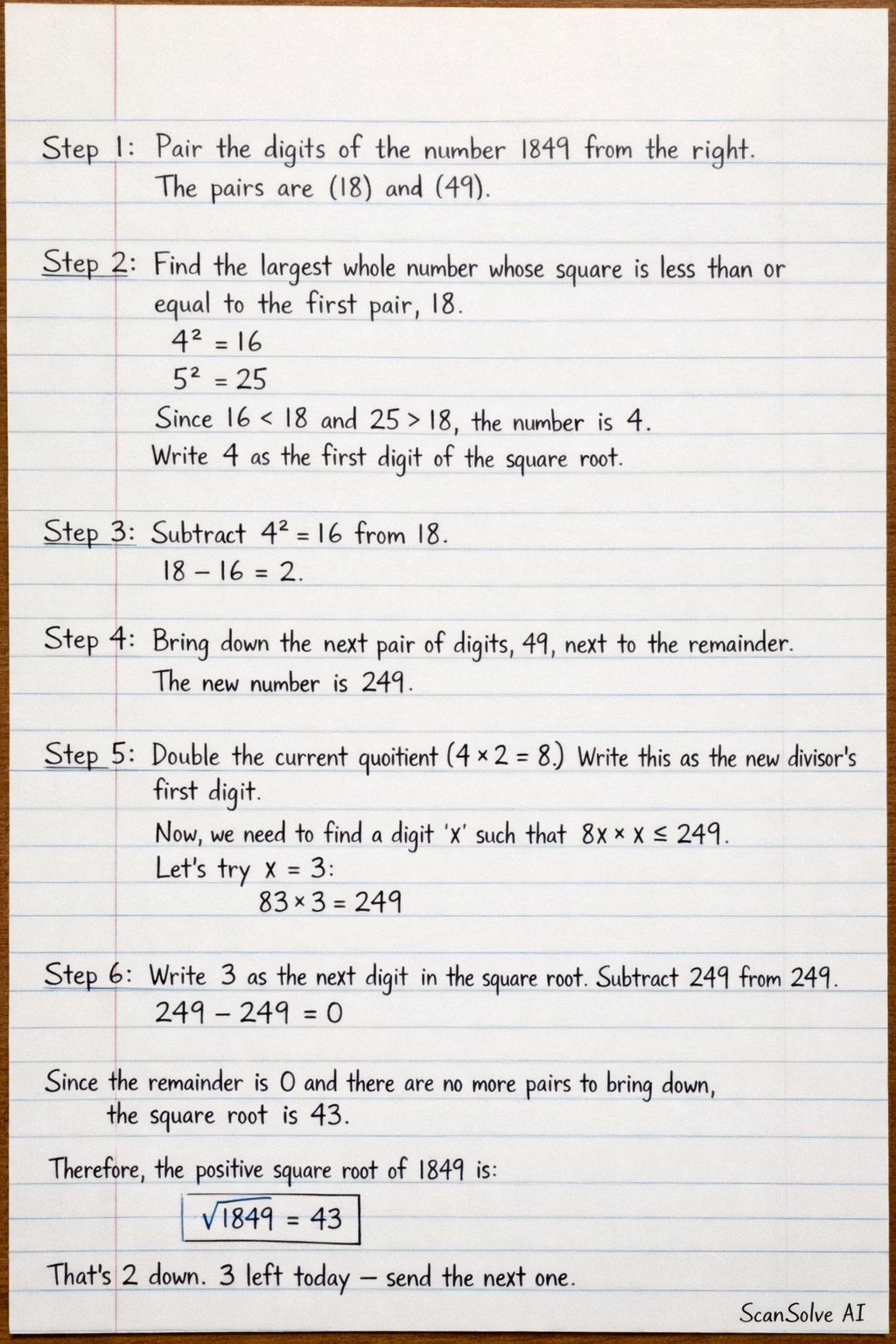
Handwritten Step-by-Step Solution
Get this as a handwritten image on WhatsApp — like a tutor wrote it for you.
Try on WhatsApp