
We read your photo as:
The student is provided with three questions: 1. The price of a loaf of bread last week was x. This week, the price rose by 20%. Determine the price of the loaf after the increase. 2. Four men takes x
ScanSolve AI Answer
Step-by-step solution
18 stepsHere are the solutions to your questions:
Question 1:
The price of a loaf of bread last week was . This week, the price rose by 20%. Determine the price of the loaf after the increase.
Express the percentage increase as a decimal.
Calculate the amount of the increase.
Add the increase to the original price to find the new price.
The price of the loaf after the increase is .
Question 2:
Four men takes days to paint a room. How long will it take 16 men working at the same rate to paint the room?Set up the inverse proportion relationship.
The total work (men days) remains constant.
Here, men, days, men. We need to find .
Substitute the known values into the equation.
Solve for .
It will take 16 men .
Question 3:
Write 0.009 in standard form.Move the decimal point to the right until the number is between 1 and 10.
The decimal point moved 3 places to the right.
Since the original number was less than 1, the exponent will be negative.
In standard form, 0.009 is .
Question 4:
Simplify the following expression:Factor out the common term from the numerator.
Factor out the common term from the denominator.
Rewrite the expression with the factored terms and simplify by canceling the common factor .
The simplified expression is .
Question 5:
The figure at the right is a sketch of a piece of land. The lengths are in meters.a) Write and simplify an algebraic expression for perimeter of the land.
b) If the shortest side is 9 m, what is the perimeter of the land?
The figure shows a right-angled triangle with legs and .
a) Write and simplify an algebraic expression for perimeter of the land.
Find the length of the hypotenuse using the Pythagorean theorem.
Let the hypotenuse be .
Write the expression for the perimeter by summing the lengths of all three sides.
Simplify the expression for the perimeter.
The algebraic expression for the perimeter is .
b) If the shortest side is 9 m, what is the perimeter of the land?
Identify the shortest side.
The sides are , , and . Since is a length, .
Comparing and , is clearly shorter. The hypotenuse is always the longest side in a right triangle.
So, the shortest side is .Set the shortest side equal to 9 m.
Substitute into the perimeter expression from part (a).
Calculate the numerical value of the perimeter.
The perimeter of the land is approximately .
Still stuck on this one?
Ask a follow-up, and the answer starts from this question.
More Mathematics Questions
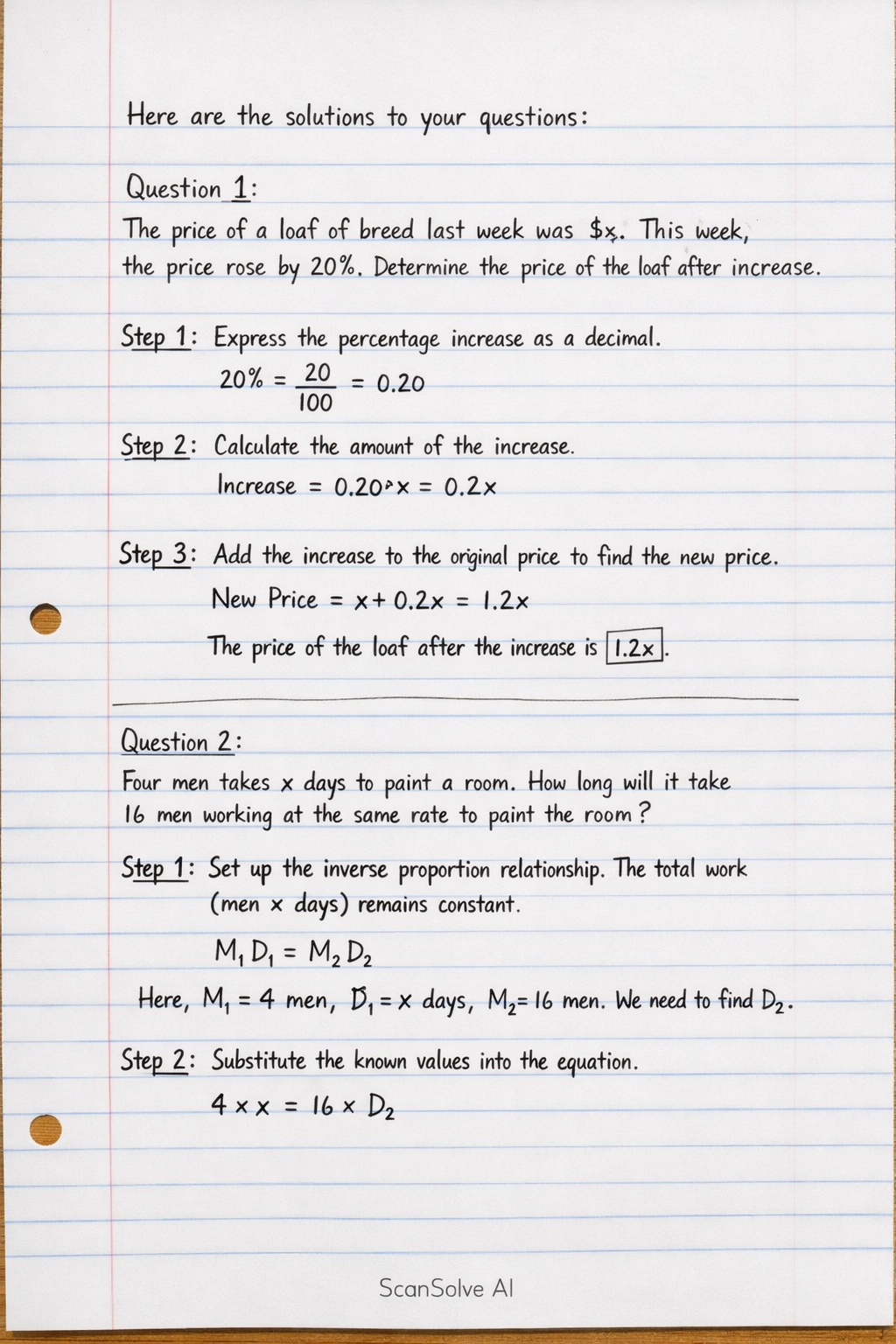
Handwritten Step-by-Step Solution
Get this as a handwritten image on WhatsApp — like a tutor wrote it for you.
Try on WhatsApp