We read your photo as:

The sum of the first and second terms of a geometric progression is -5, and the sum of the fourth and fifth terms is 40. Find the first term and the common ratio.

Mathematics

ScanSolve AI Answer

Step-by-step solution

7 steps

8. (i)

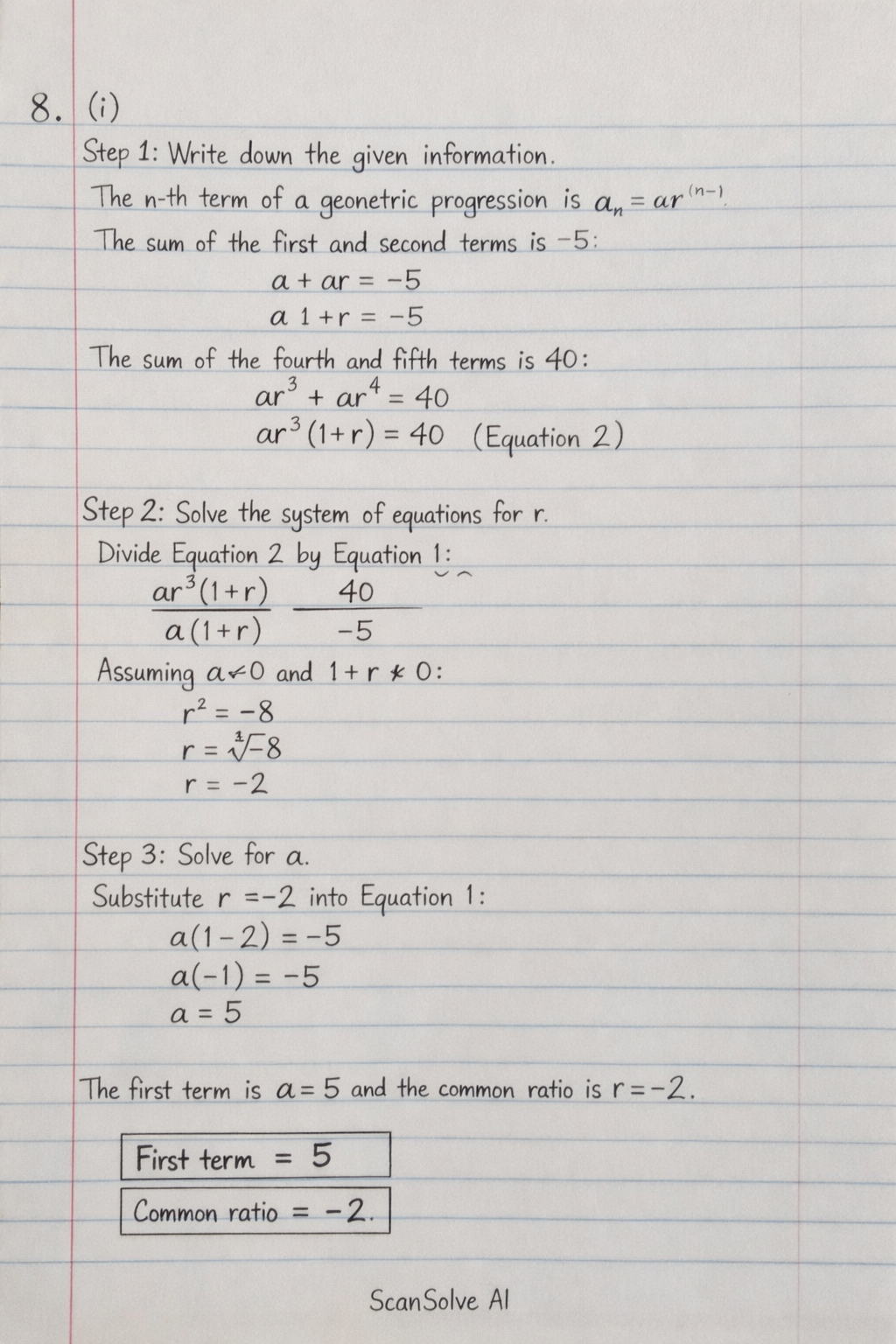
  1. Write down the given information in terms of the first term aa and common ratio rr of a geometric progression.

    The nn-th term of a geometric progression is an=arn−1a_n = ar^{n-1}.
    The sum of the first and second terms is -5:

    a1+a2=−5a_1 + a_2 = -5 a+ar=−5a + ar = -5 a(1+r)=−5(Equation 1)a(1+r) = -5 \quad \text{(Equation 1)}

    The sum of the fourth and fifth terms is 40:

    a4+a5=40a_4 + a_5 = 40 ar3+ar4=40ar^3 + ar^4 = 40 ar3(1+r)=40(Equation 2)ar^3(1+r) = 40 \quad \text{(Equation 2)}
  2. Solve the system of equations for rr.

    Divide Equation 2 by Equation 1:

    ar3(1+r)a(1+r)=40−5\frac{ar^3(1+r)}{a(1+r)} = \frac{40}{-5}

    Assuming a≠0a \neq 0 and 1+r≠01+r \neq 0:

    r3=−8r^3 = -8 r=−83r = \sqrt[3]{-8} r=−2r = -2
  3. Solve for aa.

    Substitute r=−2r=-2 into Equation 1:

    a(1+(−2))=−5a(1+(-2)) = -5 a(1−2)=−5a(1-2) = -5 a(−1)=−5a(-1) = -5 a=5a = 5

    The first term is a=5a=5 and the common ratio is r=−2r=-2.

    First term =5\text{First term } = \boxed{5} Common ratio =−2\text{Common ratio } = \boxed{-2}

    8. (ii)

  4. Write the general term of the binomial expansion.

    The general term Tk+1T_{k+1} in the expansion of (A+B)n(A+B)^n is given by Tk+1=(nk)An−kBkT_{k+1} = \binom{n}{k} A^{n-k} B^k.
    For (x+2x2)15\left(x + \frac{2}{x^2}\right)^{15}, we have A=xA=x, B=2x2B=\frac{2}{x^2}, and n=15n=15.

    Tk+1=(15k)(x)15−k(2x2)kT_{k+1} = \binom{15}{k} (x)^{15-k} \left(\frac{2}{x^2}\right)^k
  5. Simplify the general term to combine the powers of xx.

    Tk+1=(15k)x15−k2k(x2)kT_{k+1} = \binom{15}{k} x^{15-k} \frac{2^k}{(x^2)^k} Tk+1=(15k)x15−k2kx2kT_{k+1} = \binom{15}{k} x^{15-k} \frac{2^k}{x^{2k}} Tk+1=(15k)2kx15−k−2kT_{k+1} = \binom{15}{k} 2^k x^{15-k-2k} Tk+1=(15k)2kx15−3kT_{k+1} = \binom{15}{k} 2^k x^{15-3k}
  6. Find the value of kk for the term independent of xx.

    For the term to be independent of xx, the exponent of xx must be 0.

    15−3k=015 - 3k = 0 3k=153k = 15 k=5k = 5
  7. Substitute k=5k=5 into the general term to find the independent term.

    The term independent of xx is T5+1=T6T_{5+1} = T_6:

    T6=(155)25x15−3(5)T_6 = \binom{15}{5} 2^5 x^{15-3(5)} T6=(155)25x0T_6 = \binom{15}{5} 2^5 x^0 T6=(155)25T_6 = \binom{15}{5} 2^5

    Calculate (155)\binom{15}{5}:

    (155)=15!5!(15−5)!=15!5!10!=15×14×13×12×115×4×3×2×1\binom{15}{5} = \frac{15!}{5!(15-5)!} = \frac{15!}{5!10!} = \frac{15 \times 14 \times 13 \times 12 \times 11}{5 \times 4 \times 3 \times 2 \times 1} (155)=360360120=3003\binom{15}{5} = \frac{360360}{120} = 3003

    Calculate 252^5:

    25=322^5 = 32

    Multiply the values:

    T6=3003×32T_6 = 3003 \times 32 T6=96096T_6 = 96096

    The term independent of xx is 96096\boxed{96096}.

Was this helpful?

Still stuck on this one?

Ask a follow-up, and the answer starts from this question.

Got a different question?Ask your own question
Handwritten step-by-step solution preview

Handwritten Step-by-Step Solution

Get this as a handwritten image on WhatsApp — like a tutor wrote it for you.

Try on WhatsApp