
We read your photo as:
The sum of the interior angles of a polygon is 1980^ exto. Find the number of sides the polygon has. 11. The diagram below is a sketch of a rice field (not drawn to scale), use it to generate a survey
ScanSolve AI Answer
Step-by-step solution
10 stepsHere are the solutions to the problems:
10. The sum of the interior angles of a polygon is . Find the number of sides the polygon has.
Use the formula for the sum of interior angles of a polygon.
The sum of the interior angles of a polygon with sides is given by the formula:
Substitute the given sum into the formula.
We are given :
Solve for .
Divide both sides by :
Add 2 to both sides:
The polygon has .
11. The diagram below is a sketch of a rice field (not drawn to scale), use it to generate a surveyor's field book. (All measurements are in metres)
A surveyor's field book records measurements taken along a baseline. The readings are typically recorded from the bottom of the page upwards, representing movement along the baseline from the starting point (X) to the end point (Y).
Identify the baseline and its total length.
The baseline is XY, and its total length is 150 m.
Extract the chainage (distance along the baseline from X) and offset measurements from the diagram.
- From X (0m): Starting point.
- At 30m from X: Left offset to F is 20m. Right offset to A is 20m.
- At 60m from X: Left offset to E is 50m.
- At 100m from X: Right offset to B is 40m.
- At 120m from X: Left offset to D is 45m. Right offset to C is 40m.
- To Y (150m): End point of the baseline.
Construct the field book.
Left Offset Chainage (m) Right Offset 150 45 to D 120 40 to C 100 40 to B 50 to E 60 20 to F 30 20 to A 0 TO Y FROM X 12. A boy walk directly from point Q towards the foot of a vertical flag post 200m away. After conveying a distance of 140m, he observes the angle of elevation of the top of the flag post is .
Determine the boy's new distance from the flag post.
Initial distance from Q to the foot of the flag post = 200 m.
Distance walked by the boy towards the flag post = 140 m.
New distance from the boy to the foot of the flag post = .Form a right-angled triangle.
Let be the height of the flag post.
The distance from the boy's new position to the foot of the flag post is 60 m.
The angle of elevation to the top of the flag post is .
This forms a right-angled triangle where:- The height of the flag post () is the opposite side to the angle of elevation.
- The distance from the boy to the foot of the flag post (60 m) is the adjacent side to the angle of elevation.
Use the tangent trigonometric ratio.
The tangent of an angle in a right-angled triangle is the ratio of the opposite side to the adjacent side:
Solve for .
Using a calculator,
Rounding to two decimal places:
The height of the flag post is approximately .
Still stuck on this one?
Ask a follow-up, and the answer starts from this question.
More Mathematics Questions
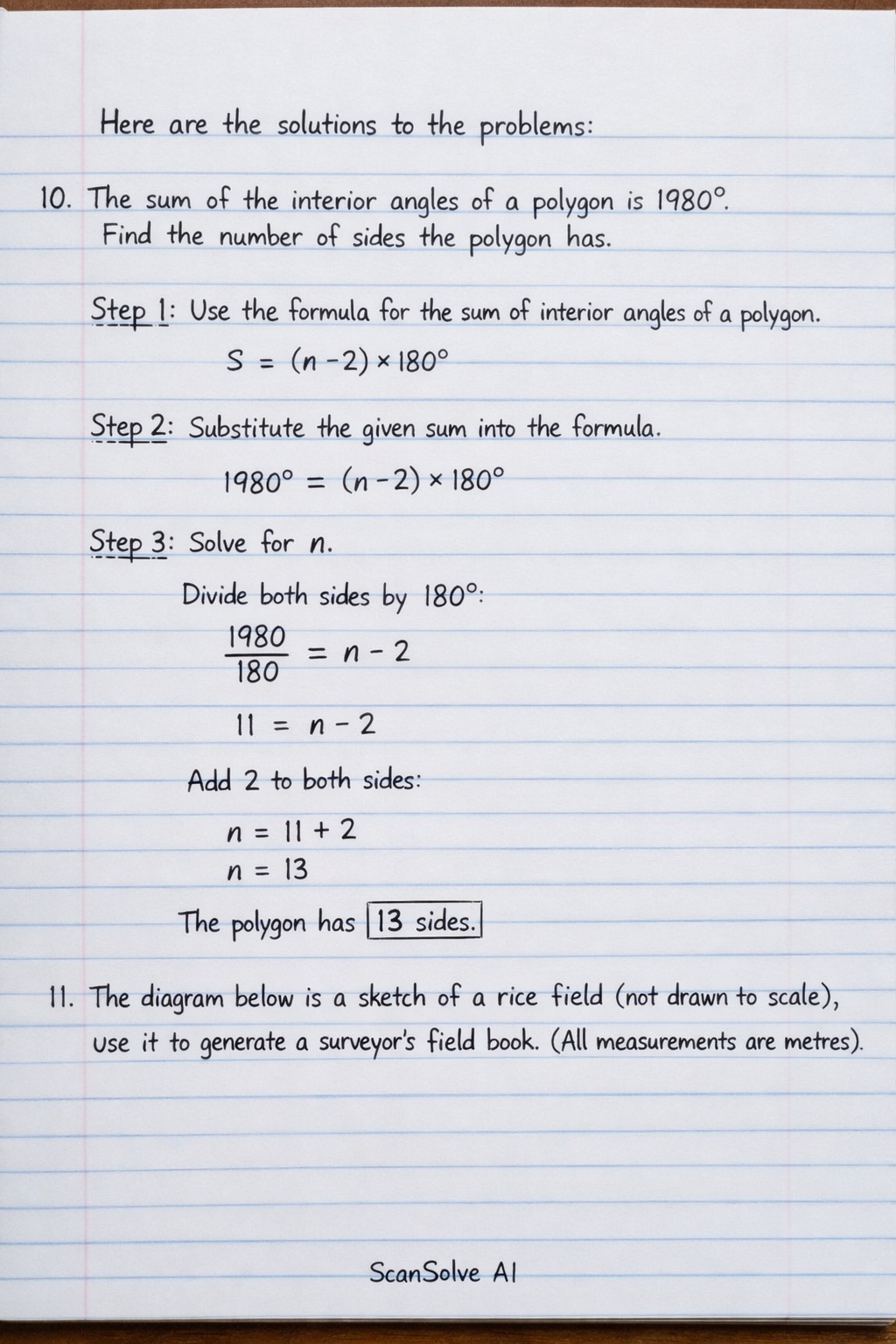
Handwritten Step-by-Step Solution
Get this as a handwritten image on WhatsApp — like a tutor wrote it for you.
Try on WhatsApp