
We read your photo as:
A polygon has a sum of interior angles equal to 1980 degrees. How many triangles can it be subdivided into, and how many sides does it have?
ScanSolve AI Answer
Step-by-step solution
3 stepsHere's how to solve the problem:
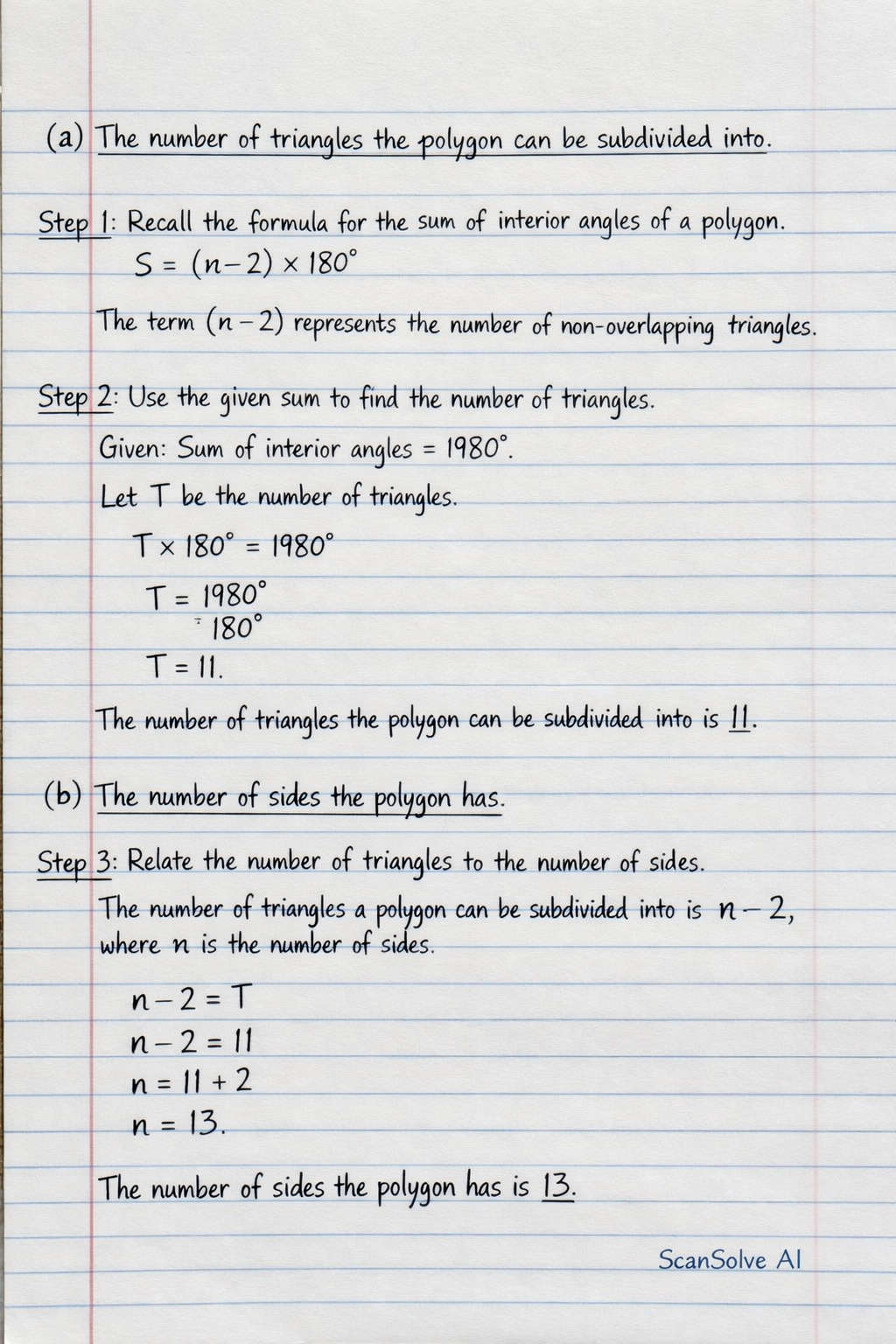
a) The number of triangles the polygon can be subdivided into.
Recall the formula for the sum of interior angles of a polygon.
The sum of the interior angles of a polygon with sides is given by . The term represents the number of non-overlapping triangles the polygon can be divided into.
Use the given sum to find the number of triangles.
Given that the sum of the interior angles is . Let be the number of triangles.
The number of triangles the polygon can be subdivided into is 11.
b) The number of sides the polygon has.
Relate the number of triangles to the number of sides.
The number of triangles a polygon can be subdivided into is , where is the number of sides.
The number of sides the polygon has is 13.
The final answers are:
a) The number of triangles the polygon can be subdivided into is .
b) The number of sides the polygon has is .
Still stuck on this one?
Ask a follow-up, and the answer starts from this question.
More Mathematics Questions
Handwritten Step-by-Step Solution
Get this as a handwritten image on WhatsApp — like a tutor wrote it for you.
Try on WhatsApp