We read your photo as:

The Sum to 500 of a G.P is 15-1/10 and the first term is -1/8 find the common ratio. The fifth term of a G.P is 2/81 if the first term is 2 find the common ratio and Sum of the first 5 terms of the G.P.

Mathematics

ScanSolve AI Answer

Answers

2 parts
i

r=13 or r=−13r = \frac{1}{3} \text{ or } r = -\frac{1}{3}

ii

S5=24281S_5 = \frac{242}{81}

Step-by-step solution

6 steps

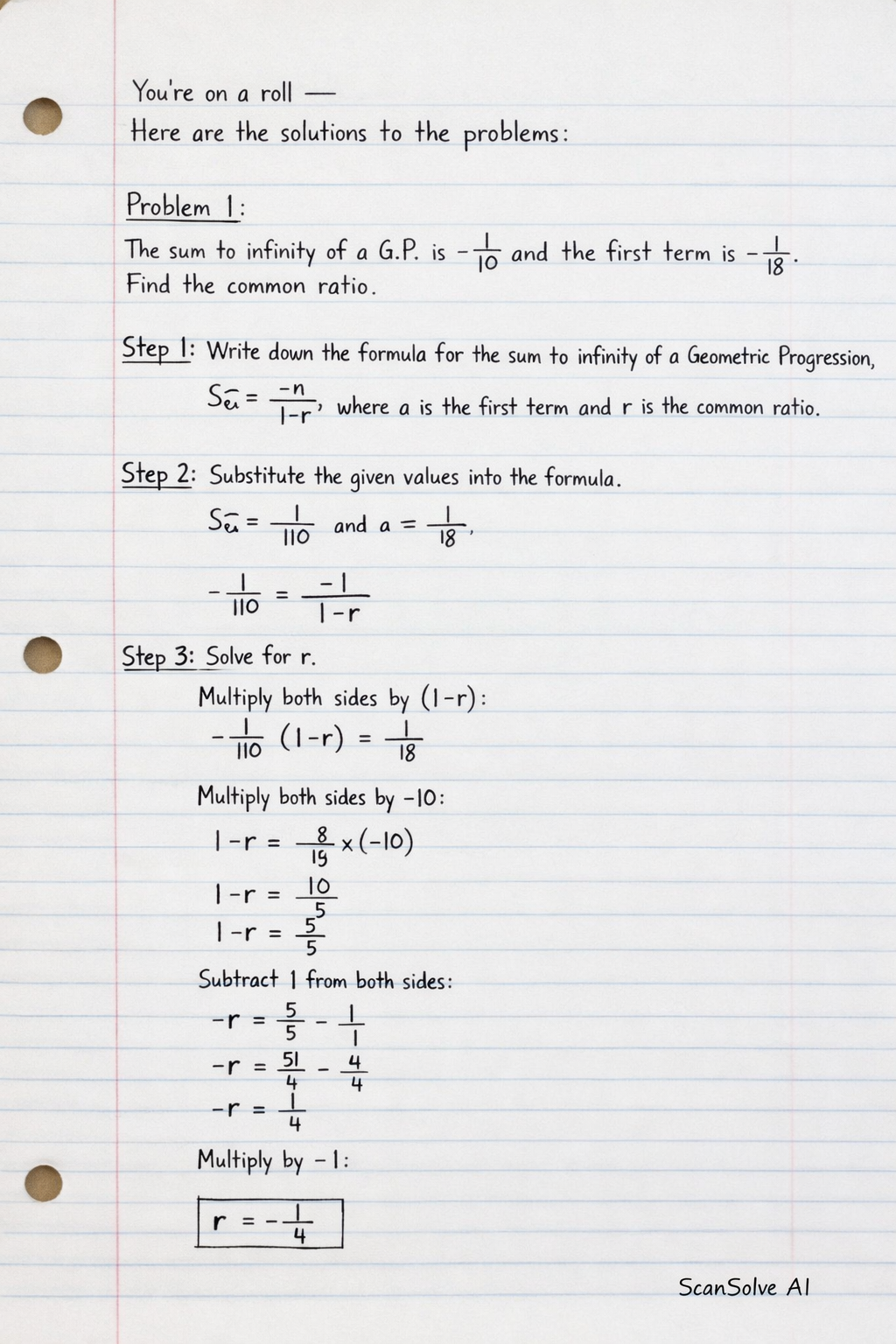
Here are the solutions to the problems:

:
The sum to infinity of a G.P. is −110-\frac{1}{10} and the first term is −18-\frac{1}{8}. Find the common ratio.

Step 1: Write down the formula for the sum to infinity of a Geometric Progression (S∞S_\infty).
The formula is S∞=a1−rS_\infty = \frac{a}{1-r}, where aa is the first term and rr is the common ratio.

Step 2: Substitute the given values into the formula.
Given S∞=−110S_\infty = -\frac{1}{10} and a=−18a = -\frac{1}{8}.

−110=−181−r-\frac{1}{10} = \frac{-\frac{1}{8}}{1-r}

Step 3: Solve for rr.
Multiply both sides by (1−r)(1-r):

−110(1−r)=−18-\frac{1}{10}(1-r) = -\frac{1}{8}

Multiply both sides by −10-10:

1−r=−18×(−10)1-r = -\frac{1}{8} \times (-10) 1−r=1081-r = \frac{10}{8} 1−r=541-r = \frac{5}{4}

Subtract 1 from both sides:

−r=54−1-r = \frac{5}{4} - 1 −r=54−44-r = \frac{5}{4} - \frac{4}{4} −r=14-r = \frac{1}{4}

Multiply by −1-1:

r=−14r = -\frac{1}{4} r=−14\boxed{r = -\frac{1}{4}}

:
The fifth term of a G.P. is 281\frac{2}{81} if the first term is 2. Find the (i) common ratio and (ii) sum of the first 5 terms of the G.P.

Part i· 3 steps

Find the common ratio (rr).

  1. Write down the formula for the nn-th term of a Geometric Progression (ana_n).

    The formula is an=arn−1a_n = ar^{n-1}, where aa is the first term and rr is the common ratio.

  2. Substitute the given values into the formula.

    Given a5=281a_5 = \frac{2}{81}, a=2a = 2, and n=5n=5.

    281=2⋅r5−1\frac{2}{81} = 2 \cdot r^{5-1} 281=2r4\frac{2}{81} = 2r^4
  3. Solve for rr.

    Divide both sides by 2:

    281×2=r4\frac{2}{81 \times 2} = r^4 181=r4\frac{1}{81} = r^4

    Take the fourth root of both sides:

    r=1814r = \sqrt[4]{\frac{1}{81}} r=13orr=−13r = \frac{1}{3} \quad \text{or} \quad r = -\frac{1}{3}

    Since the problem does not specify if the terms are positive or negative, both are mathematically possible. However, typically for such problems, the positive root is assumed unless otherwise stated. Let's assume r=13r = \frac{1}{3} for the sum calculation. If the problem intended a specific sign, it would usually be mentioned.

    r=13 or r=−13\boxed{r = \frac{1}{3} \text{ or } r = -\frac{1}{3}}

Part ii

S5=24281S_5 = \frac{242}{81}

Find the sum of the first 5 terms (S5S_5).

  1. Write down the formula for the sum of the first nn terms of a Geometric Progression (SnS_n).

    The formula is Sn=a(1−rn)1−rS_n = \frac{a(1-r^n)}{1-r} (for r≠1r \neq 1).

  2. Substitute the values for aa, rr, and nn.

    Given a=2a = 2, n=5n = 5. Let's use r=13r = \frac{1}{3}.

    S5=2(1−(13)5)1−13S_5 = \frac{2\left(1 - \left(\frac{1}{3}\right)^5\right)}{1 - \frac{1}{3}}
  3. Calculate S5S_5.

    First, calculate (13)5\left(\frac{1}{3}\right)^5:

    (13)5=1535=1243\left(\frac{1}{3}\right)^5 = \frac{1^5}{3^5} = \frac{1}{243}

    Now substitute this back into the sum formula:

    S5=2(1−1243)1−13S_5 = \frac{2\left(1 - \frac{1}{243}\right)}{1 - \frac{1}{3}} S5=2(243243−1243)33−13S_5 = \frac{2\left(\frac{243}{243} - \frac{1}{243}\right)}{\frac{3}{3} - \frac{1}{3}} S5=2(242243)23S_5 = \frac{2\left(\frac{242}{243}\right)}{\frac{2}{3}} S5=48424323S_5 = \frac{\frac{484}{243}}{\frac{2}{3}}

    To divide by a fraction, multiply by its reciprocal:

    S5=484243×32S_5 = \frac{484}{243} \times \frac{3}{2} S5=484×3243×2S_5 = \frac{484 \times 3}{243 \times 2} S5=242×3243S_5 = \frac{242 \times 3}{243} S5=24281S_5 = \frac{242}{81}

    If we used r=−13r = -\frac{1}{3}:

    S5=2(1−(−13)5)1−(−13)S_5 = \frac{2\left(1 - \left(-\frac{1}{3}\right)^5\right)}{1 - \left(-\frac{1}{3}\right)} S5=2(1−(−1243))1+13S_5 = \frac{2\left(1 - \left(-\frac{1}{243}\right)\right)}{1 + \frac{1}{3}} S5=2(1+1243)43S_5 = \frac{2\left(1 + \frac{1}{243}\right)}{\frac{4}{3}} S5=2(244243)43S_5 = \frac{2\left(\frac{244}{243}\right)}{\frac{4}{3}} S5=48824343S_5 = \frac{\frac{488}{243}}{\frac{4}{3}} S5=488243×34S_5 = \frac{488}{243} \times \frac{3}{4} S5=122×3243S_5 = \frac{122 \times 3}{243} S5=12281S_5 = \frac{122}{81}

    Given the context of typical problems, the positive common ratio is usually intended.

    S5=24281\boxed{S_5 = \frac{242}{81}}
Was this helpful?

Try one yourself

A new problem that tests the same skill.

Still stuck on this one?

Ask a follow-up, and the answer starts from this question.

Got a different question?Ask your own question
Handwritten step-by-step solution preview

Handwritten Step-by-Step Solution

Get this as a handwritten image on WhatsApp — like a tutor wrote it for you.

Try on WhatsApp