
We read your photo as:
The table above shows the test scores of students in a class. If the average score of 10 boys was 12 years, a boy of 14 years was replaced with that of 6, find the new average of boys.
ScanSolve AI Answer
Step-by-step solution
20 stepsHere are the solutions to the mathematics questions:
1. Solve the inequality .
Find the least common multiple (LCM) of the denominators (3 and 4), which is 12.
Multiply the entire inequality by 12 to eliminate the fractions.
Distribute the numbers into the parentheses.
Combine like terms.
Isolate by adding 1 to both sides and then dividing by 5.
The solution to the inequality is .
2. Find the range of satisfying both inequalities: and .
Solve the first inequality.
Solve the second inequality.
Determine the range of that satisfies both conditions.
We need AND .
Since , there is no value of that can be simultaneously less than 2 and greater than or equal to 2.86.
Therefore, there is no range of that satisfies both inequalities.3. Find the mean deviation of the numbers 2, 3, 5, 6.
Calculate the mean () of the given numbers.
Calculate the absolute deviation of each number from the mean ().
Sum the absolute deviations.
Calculate the mean deviation by dividing the sum of absolute deviations by the number of data points (4).
The mean deviation is .
4. What is the median and semi-interquartile range of the distribution below?
Scores () Frequency () 1 8 2 11 3 13 4 14 5 5 6 4 7 5 8 8 Calculate the cumulative frequency () and total frequency ().
Scores () Frequency () Cumulative Frequency () 1 8 8 2 11 19 3 13 32 4 14 46 5 5 51 6 4 55 7 5 60 8 8 68 Total frequency () = 68. Find the median ().
The median is the value at the -th position.
From the cumulative frequency, the 34.5-th value falls within the score of 4 (since for score 3 and for score 4).
So, the median () = 4.Find the first quartile ().
The first quartile is the value at the -th position.
From the cumulative frequency, the 17.25-th value falls within the score of 2 (since for score 1 and for score 2).
So, = 2.Find the third quartile ().
The third quartile is the value at the -th position.
From the cumulative frequency, the 51.75-th value falls within the score of 6 (since for score 5 and for score 6).
So, = 6.Calculate the semi-interquartile range (SIQR).
The median is and the semi-interquartile range is .
5. The average age of 10 boys was 12 years. A boy of 14 years was replaced with that of 6 years. Find the new average age of boys.
Calculate the total initial age of the 10 boys.
Calculate the change in total age due to the replacement.
Calculate the new total age.
Calculate the new average age.
The number of boys remains 10.
The new average age of the boys is .
Still stuck on this one?
Ask a follow-up, and the answer starts from this question.
More Mathematics Questions
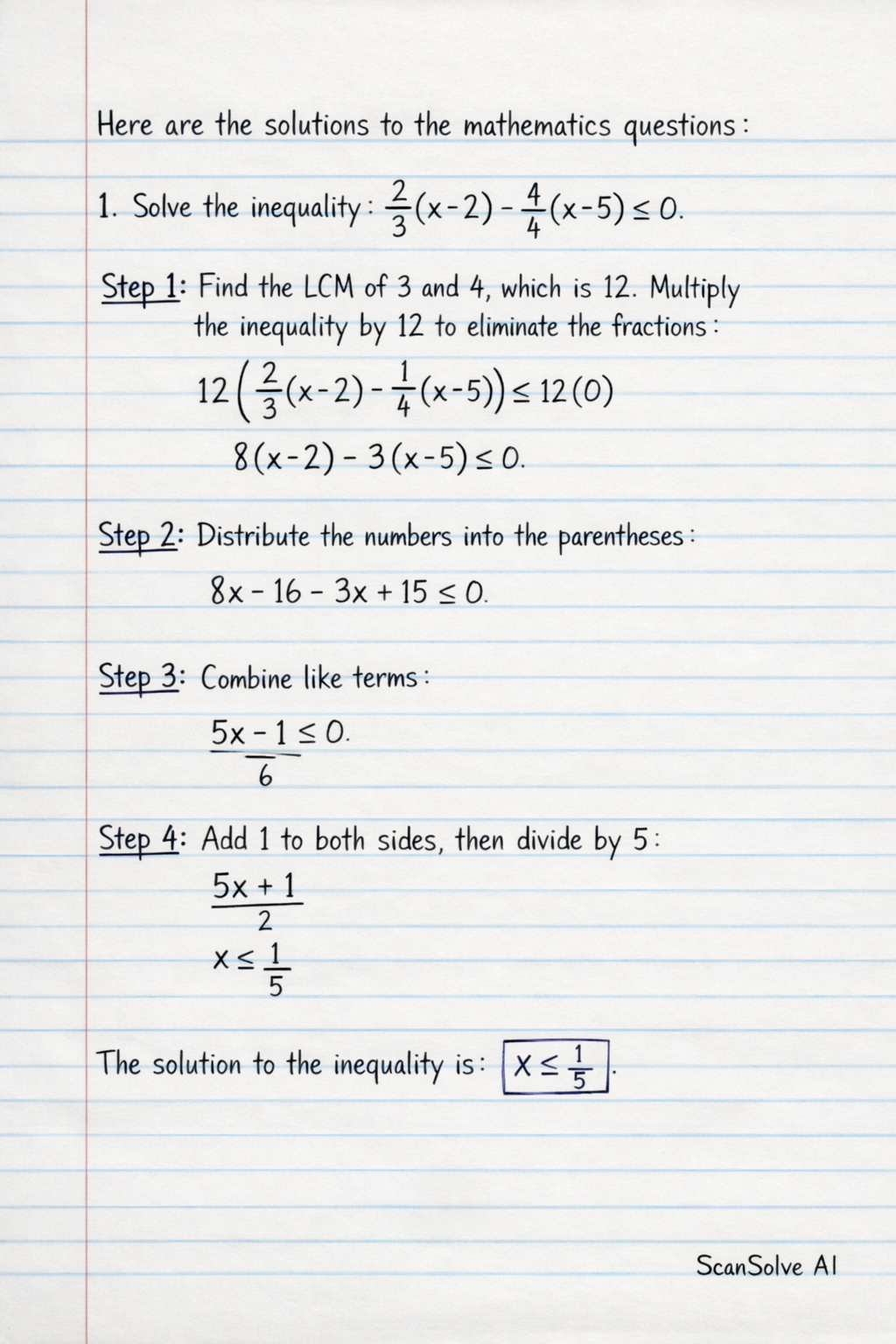
Handwritten Step-by-Step Solution
Get this as a handwritten image on WhatsApp — like a tutor wrote it for you.
Try on WhatsApp