
We read your photo as:
In the right-angled triangles below, calculate the length of the sides that have not been given. Leave your answers in surd form where applicable.
ScanSolve AI Answer
Step-by-step solution
17 stepsHere are the solutions for the problems you've sent:
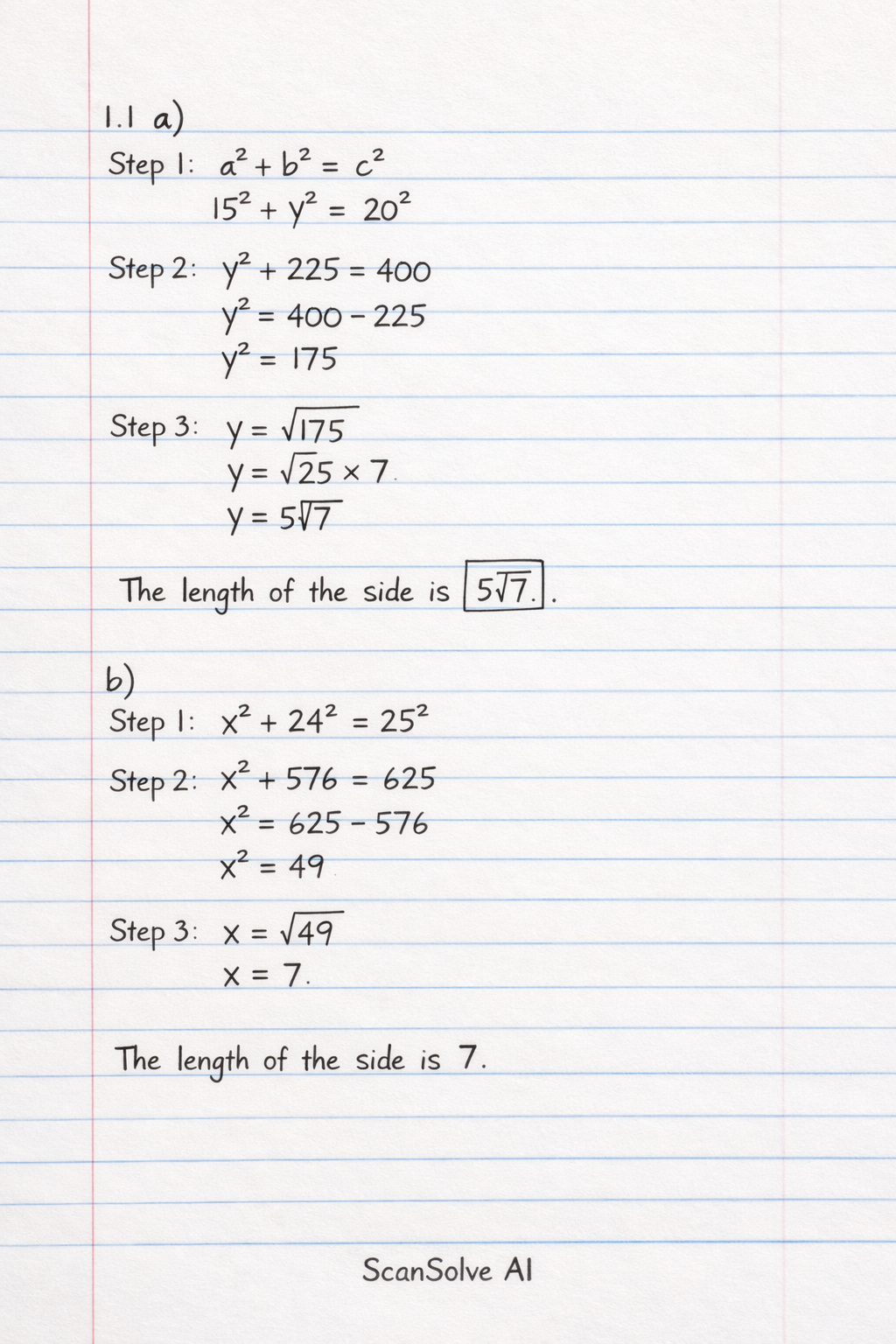
1.1 In the right-angled triangles below, calculate the length of the sides that have not been given. Leave your answers in surd form where applicable.
a)
Apply the Pythagorean theorem.
For a right-angled triangle, , where is the hypotenuse.
Given sides are 15 and 20 (hypotenuse). Let the unknown side be .Calculate the squares and solve for .
Find the square root and simplify the surd.
The length of the side is .
b)
Apply the Pythagorean theorem.
Given sides are 24 and 25 (hypotenuse). Let the unknown side be .
Calculate the squares and solve for .
Find the square root.
The length of the side is .
1.2 A ladder with a length of 10m is placed at an angle against a wall. The bottom of the ladder is 2 meters away from the wall. How far up the wall will the ladder reach? Round off to two decimal places.
Identify the sides of the right-angled triangle.
The ladder forms the hypotenuse ( m). The distance from the wall is one leg ( m). The height the ladder reaches up the wall is the other leg ().
Apply the Pythagorean theorem: .Calculate the squares and solve for .
Find the square root and round to two decimal places.
The ladder will reach approximately up the wall.
1.3 RQ is a vertical pole. The foot of the pole, Q, is on the same horizontal plane as P and S. The pole is anchored with cables RS and RP. The angle of depression from the top of the pole to the point S is . RS is 20m and QS is 17m. . PQ = QS.
a) Calculate the size of .
Understand the angle of depression.
The angle of depression from R to S is the angle between the horizontal line from R (let's call it RT) and the line of sight RS. So, .
Use properties of parallel lines.
Since RQ is a vertical pole and QS is on a horizontal plane, RQ is perpendicular to QS. The horizontal line RT is parallel to QS.
Therefore, and are alternate interior angles.So, .
b) Calculate the length of RQ.
Identify the right-angled triangle.
is a right-angled triangle at Q (since RQ is vertical and QS is horizontal).
We are given the hypotenuse RS = 20 m and leg QS = 17 m. We need to find leg RQ.Apply the Pythagorean theorem.
Calculate the squares and solve for RQ.
The length of RQ is .
c) Calculate the length of RP.
Identify the right-angled triangle and its sides.
We are given PQ = QS. Since QS = 17 m, then PQ = 17 m.
is a right-angled triangle at Q.
We have leg RQ = m (from part b) and leg PQ = 17 m. We need to find the hypotenuse RP.Apply the Pythagorean theorem.
Calculate the squares and solve for RP.
The length of RP is .
Still stuck on this one?
Ask a follow-up, and the answer starts from this question.
More Mathematics Questions
Handwritten Step-by-Step Solution
Get this as a handwritten image on WhatsApp — like a tutor wrote it for you.
Try on WhatsApp