
We read your photo as:
This solution covers multiple math problems involving sets, including listing elements, set-builder notation, and identifying equivalent sets.
ScanSolve AI Answer
here are the solutions to the math problems.
Question (e) from the first image:
Which is the set of prime numbers less than 10?
The prime numbers less than 10 are 2, 3, 5, and 7. (1 is not a prime number).
The correct option is ii. .
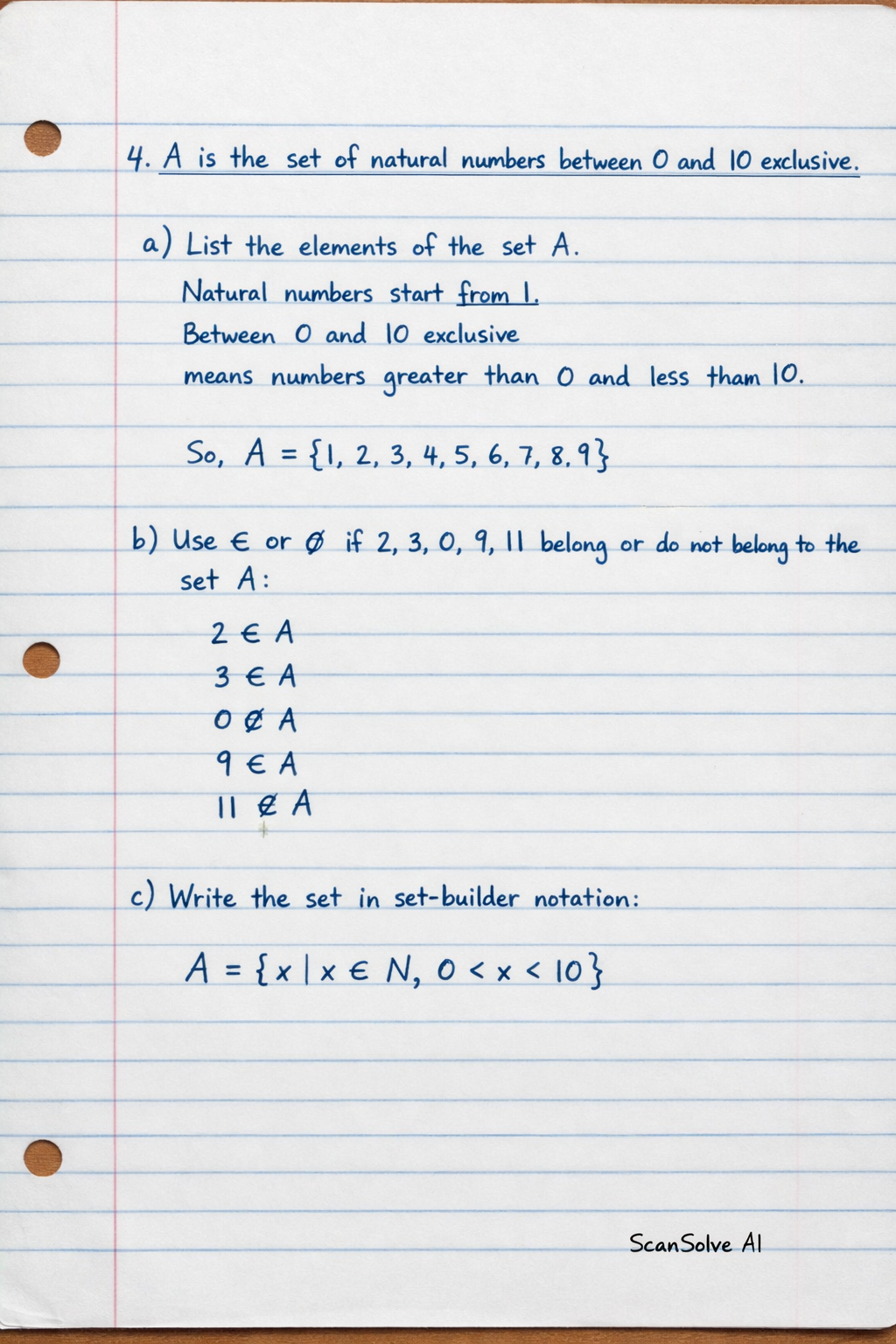
4. A is the set of natural numbers between 0 and 10 exclusive.
- a) List the elements of the set A. Natural numbers start from 1. "Between 0 and 10 exclusive" means numbers greater than 0 and less than 10.
- b) Use or if 2, 3, 0, 9, 11 belong or do not belong to the set A.
- c) Write the set in set-builder notation.
5. a) List the members of the following sets.
- A = {odd numbers from 0 to 10}
- B = {prime numbers between 10 and 24}
- C = {multiples of 7 between 6 and 50}
b) Which sets are equivalent among A, B and C? Equivalent sets have the same number of elements.
- Number of elements in A, .
- Number of elements in B, .
- Number of elements in C, . Sets A and B have the same number of elements. The equivalent sets are .
6. Given that , , , , and .
Assumption: The second definition of S, , overwrites the first definition .
So, the sets are: , , , , .
- a) Write down the number of elements in each set.
- b) Which of the sets are equal? Equal sets contain exactly the same elements. and contain the same elements. The equal sets are .
- c) Which of the sets have equal number of elements but the sets are not equal? From part (a), and . However, Q and S are equal sets. There are no other pairs of sets with an equal number of elements that are not themselves equal.
7.
- a) If and , all elements of A are also the elements of B, but again . Why? because set B contains an element 'e' that is not present in set A. For two sets to be equal, they must contain exactly the same elements.
- b) If and , why are P and Q not equal sets? But P is equivalent to Q. Why? P and Q are not equal sets because they do not contain the same elements (e.g., 'g' is in P but not in Q). They are equivalent sets because they have the same number of elements: and .
8. is a given set.
Write the following subsets of A (i) by listing (ii) by set-builder notation.
- a) B = Set of elements of A that are prime numbers
- (i)
- (ii)
- b) C = Set of elements of A that are even numbers
- (i)
- (ii)
- c) D = Set of elements of A that are odd numbers
- (i)
- (ii)
- d) E = Set of elements of A that are even prime numbers
- (i)
- (ii)
- e) F = Set of elements of A that are between 1 and 4
- (i)
- (ii) $F = \boxed{{x \mid x \in A and 1 <
Still stuck on this one?
Ask a follow-up, and the answer starts from this question.
More Mathematics Questions
Handwritten Step-by-Step Solution
Get this as a handwritten image on WhatsApp — like a tutor wrote it for you.
Try on WhatsApp