
We read your photo as:
Three numbers are in geometric progression. Their sum is 26 and their product is 216. Find the numbers.
ScanSolve AI Answer
Answer
Step-by-step solution
8 stepsIdentify the given information for the geometric progression.
Let the three terms of the geometric progression be , , and , where is the middle term and is the common ratio.
The sum of the first three terms is 26:The product of the first three terms is 216:
Solve for using the product equation.
Take the cube root of both sides:
Substitute the value of into the sum equation.
Substitute into equation :
Simplify and rearrange the equation to solve for .
Subtract 6 from both sides:
Multiply the entire equation by to eliminate the fraction:
Rearrange into a standard quadratic equation form :
Divide the entire equation by 2 to simplify:
Solve the quadratic equation for .
Factor the quadratic equation:
Set each factor to zero to find the possible values for :
The common ratio can be or 3.
The common ratio is .
Recall the difference of squares formula.
The difference of squares formula states that .
Substitute the given values into the formula.
We are given:
Substitute these values into the formula:
Solve for .
Divide both sides by 2:
The value of is .
Try one yourself
A new problem that tests the same skill.
Still stuck on this one?
Ask a follow-up, and the answer starts from this question.
More Mathematics Questions
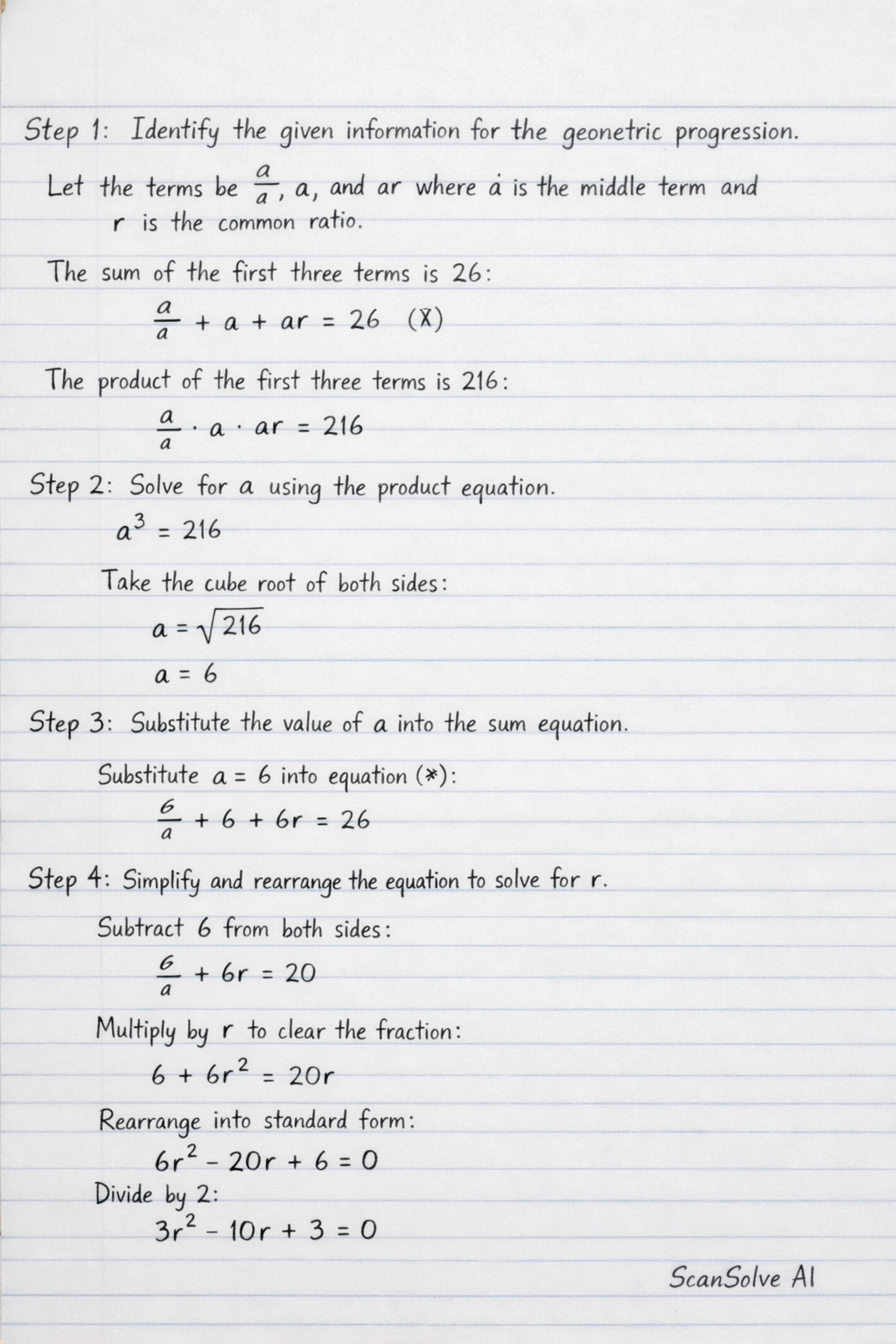
Handwritten Step-by-Step Solution
Get this as a handwritten image on WhatsApp — like a tutor wrote it for you.
Try on WhatsApp