
We read your photo as:
Three similar pieces of timber of length 240cm, 320cm, are cut into two equal pieces. Find the largest possible area of a square which can be made from any of the three pieces (3m)
ScanSolve AI Answer
Answer
Step-by-step solution
4 stepsHere is the solution to the timber problem:
1. Three similar pieces of timber of length 240cm, 320cm, are cut into two equal pieces. Find the largest possible area of a square which can be made from any of the three pieces (3m)
Determine the lengths of the timber pieces after they are cut.
Each original piece of timber is cut into two equal pieces.
For an original piece of length 240 cm:For an original piece of length 320 cm:
The problem implies we have pieces of these lengths available after cutting.
Calculate the side length of a square that can be made from each type of cut piece.
To form a square, four equal sides are needed. The perimeter of the square will be equal to the length of the timber piece used. If is the side length of the square, then .
For a 120 cm long piece:
For a 160 cm long piece:
Calculate the area of the square for each case.
The area of a square is given by the formula .
For the square made from a 120 cm piece:
For the square made from a 160 cm piece:
Determine the largest possible area.
Comparing the two possible areas, and , the largest possible area is .
Try one yourself
A new problem that tests the same skill.
Still stuck on this one?
Ask a follow-up, and the answer starts from this question.
More Mathematics Questions
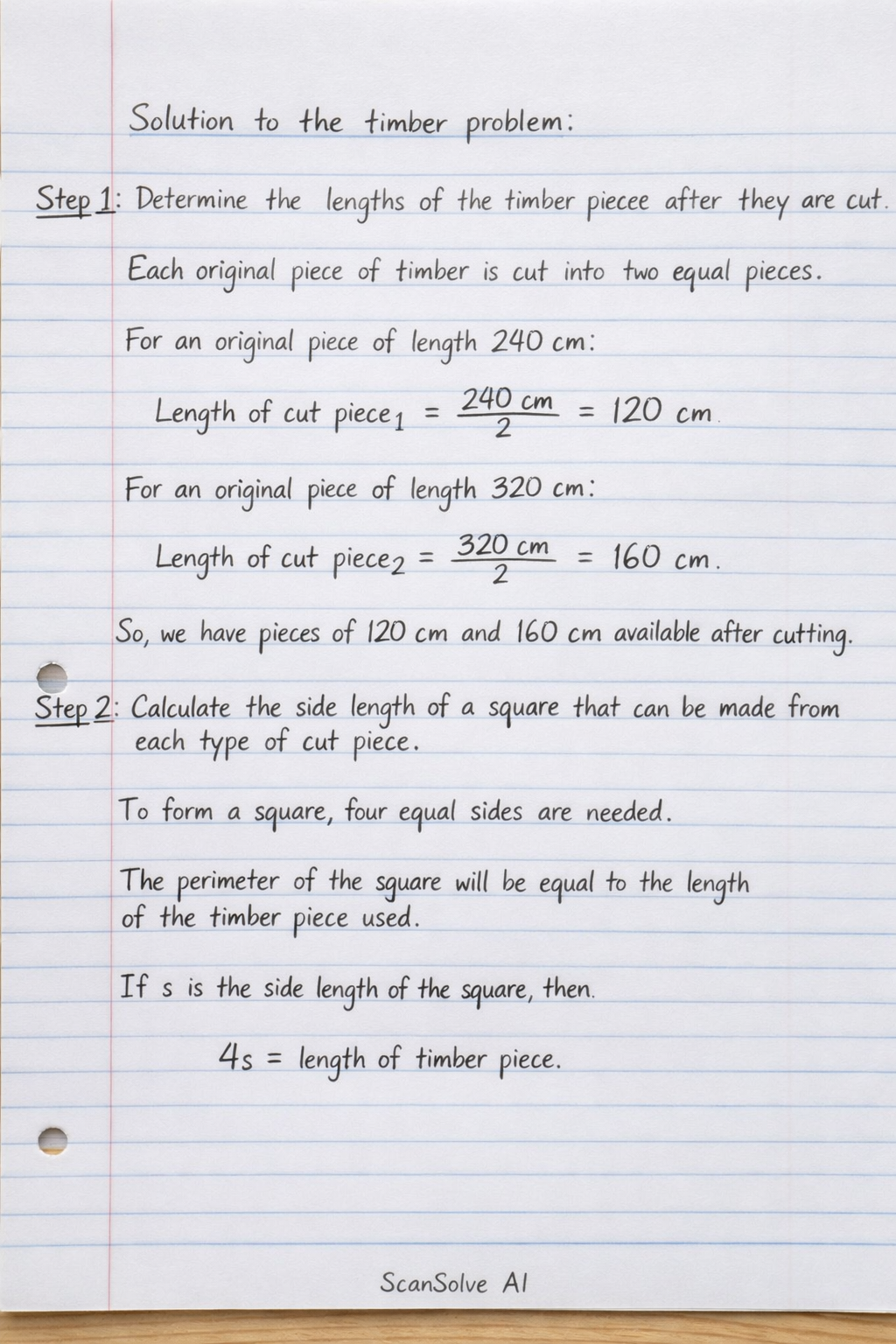
Handwritten Step-by-Step Solution
Get this as a handwritten image on WhatsApp — like a tutor wrote it for you.
Try on WhatsApp