
We read your photo as:
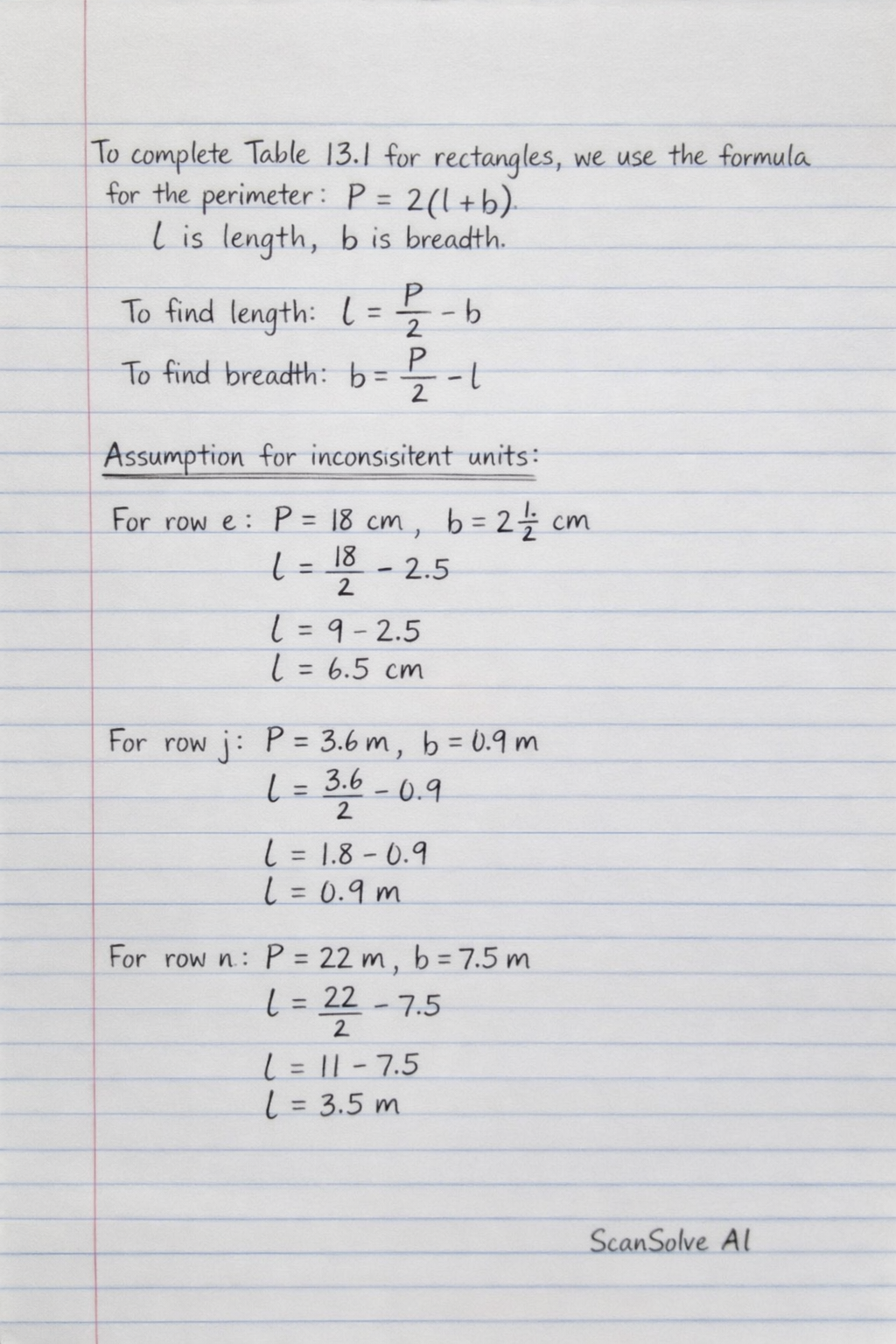
To complete Table 13.1 for rectangles, we use the formula for the perimeter of a rectangle: P = 2 x (l + b), where l is the length and b is the breadth. We will also use rearranged forms to
Mathematics
ScanSolve AI Answer
Step-by-step solution
3 stepsTo complete Table 13.1 for rectangles, we use the formula for the perimeter of a rectangle: , where is the length and is the breadth. We will also use rearranged forms to find length or breadth: and .
- Assumption for inconsistent units: For rows e, j, and n, where length and breadth or perimeter are given in different units (e.g., cm and m), we will assume consistency by converting the smaller unit to match the larger unit's context or by assuming a typo in the unit. Specifically:
- For row e, we assume breadth is instead of .
- For row j, we assume breadth is instead of .
- For row n, we assume breadth is instead of to match the perimeter's unit.
Calculate the perimeter for rows where length and breadth are given.
- a) ,
- b) ,
- c) ,
- d) ,
- e) , (assuming breadth is in cm)
- f) ,
- i) ,
- j) , (assuming breadth is in m)
Calculate the length for rows where breadth and perimeter are given.
- g) ,
- k) ,
- n) (assuming breadth is in m),
- o) ,
Calculate the breadth for rows where length and perimeter are given.
- h) ,
Was this helpful?
Still stuck on this one?
Ask a follow-up, and the answer starts from this question.
Got a different question?Ask your own question
More Mathematics Questions
QThe formula for the perimeter of a rectangle is P = 2(l + b).QThe homework involves calculating the area and width of rectangles and the area of a square given…QFormula of finding a perimeter of rectangleQTo calculate the simple area of a rectangle, we use the formula:QCalculate the areas of the following rectangles: a) Length = 21 cm, Breadth = 17 cm b) Length = 24…
Browse by topic:Geometry
Handwritten Step-by-Step Solution
Get this as a handwritten image on WhatsApp — like a tutor wrote it for you.
Try on WhatsApp