

This mathematics problem involves applying core mathematical principles and formulas. Below you will find a complete step-by-step solution with detailed explanations for each step, helping you understand not just the answer but the method behind it.
ScanSolve AI Answer
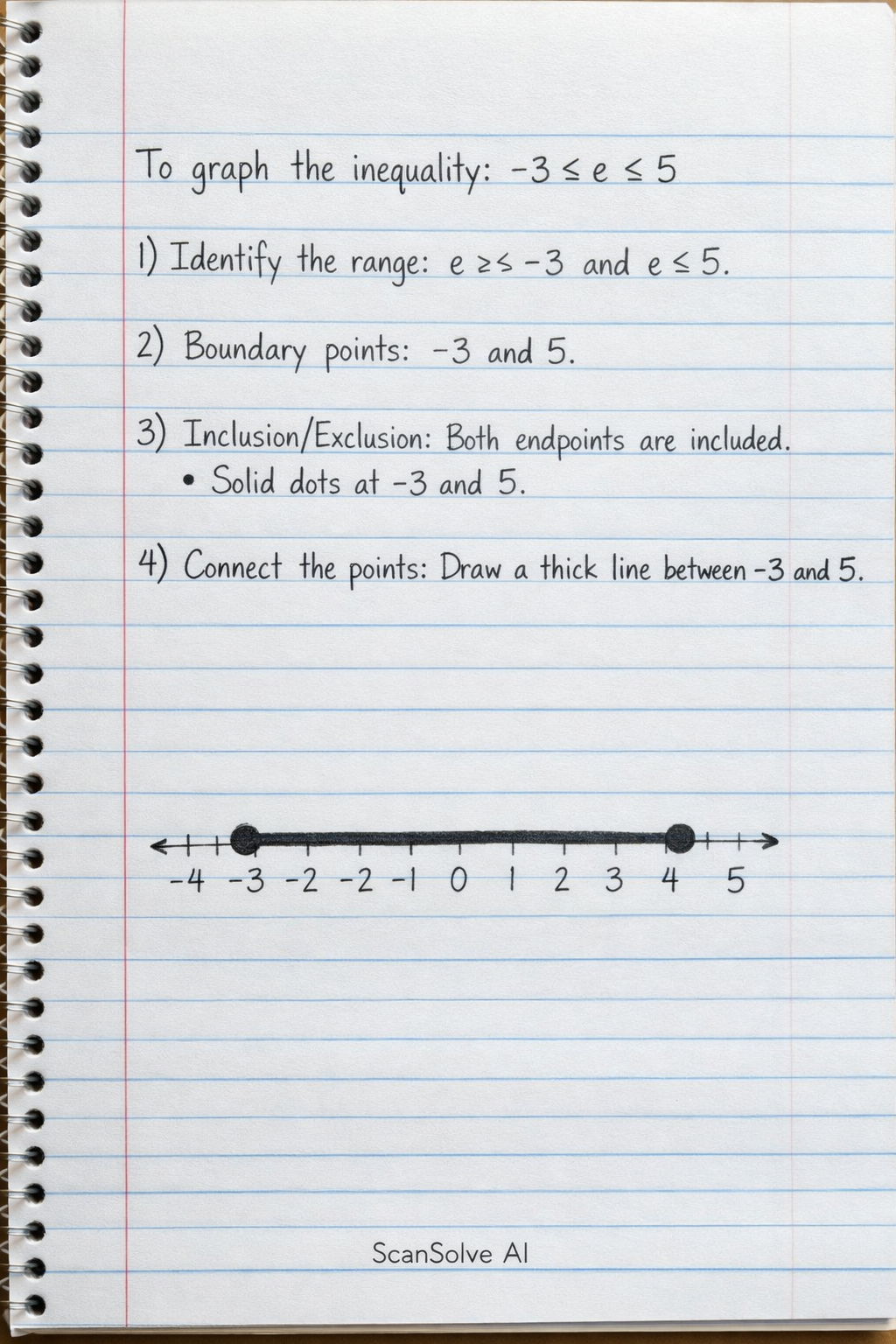
To represent the inequality -3 e 5 on a number line, where e is a real number: 1. Identify the range: The inequality states that e is greater than or equal to -3 and less than or equal to 5. 2. Boundary points: The boundary points are -3 and 5. 3. Inclusion/Exclusion: Since the inequality uses "" (less than or equal to) and "" (greater than or equal to), both -3 and 5 are included in the solution set. This is represented by solid dots at these points. 4. Connect the points: All real numbers between -3 and 5 (inclusive) satisfy the inequality. This is represented by a thick line segment connecting the solid dot at -3 and the solid dot at 5. Here is the description of the number line representation: Draw a number line. Place a solid dot at -3. Place a solid dot at 5. Draw a thick line segment connecting the solid dot at -3 and the solid dot at 5.