
We read your photo as:
Town B is 150 km on a bearing of 050° from town A. Town C is on a bearing of 110° from town A and 150° from town B. Town D is 240 km on a bearing of 320° from town A. Calculate distances and bearings
ScanSolve AI Answer
Answer
Step-by-step solution
3 stepsHere is the solution to question 47.
47. Town B is 150 km on a bearing of from town A. Another town C is on a bearing of from town A and on a bearing of from town B. A fourth town D is 240 km on a bearing of from town A. Without using a scale drawing, calculate to the nearest kilometre:
First, let's determine the angles within the triangles formed by towns A, B, C, and D.
Let N be the North direction from town A.
- Bearing of B from A is . So, .
- Bearing of C from A is . So, .
- Bearing of D from A is . So, .
From these, we can find the angles at A:
Alternatively, . The interior angle is .
Now, let's find the angle .
Draw a North line at B, parallel to the North line at A.
The alternate interior angle to is the angle between the North line at B and the line BA (pointing towards A). So, .
The bearing of C from B is . This means the angle from the North line at B, clockwise to BC, is . So, .
In , we have:
km
The third angle .
Part a· 2 steps
The distance AC
Use the Sine Rule in to find AC.
Solve for AC.
Rounding to the nearest kilometre:
The distance AC is .
Part b· 1 step
The distance CD
Consider $\triangle
Try one yourself
A new problem that tests the same skill.
Still stuck on this one?
Ask a follow-up, and the answer starts from this question.
More Mathematics Questions
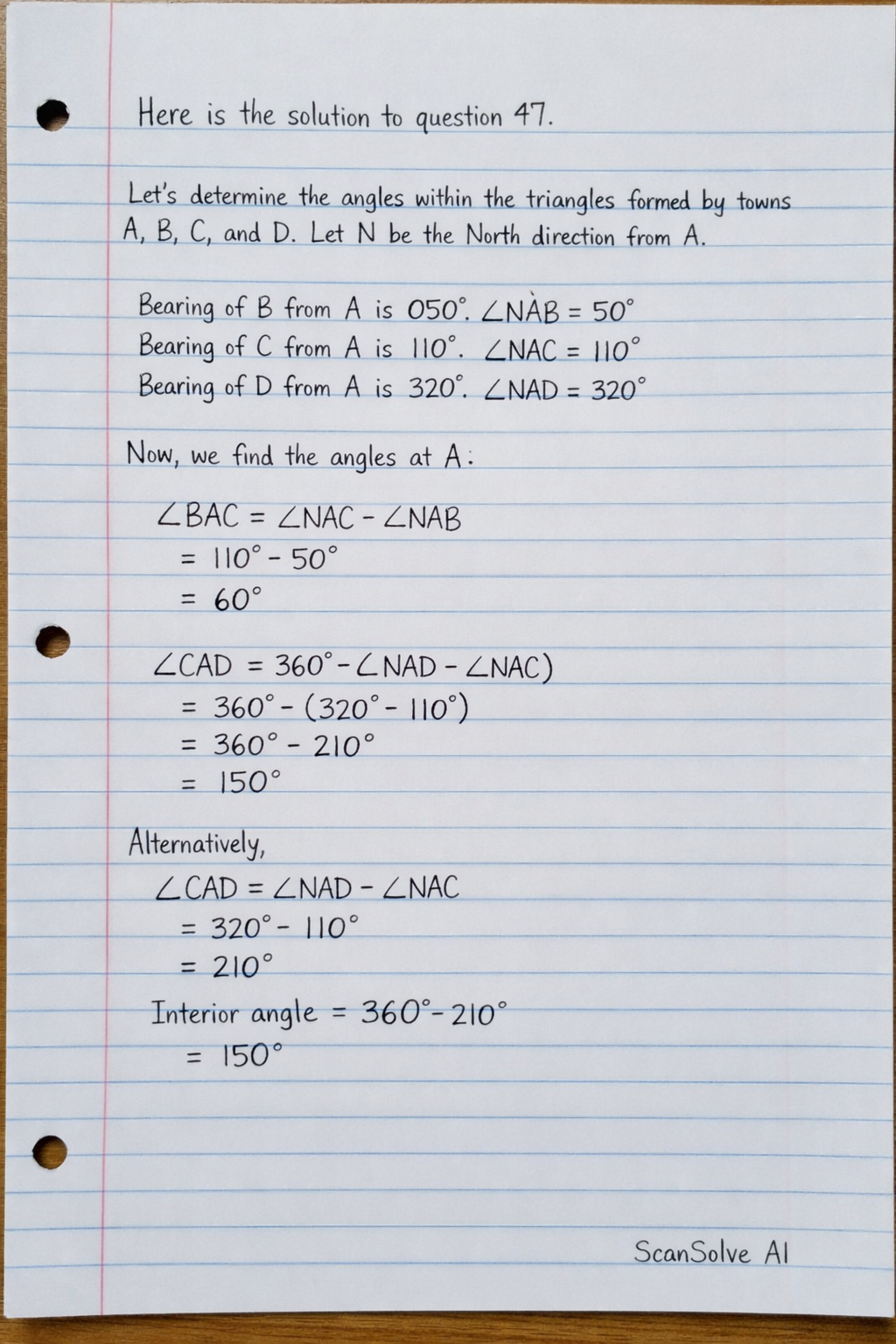
Handwritten Step-by-Step Solution
Get this as a handwritten image on WhatsApp — like a tutor wrote it for you.
Try on WhatsApp