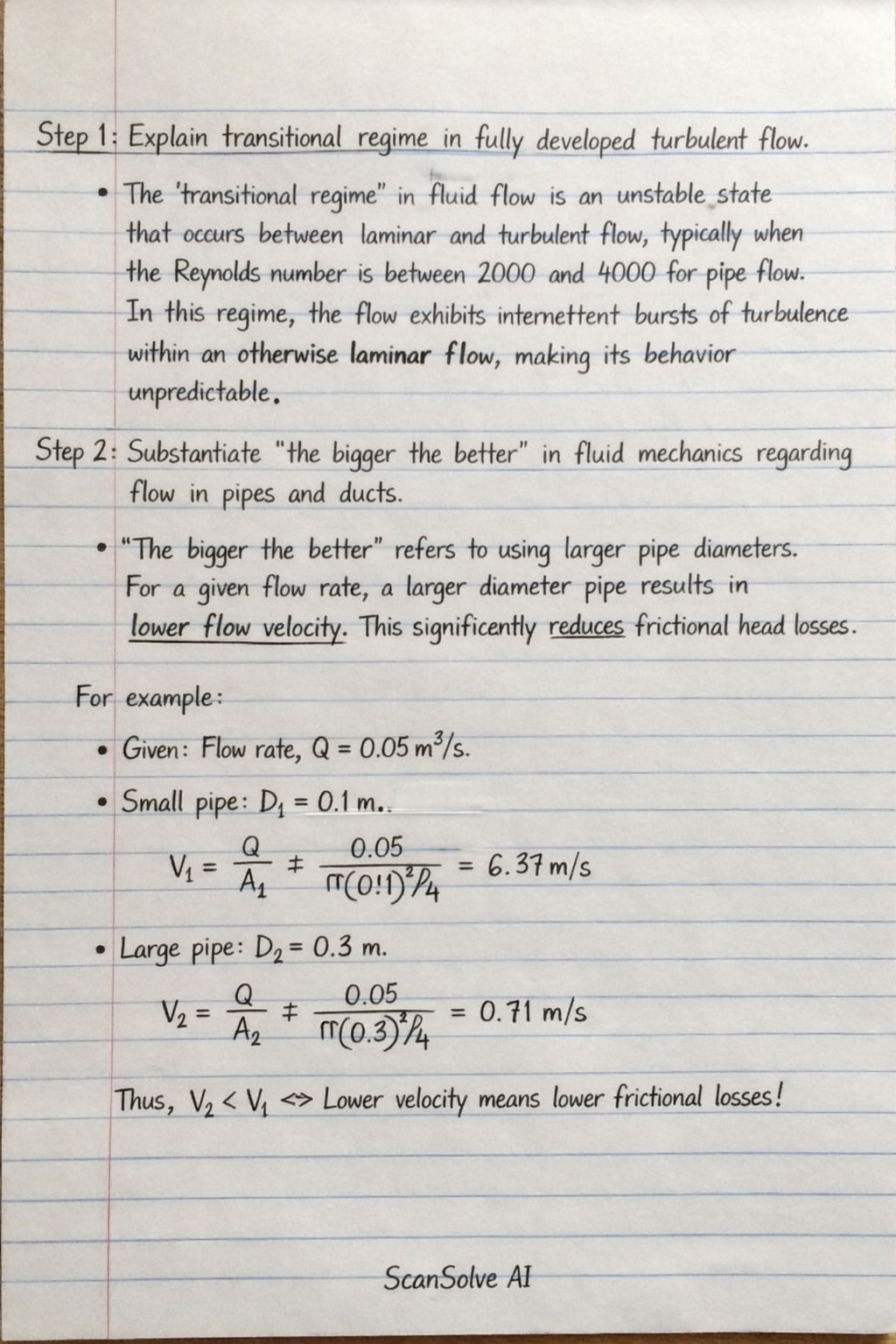
This physics problem tests your understanding of fundamental physical laws and their applications. The step-by-step solution below breaks down the problem using relevant equations and physical reasoning.
Explain "transitional regime" in fluid mechanics, analyze the slogan "the bigger the better" for fluid flow, and solve an irrigation system problem involving pressure, flow rate, and cost.
Physics

ScanSolve AI Answer
Step 1: Explain transitional regime in fully developed turbulent flow.
- The transitional regime in fluid flow is an unstable state that occurs between laminar and turbulent flow, typically when the Reynolds number is between 2000 and 4000 for pipe flow. In this regime, the flow exhibits intermittent bursts of turbulence within an otherwise laminar flow, making its behavior unpredictable.
Step 2: Substantiate "the bigger the better" in fluid mechanics regarding flow in pipes and ducts.
- "The bigger the better" refers to using larger pipe diameters. For a given flow rate, a larger diameter pipe results in lower flow velocity. This significantly reduces frictional head losses (which are proportional to and inversely proportional to $
Was this helpful?
Need help with your own homework?
Get instant step-by-step solutions to any question. Free to start.
Ask Your Question
Handwritten Step-by-Step Solution
Get this as a handwritten image on WhatsApp — like a tutor wrote it for you.
Try on WhatsAppMore Physics Questions
Still have questions?
Quick Answer
Explain transitional regime in fully developed turbulent flow. The transitional regime* in fluid flow is an unstable state that occurs between laminar and turbulent flow, typically when the Reynolds number is between 2000 and 4000 for pipe flow.
ScanSolve AI Answer
Step 1: Explain transitional regime in fully developed turbulent flow. The transitional regime* in fluid flow is an unstable state that occurs between laminar and turbulent flow, typically when the Reynolds number is between 2000 and 4000 for pipe flow. In this regime, the flow exhibits intermittent bursts of turbulence within an otherwise laminar flow, making its behavior unpredictable. Step 2: Substantiate "the bigger the better" in fluid mechanics regarding flow in pipes and ducts. "The bigger the better" refers to using larger pipe diameters. For a given flow rate, a larger diameter pipe results in lower flow velocity. This significantly reduces frictional head losses* (which are proportional to V^2 and inversely proportional to $