Translate ABC using the vector -3 1 to obtain A'B'C'.
|Mathematics
Translate ABC using the vector -3 1 to obtain A'B'C'.
ScanSolve AI Answer
Answer
△A′′′B′′′C′′′ has the same perimeter as △ABC
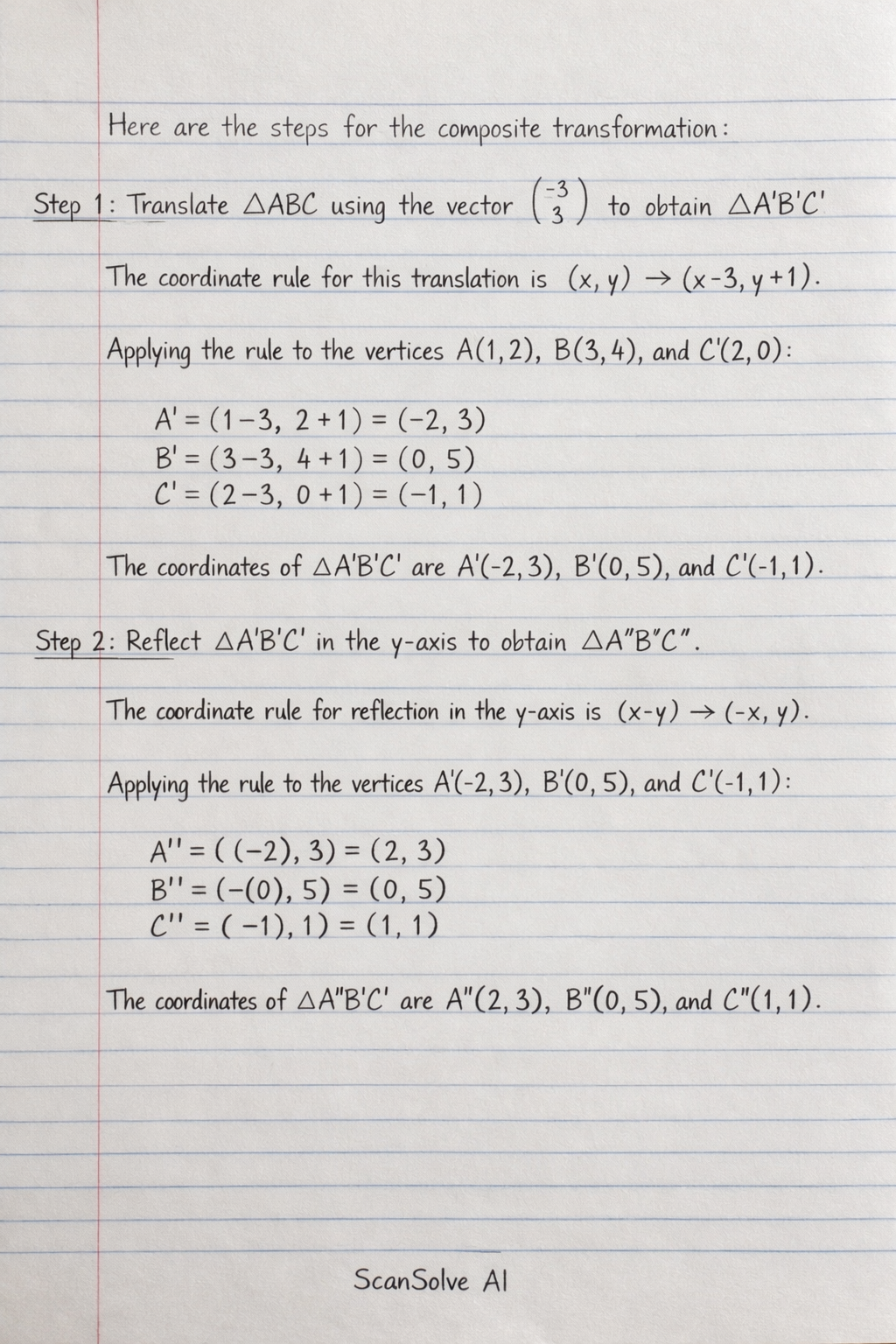
Here are the steps for the composite transformation:
Step 1: Translate △ABC using the vector (−31) to obtain △A′B′C′.
The coordinate rule for this translation is (x,y)→(x−3,y+1).
Applying the rule to the vertices A(1,2), B(3,4), and C(2,0):
A′=(1−3,2+1)=(−2,3)B′=(3−3,4+1)=(0,5)C′=(2−3,0+1)=(−1,1)
The coordinates of △A′B′C′ are A′(−2,3), B′(0,5), and C′(−1,1).
Step 2: Reflect △A′B′C′ in the y-axis to obtain △A′′B′′C′′.
The coordinate rule for reflection in the y-axis is (x,y)→(−x,y).
Applying the rule to the vertices A′(−2,3), B′(0,5), and C′(−1,1):
A′′=(−(−2),3)=(2,3)B′′=(−(0),5)=(0,5)C′′=(−(−1),1)=(1,1)
The coordinates of △A′′B′′C′′ are A′′(2,3), B′′(0,5), and C′′(1,1).
Step 3: Rotate △A′′B′′C′′ through 90∘ anticlockwise about the origin to obtain △A′′′B′′′C′′′.
The coordinate rule for a 90∘ anticlockwise rotation about the origin is (x,y)→(−y,x).
Applying the rule to the vertices A′′(2,3), B′′(0,5), and C′′(1,1):
A′′′=(−(3),2)=(−3,2)B′′′=(−(5),0)=(−5,0)C′′′=(−(1),1)=(−1,1)
The coordinates of △A′′′B′′′C′′′ are A′′′(−3,2), B′′′(−5,0), and C′′′(−1,1).
Step 4: Enlarge △A′′′B′′′C′′′ with a scale factor of k=2 centred at the origin to obtain △A′′′′B′′′′C′′′′.
The coordinate rule for enlargement with scale factor k=2 centred at the origin is (x,y)→(2x,2y).
Applying the rule to the vertices A′′′(−3,2), B′′′(−5,0), and C′′′(−1,1):
A′′′′=(2×−3,2×2)=(−6,4)B′′′′=(2×−5,2×0)=(−10,0)C′′′′=(2×−1,2×1)=(−2,2)
The coordinates of △A′′′′B′′′′C′′′′ are A′′′′(−6,4), B′′′′(−10,0), and C′′′′(−2,2).
To create the labeled graph, plot the original triangle ABC and all the transformed images A′B′C′, A′′B′′C′′, A′′′B′′′C′′′, and A′′′′B′′′′C′′′′ using the coordinates calculated above on a coordinate plane.
Step 5: Compare the perimeter of △ABC and △A′′′′B′′′′C′′′′.
First, calculate the side lengths of △ABC using the distance formula d=(x2−x1)2+(y2−y1)2:
AB=(3−1)2+(4−2)2=22+22=4+4=8BC=(2−3)2+(0−4)2=(−1)2+(−4)2=1+16=17CA=(1−2)2+(2−0)2=(−1)2+22=1+4=5
The perimeter of △ABC is PABC=AB+BC+CA=8+17+5.
The final transformation from △A′′′B′′′C′′′ to △A′′′′B′′′′C′′′′ is an enlargement with a scale factor of k=2. All previous transformations (translation, reflection, rotation) are rigid transformations, meaning they preserve length and shape. Therefore, △A′′′B′′′C′′′ has the same perimeter as △ABC.
When a shape is enlarged by a scale factor k, its perimeter is multiplied by k.
So, the perimeter of △A′′′′B′′′′C′′′′ is k times the perimeter of △ABC.
Was this helpful?
Need help with your own homework?
Get instant step-by-step solutions to any question. Free to start.
This mathematics problem involves applying core mathematical principles and formulas. Below you will find a complete step-by-step solution with detailed explanations for each step, helping you understand not just the answer but the method behind it.
ScanSolve AI Answer
Here are the steps for the composite transformation: Step 1: Translate ABC using the vector -3 \\ 1 to obtain A'B'C'. The coordinate rule for this translation is (x, y) (x-3, y+1). Applying the rule to the vertices A(1, 2), B(3, 4), and C(2, 0): A' = (1-3, 2+1) = (-2, 3) B' = (3-3, 4+1) = (0, 5) C' = (2-3, 0+1) = (-1, 1) The coordinates of A'B'C' are A'(-2, 3), B'(0, 5), and C'(-1, 1). Step 2: Reflect A'B'C' in the y-axis to obtain A''B''C''. The coordinate rule for reflection in the y-axis is (x, y) (-x, y). Applying the rule to the vertices A'(-2, 3), B'(0, 5), and C'(-1, 1): A'' = (-(-2), 3) = (2, 3) B'' = (-(0), 5) = (0, 5) C'' = (-(-1), 1) = (1, 1) The coordinates of A''B''C'' are A''(2, 3), B''(0, 5), and C''(1, 1). Step 3: Rotate A''B''C'' through 90^ anticlockwise about the origin to obtain A'''B'''C'''. The coordinate rule for a 90^ anticlockwise rotation about the origin is (x, y) (-y, x). Applying the rule to the vertices A''(2, 3), B''(0, 5), and C''(1, 1): A''' = (-(3), 2) = (-3, 2) B''' = (-(5), 0) = (-5, 0) C''' = (-(1), 1) = (-1, 1) The coordinates of A'''B'''C''' are A'''(-3, 2), B'''(-5, 0), and C'''(-1, 1). Step 4: Enlarge A'''B'''C''' with a scale factor of k=2 centred at the origin to obtain A''''B''''C''''. The coordinate rule for enlargement with scale factor k=2 centred at the origin is (x, y) (2x, 2y). Applying the rule to the vertices A'''(-3, 2), B'''(-5, 0), and C'''(-1, 1): A'''' = (2 × -3, 2 × 2) = (-6, 4) B'''' = (2 × -5, 2 × 0) = (-10, 0) C'''' = (2 × -1, 2 × 1) = (-2, 2) The coordinates of A''''B''''C'''' are A''''(-6, 4), B''''(-10, 0), and C''''(-2, 2). To create the labeled graph, plot the original triangle ABC and all the transformed images A'B'C', A''B''C'', A'''B'''C''', and A''''B''''C'''' using the coordinates calculated above on a coordinate plane. Step 5: Compare the perimeter of ABC and A''''B''''C''''. First, calculate the side lengths of ABC using the distance formula d = sqrt((x_2-x_1)^2 + (y_2-y_1)^2): AB = sqrt((3-1)^2 + (4-2)^2) = sqrt(2^2 + 2^2) = sqrt(4+4) = sqrt(8) BC = sqrt((2-3)^2 + (0-4)^2) = sqrt((-1)^2 + (-4)^2) = sqrt(1+16) = sqrt(17) CA = sqrt((1-2)^2 + (2-0)^2) = sqrt((-1)^2 + 2^2) = sqrt(1+4) = sqrt(5) The perimeter of ABC is P_ABC = AB + BC + CA = sqrt(8) + sqrt(17) + sqrt(5). The final transformation from A'''B'''C''' to A''''B''''C'''' is an enlargement with a scale factor of k=2. All previous transformations (translation, reflection, rotation) are rigid transformations, meaning they preserve length and shape. Therefore, A'''B'''C''' has the same perimeter as ABC. When a shape is enlarged by a scale factor k, its perimeter is multiplied by k. So, the perimeter of A''''B''''C'''' is k times the perimeter of ABC. P_A''''B