
We read your photo as:
Triangle KLM is similar to triangle LRS where angle K corresponds to angle Q and where angles L and R are right angles. If sin K = 105/233 and sin M = 203/233, what is the value of tan S?
ScanSolve AI Answer
Step-by-step solution
22 stepsHere are the solutions to your questions:
8. Triangle KLM is similar to triangle QRS where angle K corresponds to angle Q and where angles L and R are right angles. If and , what is the value of ?
Understand similar triangles and angle relationships.
Since , their corresponding angles are equal. This means , , and . We are given that and . In a right-angled triangle, the sum of the two acute angles is , so .
Use the given sine values to find the sides of .
Let the sides opposite to angles K, L, M be respectively.
In , .
We are given . In a right triangle, .
So, we can assume and (or a multiple thereof).
We are also given . In a right triangle, .
This implies and .
These values are consistent: , , .Verify with the Pythagorean theorem.
Check if :
.
.
The side lengths are consistent with a right triangle.Calculate .
The tangent of angle M is .
Determine .
Since , we have .
The value of is .
9. In the diagram, is similar to , with corresponding to and corresponding to . Which of the following must be true?
The options are: A) , B) , C) , D) .Interpret the similarity statement.
Given . This means their corresponding angles are equal:
- (These are vertically opposite angles, which are always equal, confirming the similarity).
Analyze the relationship between lines AB and DE.
Consider lines AB and DE intersected by the transversal line BD.
The angles and are alternate interior angles.
From the similarity, we know that .Apply the property of parallel lines.
If alternate interior angles formed by a transversal intersecting two lines are equal, then the two lines are parallel.
Since , it implies that line AB is parallel to line DE.Select the correct option.
The statement that must be true is .
The correct option is .10. If arc FG is congruent to arc GH and the measure of is , what is the measure of ?
Understand the properties of congruent arcs in a circle.
If two arcs in a circle are congruent (arc FG arc GH), then the chords that subtend these arcs are equal in length. So, chord FG = chord GH.
Identify the type of triangle.
Since chord FG = chord GH, is an isosceles triangle.
Apply properties of isosceles triangles.
In an isosceles triangle, the angles opposite the equal sides are equal. The angle opposite side FG is , and the angle opposite side GH is . Therefore, .
Use the sum of angles in a triangle.
The sum of the interior angles of any triangle is .
Substitute and the given :
Solve for .
The measure of is .
11. Triangle ABC is a right triangle and . What is the length of side BC?
The diagram shows a right triangle ABC, with the right angle at C. The hypotenuse AB has a length of 26.Use the definition of sine in a right triangle.
In a right triangle, .
For angle B, the opposite side is AC and the hypotenuse is AB.
So, .Substitute the given values and solve for AC.
We are given and .
Multiply both sides by 26:
Use the Pythagorean theorem to find BC.
In a right triangle, .
Substitute the known values and :Solve for BC.
The length of side BC is .
12. All the dimensions shown are for the interior of the triangle. What is the value of ?
The diagram shows an isosceles triangle with two equal sides of and a base of . The base angles are labeled .Draw an altitude to create right triangles.
Draw an altitude from the apex (the vertex between the two equal sides) to the base. In an isosceles triangle, this altitude bisects the base and forms two congruent right-angled triangles.
Determine the lengths of the sides of one right triangle.
The hypotenuse of each right triangle is one of the equal sides of the isosceles triangle, which is .
The base of each right triangle is half of the isosceles triangle's base: .
The angle is one of the acute angles in this right triangle.Use the definition of cosine in a right triangle.
In a right triangle, .
For angle , the adjacent side is and the hypotenuse is .Simplify the fraction.
The value of is .
Still stuck on this one?
Ask a follow-up, and the answer starts from this question.
More Mathematics Questions
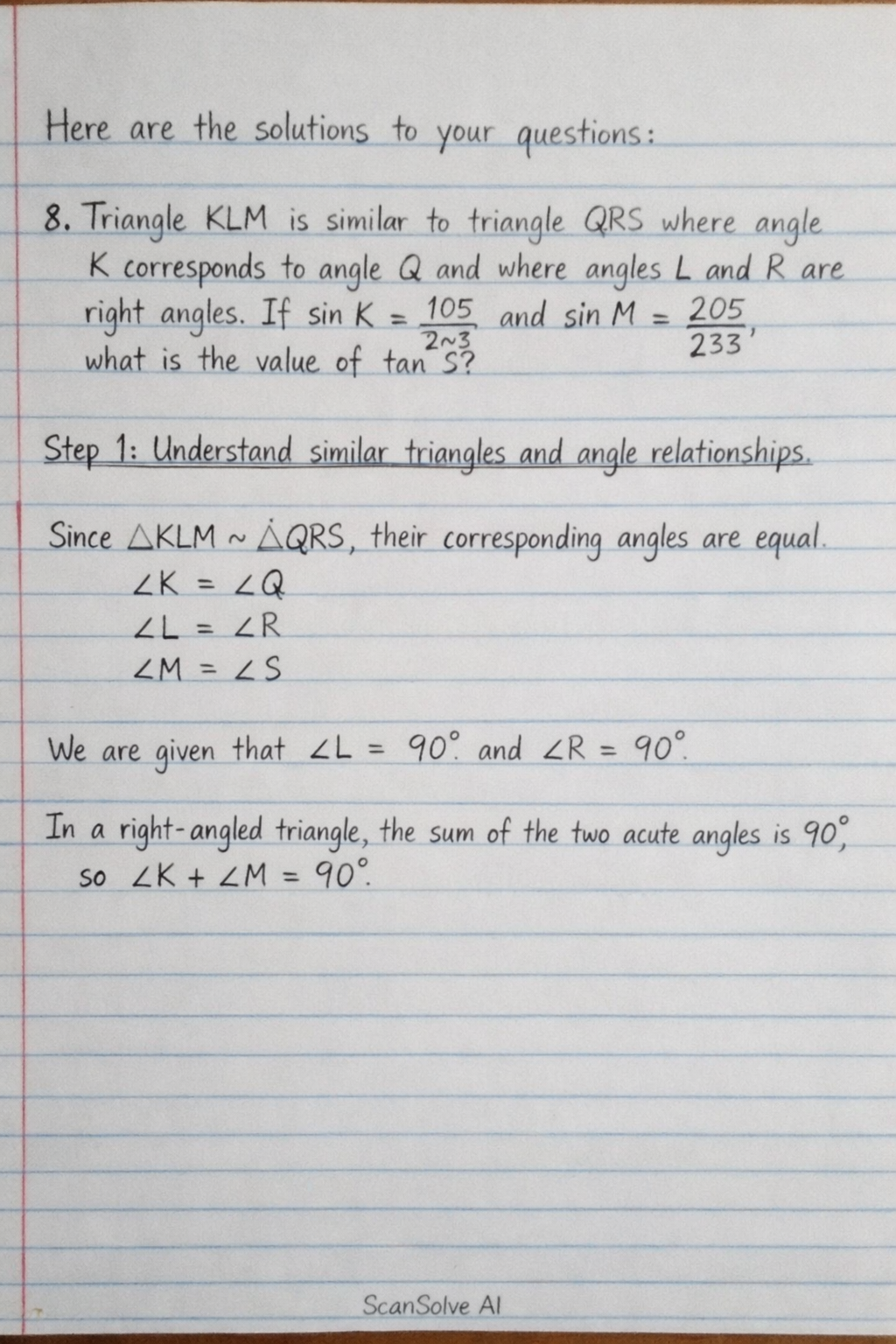
Handwritten Step-by-Step Solution
Get this as a handwritten image on WhatsApp — like a tutor wrote it for you.
Try on WhatsApp