
We read your photo as:
Find two consecutive even numbers that sum to 270. Also, describe the region R defined by x >= -1, 3y - x >= -5, and 3x + 5y < 15.
ScanSolve AI Answer
Answer
Step-by-step solution
13 steps:
Define the numbers.
Let the first even number be .
Since the numbers are consecutive even numbers, the next even number is .Set up the equation.
The sum of the two numbers is 270:
Solve for .
Find the two numbers.
The first number is .
The second number is .The two consecutive even numbers are .
:
To draw and label the region R, we first need to draw the boundary lines for each inequality.Draw the line for .
The boundary line is . This is a solid vertical line passing through .
The region is to the right of this line.Draw the line for .
The boundary line is . This is a solid line.
To draw it, find two points:- If , . Point: .
- If , . Point: . Plot these points and draw a solid line through them. To determine the region, test a point, e.g., : , which is true. So, the region is above the line (containing the origin).
Draw the line for .
The boundary line is . This is a dashed line because of the strict inequality .
To draw it, find two points:- If , . Point: .
- If , . Point: . Plot these points and draw a dashed line through them. To determine the region, test a point, e.g., : , which is true. So, the region is below the line (containing the origin).
Identify and label region R.
Region R is the area where all three shaded regions overlap. It will be a triangular region bounded by the lines , , and .
- The region is to the right of .
- The region is above .
- The region is below . Shade this common region and label it R.
:
Set up initial number of members.
Let the original number of males be and females be .
The ratio of males to females is 2:3.This means and for some constant .
Account for changes on Tuesday.
On Tuesday:
- Ten males were absent, so the number of males present is .
- Six new female members joined, so the number of females present is .
Set up the new ratio equation.
On Tuesday, the ratio of males to females was 1:3.
Solve for .
Cross-multiply:
Subtract from both sides:
Add 30 to both sides:
Divide by 3:
Calculate the original number of regular members.
Original number of males .
Original number of females .
The total number of regular members is .The group has .
Try one yourself
A new problem that tests the same skill.
Still stuck on this one?
Ask a follow-up, and the answer starts from this question.
More Mathematics Questions
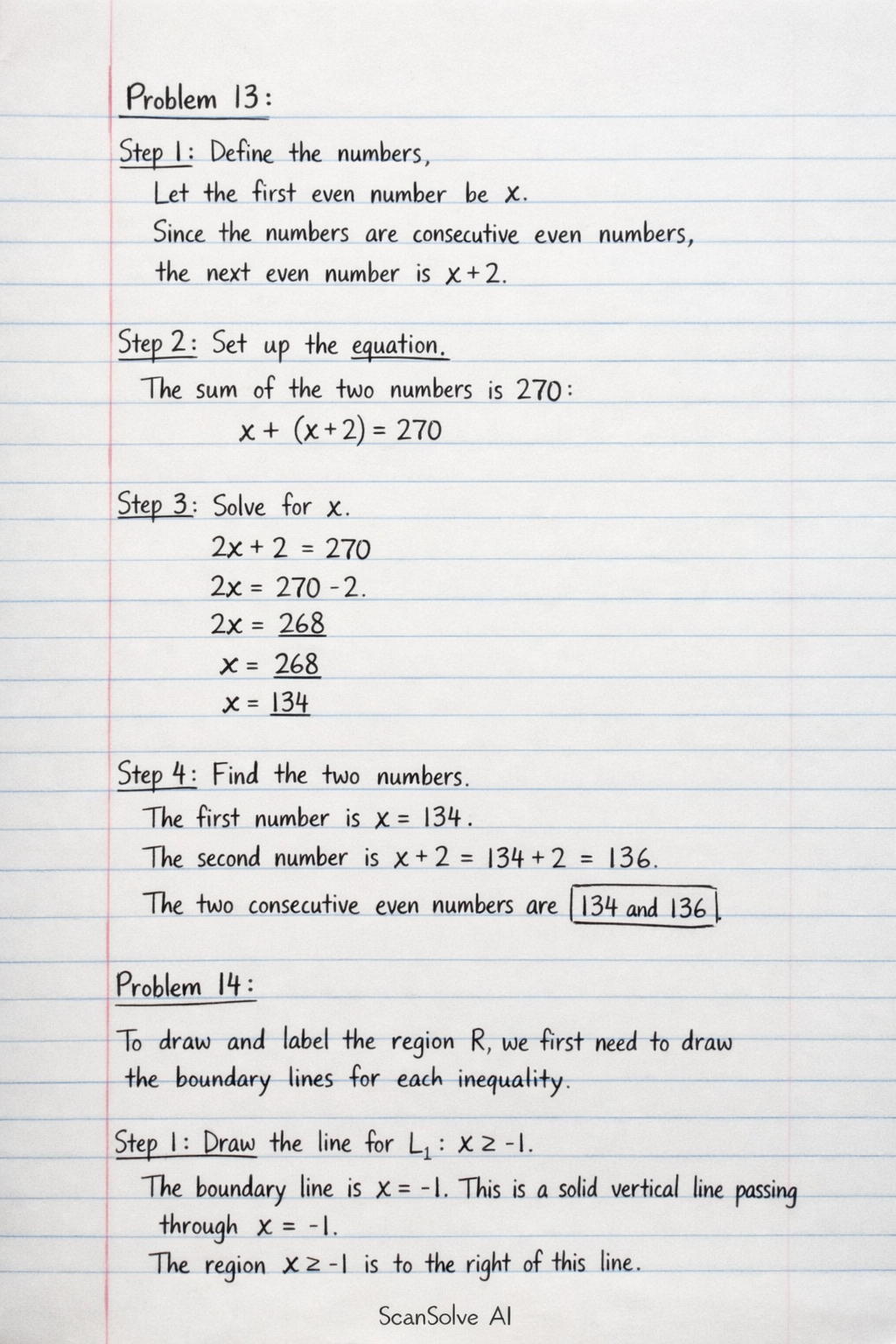
Handwritten Step-by-Step Solution
Get this as a handwritten image on WhatsApp — like a tutor wrote it for you.
Try on WhatsApp