
We read your photo as:
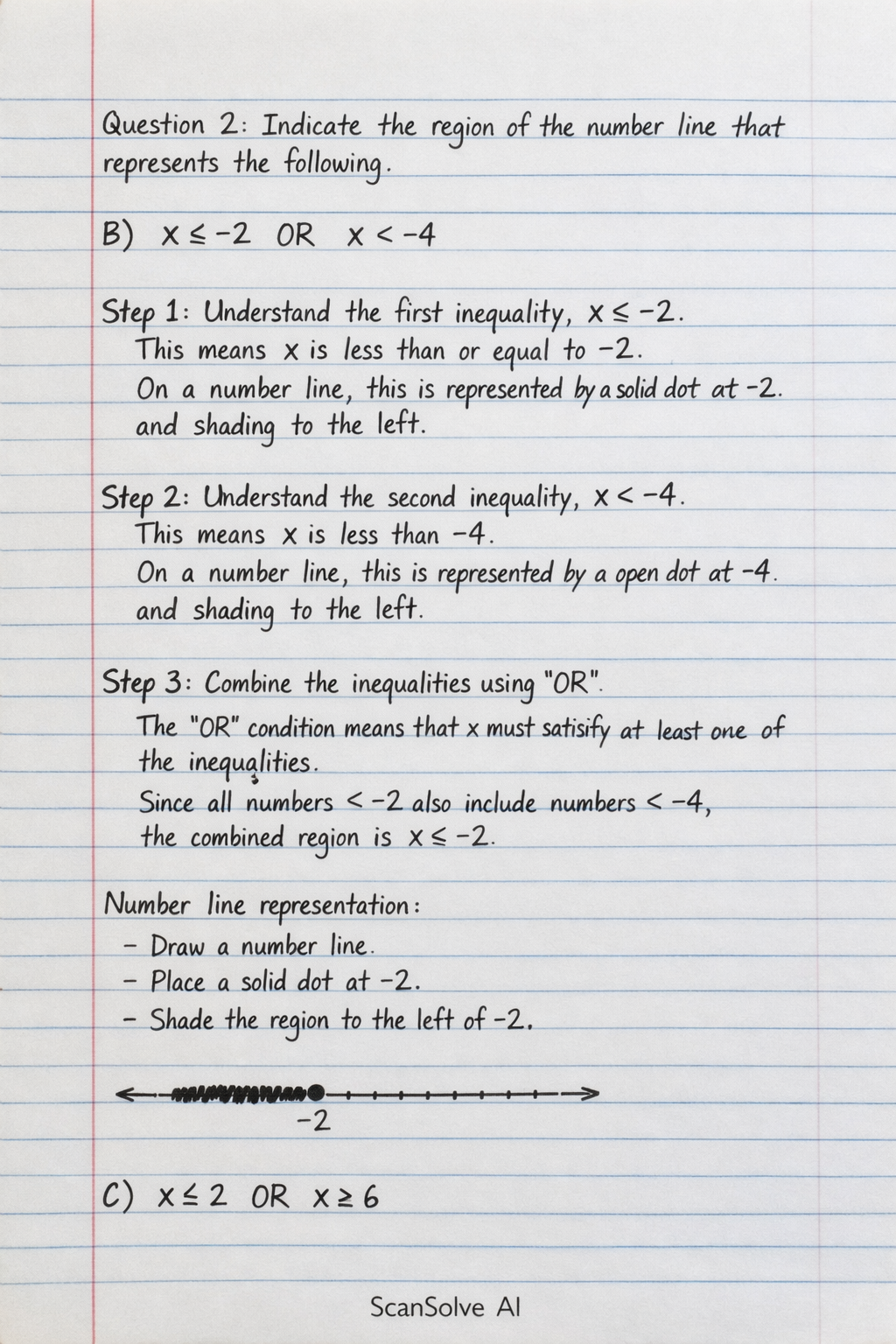
Indicate the region of the number line that represents the following: B) x <= -2 OR x < -4; C) x <= 2 OR x >= 6
ScanSolve AI Answer
Step-by-step solution
12 stepshere are the number line representations for the remaining parts of Question 2:
Indicate the region of the number line that represents the following.
B) OR
Understand the first inequality, .
This means is less than or equal to -2. On a number line, this is represented by a solid dot at -2 and shading to the left.
Understand the second inequality, .
This means is less than -4. On a number line, this is represented by an open dot at -4 and shading to the left.
Combine the inequalities using "OR".
The "OR" condition means that must satisfy at least one of the inequalities. Since all numbers less than or equal to -2 also include numbers less than -4, the combined region is .
Number line representation:
Draw a number line. Place a solid dot (•) at -2. Shade the region to the left of -2.C) OR
Understand the first inequality, .
This means is less than or equal to 2. On a number line, this is represented by a solid dot at 2 and shading to the left.
Understand the second inequality, .
This means is greater than or equal to 6. On a number line, this is represented by a solid dot at 6 and shading to the right.
Combine the inequalities using "OR".
The "OR" condition means that must satisfy at least one of the inequalities. These are two separate regions.
Number line representation:
Draw a number line. Place a solid dot (•) at 2 and shade to the left. Place a solid dot (•) at 6 and shade to the right.D) AND
Understand the first inequality, .
This means is less than -2. On a number line, this is represented by an open dot at -2 and shading to the left.
Understand the second inequality, .
This means is greater than or equal to -7. On a number line, this is represented by a solid dot at -7 and shading to the right.
Combine the inequalities using "AND".
The "AND" condition means that must satisfy both inequalities simultaneously. The region where both are true is between -7 (inclusive) and -2 (exclusive).
Number line representation:
Draw a number line. Place a solid dot (•) at -7. Place an open dot (○) at -2. Shade the region between -7 and -2.E) OR
Understand the first inequality, .
This means is greater than or equal to 0. On a number line, this is represented by a solid dot at 0 and shading to the right.
Understand the second inequality, .
This means is less than or equal to -6. On a number line, this is represented by a solid dot at -6 and shading to the left.
Combine the inequalities using "OR".
The "OR" condition means that must satisfy at least one of the inequalities. These are two separate regions.
Number line representation:
Draw a number line. Place a solid dot (•) at -6 and shade to the left. Place a solid dot (•) at 0 and shade to the right.
Still stuck on this one?
Ask a follow-up, and the answer starts from this question.
More Mathematics Questions
Handwritten Step-by-Step Solution
Get this as a handwritten image on WhatsApp — like a tutor wrote it for you.
Try on WhatsApp