
We read your photo as:
Find two consecutive integers whose squares sum to 61.
ScanSolve AI Answer
Step-by-step solution
15 stepsDefine the two consecutive integers.
Let the first integer be .
The next consecutive integer is .Set up the equation based on the given information.
The sum of their squares is 61.
Expand and simplify the equation.
Subtract 61 from both sides:
Divide the entire equation by 2.
Solve the quadratic equation by factoring.
We need two numbers that multiply to -30 and add to 1. These numbers are 6 and -5.
Find the possible values for .
Set each factor to zero:
Determine the pairs of consecutive integers.
If , the integers are 5 and .
Check: .If , the integers are and .
Check: .The two integers are either or .
Define the dimensions of the rectangle.
Let the length of the rectangle be cm.
The width is 6 cm shorter than the length, so the width cm.Use the given area to form an equation.
The area of a rectangle is given by .
Given .Expand and simplify the equation.
Rearrange into a standard quadratic form:
Solve the quadratic equation for .
We need two numbers that multiply to -27 and add to -6. These numbers are -9 and 3.
Find the possible values for .
Set each factor to zero:
Choose the valid length.
Since length cannot be negative, we take cm.
Calculate the width.
Calculate the perimeter of the rectangle.
The perimeter of a rectangle is given by .
The perimeter of the rectangle is .
Still stuck on this one?
Ask a follow-up, and the answer starts from this question.
More Mathematics Questions
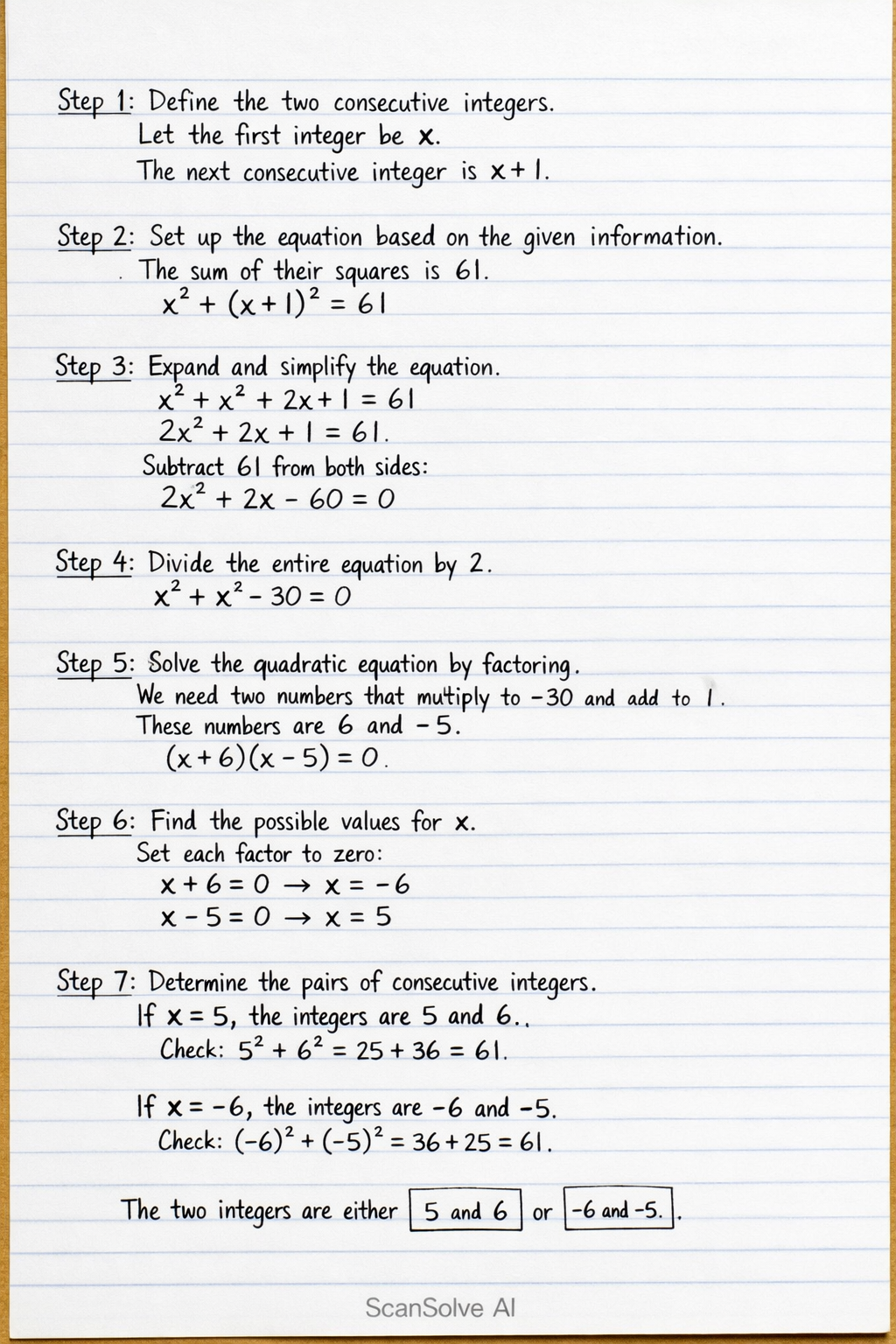
Handwritten Step-by-Step Solution
Get this as a handwritten image on WhatsApp — like a tutor wrote it for you.
Try on WhatsApp