
We read your photo as:
Two similar cones have radii in the ratio 2:5. a) Find the ratio of their volumes. b) If the volume of the larger cone is 25 cm3, what is the volume of the smaller cone?
ScanSolve AI Answer
Step-by-step solution
13 stepsHere are the solutions to questions 3, 8, 9, and 14.
Question 3:
a) Find the ratio of their volumes.
b) If the volume of the larger cone is , what is the volume of the smaller cone?
Determine the relationship between the ratio of radii and the ratio of volumes for similar cones.
For similar figures, if the ratio of corresponding lengths (like radii) is , then the ratio of their volumes is .
Given the ratio of radii is .Calculate the ratio of their volumes.
The ratio of their volumes is .
Calculate the volume of the smaller cone.
Given the volume of the larger cone .
a) The ratio of their volumes is .
b) The volume of the smaller cone is .
Question 8:
A tin full of melon with a radius of costs N10. How much would a similar tin with radius cost?Determine the ratio of the radii of the two similar tins.
Let be the radius of the first tin and be the radius of the second tin.
Determine the ratio of their volumes.
Since the cost is proportional to the volume of the melon, we need the ratio of volumes. For similar shapes, the ratio of volumes is the cube of the ratio of corresponding lengths (radii).
Calculate the cost of the second tin.
Let be the cost of the first tin and be the cost of the second tin.
The similar tin with radius would cost .
Question 9:
A metal rod costs N250. Calculate the cost of a similar rod if the length is of the first one.Determine the ratio of the lengths of the two similar rods.
Let be the length of the first rod and be the length of the second rod.
Given .Determine the ratio of their volumes.
Assume the cost of the metal rod is proportional to its volume. For similar shapes, the ratio of volumes is the cube of the ratio of corresponding lengths.
Calculate the cost of the second rod.
Let be the cost of the first rod and be the cost of the second rod.
The cost of the similar rod is .
Question 14:
Two similar shapes have volumes and . If the surface area of the larger shape is , find the surface area of the smaller shape.Determine the ratio of the volumes of the two shapes.
Let be the volume of the smaller shape and be the volume of the larger shape.
Determine the ratio of their corresponding lengths (scale factor).
For similar figures, the ratio of volumes is the cube of the ratio of lengths. So, the ratio of lengths is the cube root of the ratio of volumes.
Determine the ratio of their surface areas.
For similar figures, the ratio of surface areas is the square of the ratio of corresponding lengths.
Calculate the surface area of the smaller shape.
Given the surface area of the larger shape .
The surface area of the smaller shape is .
Still stuck on this one?
Ask a follow-up, and the answer starts from this question.
More Mathematics Questions
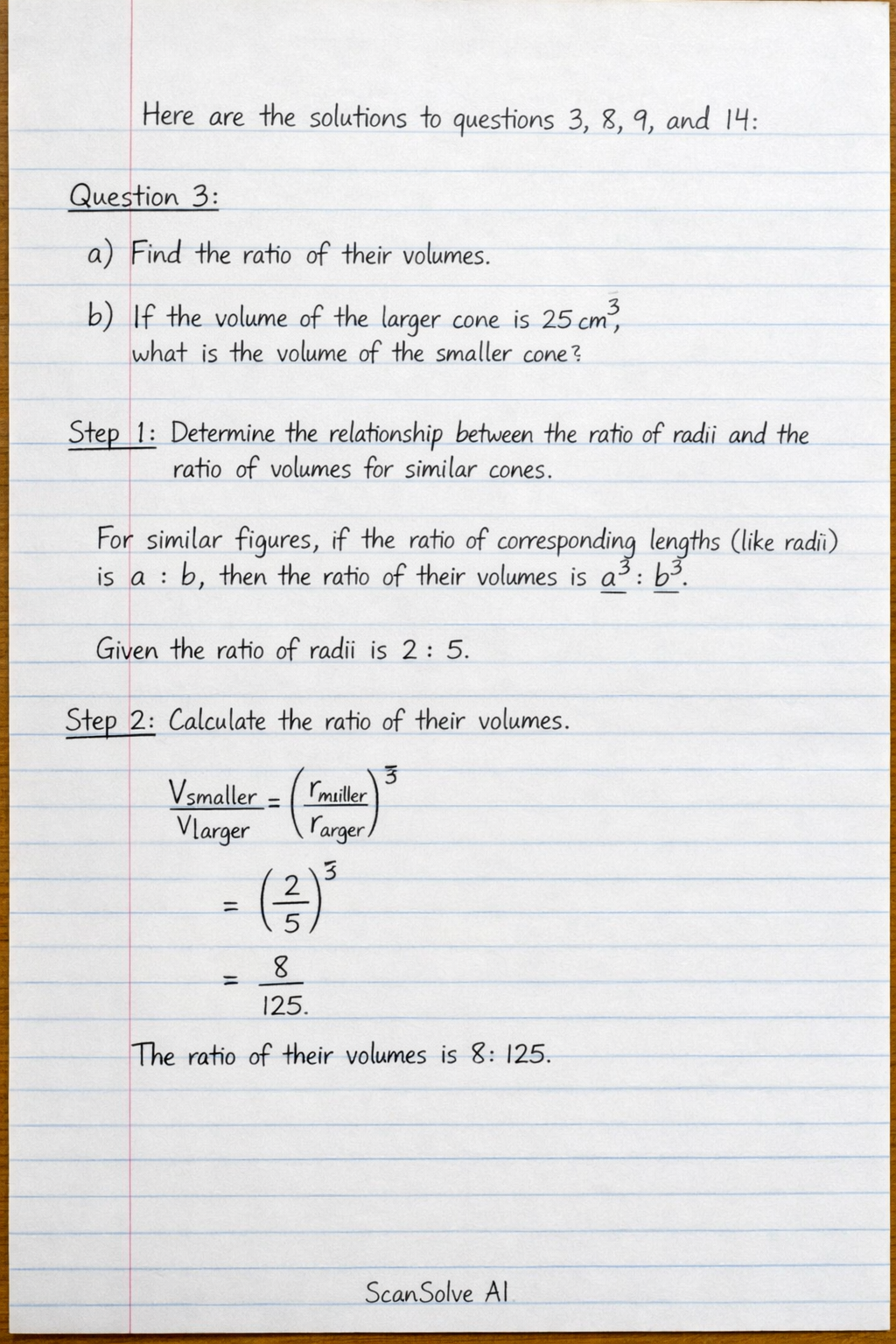
Handwritten Step-by-Step Solution
Get this as a handwritten image on WhatsApp — like a tutor wrote it for you.
Try on WhatsApp