This mathematics problem involves applying core mathematical principles and formulas. Below you will find a complete step-by-step solution with detailed explanations for each step, helping you understand not just the answer but the method behind it.
ScanSolve AI Answer
You're on a roll —
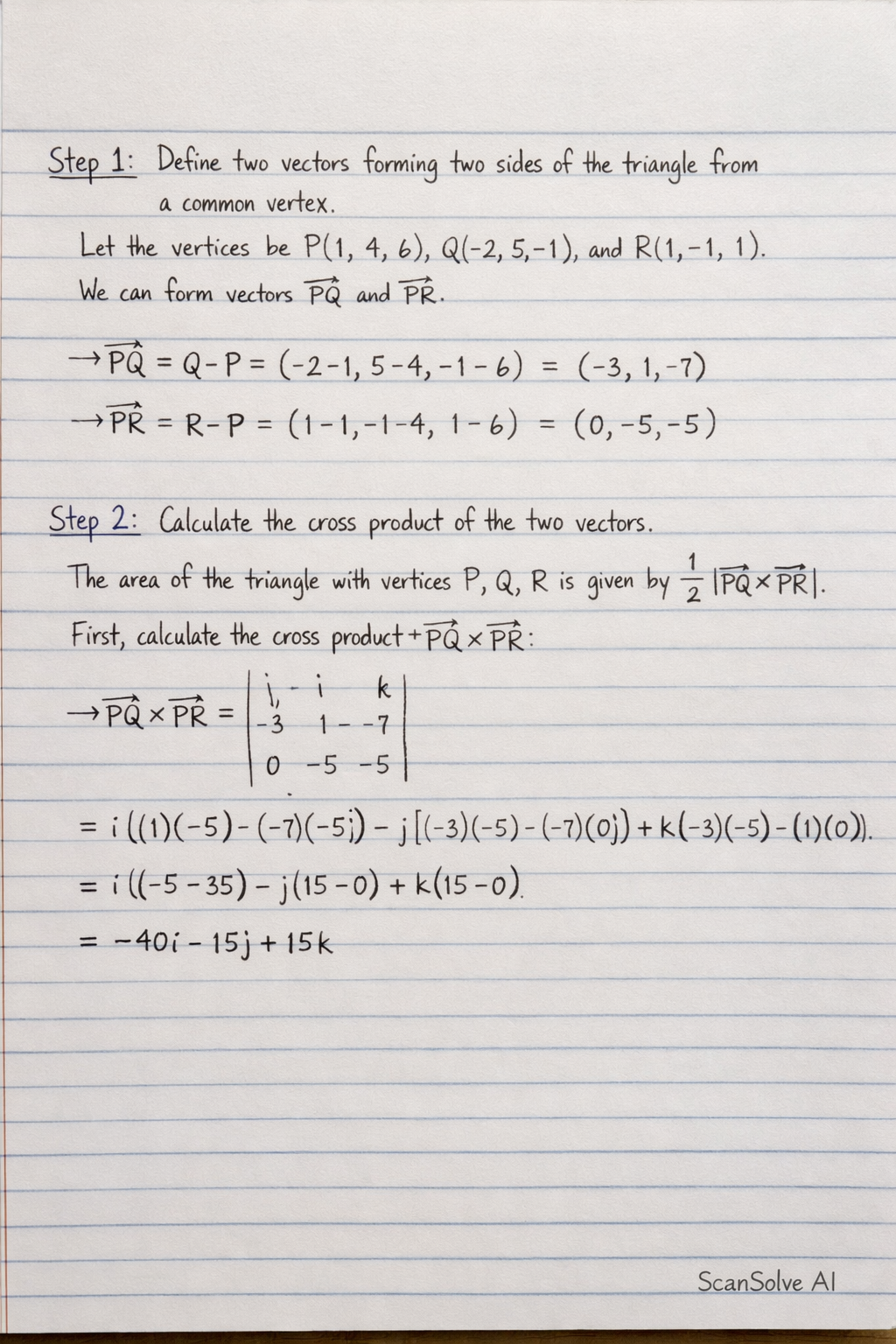
Step 1: Define two vectors forming two sides of the triangle from a common vertex.
Let the vertices be $P(1, 4, 6)$, $Q(-2, 5, -1)$, and $R(1, -1, 1)$.
We can form vectors $\vec{PQ}$ and $\vec{PR}$.
$$\vec{PQ} = Q - P = (-2-1, 5-4, -1-6) = (-3, 1, -7)$$
$$\vec{PR} = R - P = (1-1, -1-4, 1-6) = (0, -5, -5)$$
Step 2: Calculate the cross product of the two vectors.
The area of a triangle with vertices $P, Q, R$ is given by $\frac{1}{2} |\vec{PQ} \times \vec{PR}|$.
First, calculate the cross product $\vec{PQ} \times \vec{PR}$:
$$ \vec{PQ} \times \vec{PR} = \begin{vmatrix} \mathbf{i} & \mathbf{j} & \mathbf{k} \\ -3 & 1 & -7 \\ 0 & -5 & -5 \end{vmatrix} $$
$$ = \mathbf{i}((1)(-5) - (-7)(-5)) - \mathbf{j}((-3)(-5) - (-7)(0)) + \mathbf{k}((-3)(-5) - (1)(0)) $$
$$ = \mathbf{i}(-5 - 35) - \mathbf{j}(15 - 0) + \mathbf{k}(15 - 0) $$
$$ = -40\mathbf{i} - 15\mathbf{j} + 15\mathbf{k} $$
Step 3: Calculate the magnitude of the cross product.
$$ |\vec{PQ} \times \vec{PR}| = \sqrt{(-40)^2 + (-15)^2 + (15)^2} $$
$$ = \sqrt{1600 + 225 + 225} $$
$$ = \sqrt{2050} $$
We can simplify $\sqrt{2050}$:
$$ \sqrt{2050} = \sqrt{25 \times 82} = 5\sqrt{82} $$
Step 4: Calculate the area of the triangle.
The area of the triangle is half the magnitude of the cross product:
$$ \text{Area} = \frac{1}{2} |\vec{PQ} \times \vec{PR}| = \frac{1}{2} (5\sqrt{82}) $$
$$ \text{Area} = \frac{5\sqrt{82}}{2} $$
The area of the triangle is $\boxed{\frac{5\sqrt{82}}{2}}$.
What's next?
Define two vectors forming two sides of the triangle from a common vertex.
|Mathematics
Define two vectors forming two sides of the triangle from a common vertex.
ScanSolve AI Answer
You're on a roll —
Step 1: Define two vectors forming two sides of the triangle from a common vertex.
Let the vertices be P(1,4,6), Q(−2,5,−1), and R(1,−1,1).
We can form vectors PQ and PR.
PQ=Q−P=(−2−1,5−4,−1−6)=(−3,1,−7)PR=R−P=(1−1,−1−4,1−6)=(0,−5,−5)
Step 2: Calculate the cross product of the two vectors.
The area of a triangle with vertices P,Q,R is given by 21∣PQ×PR∣.
First, calculate the cross product PQ×PR:
PQ×PR=i−30j1−5k−7−5=i((1)(−5)−(−7)(−5))−j((−3)(−5)−(−7)(0))+k((−3)(−5)−(1)(0))=i(−5−35)−j(15−0)+k(15−0)=−40i−15j+15k
Step 3: Calculate the magnitude of the cross product.
∣PQ×PR∣=(−40)2+(−15)2+(15)2=1600+225+225=2050
We can simplify 2050:
2050=25×82=582
Step 4: Calculate the area of the triangle.
The area of the triangle is half the magnitude of the cross product:
Area=21∣PQ×PR∣=21(582)Area=2582
The area of the triangle is 2582.
What's next?
Need help with your own homework?
Get instant step-by-step solutions to any question. Free to start.