
We read your photo as:
Understand the problem. If a number Z leaves a remainder of 7 when divided by 30, 36, and 47, it means that (Z - 7) is perfectly divisible by 30, 36, and 47. Therefore, (Z - 7) is a common multipl
ScanSolve AI Answer
Step-by-step solution
4 stepsHere are the solutions to the problems:
18. A number Z is such that when it is divided by 30, 36 and 47 the remainder is always 7. Find the smallest possible value of Z.
Understand the problem.
If a number Z leaves a remainder of 7 when divided by 30, 36, and 47, it means that is perfectly divisible by 30, 36, and 47. Therefore, is a common multiple of 30, 36, and 47. To find the smallest possible value of Z, we need to find the Least Common Multiple (LCM) of 30, 36, and 47, and then add 7 to it.
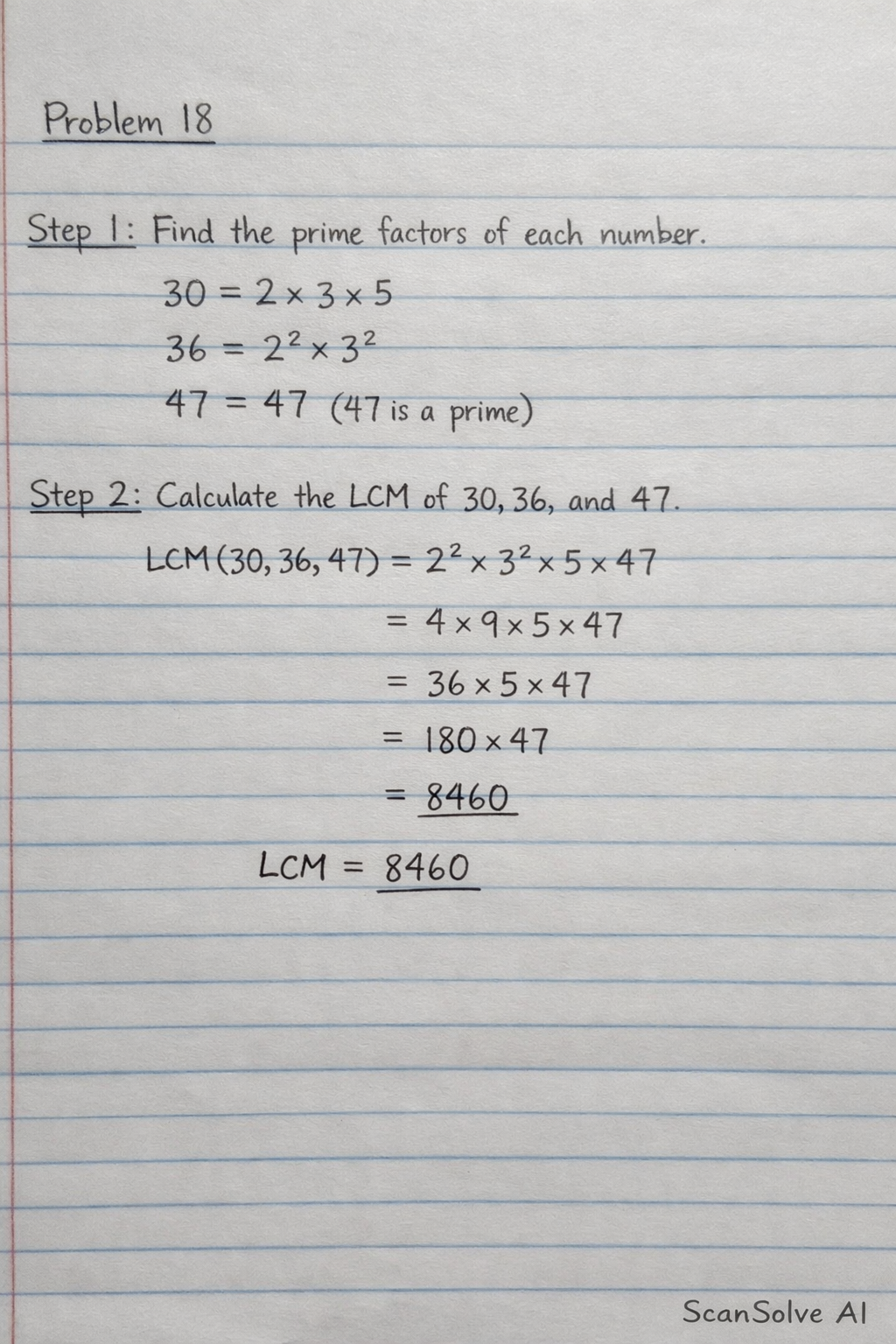
Find the prime factorization of each number.
Calculate the LCM of 30, 36, and 47.
The LCM is found by taking the highest power of all prime factors present in any of the numbers.
Find the value of Z.
Since , we have:
The smallest possible value of Z is .
19. Which of the following number is divisible by both 3 and 4: 36, 744, 101, 302, 805
To be divisible by both 3 and 4, a number must satisfy the divisibility rules for both 3 and 4.
- Divisibility Rule for 3: The sum of the digits of the number must be divisible by 3.
- Divisibility Rule for 4: The number formed by the last two digits must be divisible by 4.
Let's check each number:
-
36:
- Sum of digits: . Since 9 is divisible by 3, 36 is divisible by 3.
- Last two digits: 36. Since 36 is divisible by 4 (), 36 is divisible by 4.
- Conclusion: 36 is divisible by both 3 and 4.
-
744:
- Sum of digits: . Since 15 is divisible by 3, 744 is divisible by 3.
- Last two digits: 44. Since 44 is divisible by 4 (), 744 is divisible by 4.
- Conclusion: 744 is divisible by both 3 and 4.
-
101:
- Sum of digits: . Since 2 is not divisible by 3, 101 is not divisible by 3.
- Conclusion: Not divisible by both 3 and 4.
-
302:
- Sum of digits: . Since 5 is not divisible by 3, 302 is not divisible by 3.
- Conclusion: Not divisible by both 3 and 4.
-
805:
- Sum of digits: . Since 13 is not divisible by 3, 805 is not divisible by 3.
- Conclusion: Not divisible by both 3 and 4.
The numbers divisible by both 3 and 4 are .
Still stuck on this one?
Ask a follow-up, and the answer starts from this question.
More Mathematics Questions
Handwritten Step-by-Step Solution
Get this as a handwritten image on WhatsApp — like a tutor wrote it for you.
Try on WhatsApp