

This mathematics problem involves applying core mathematical principles and formulas. Below you will find a complete step-by-step solution with detailed explanations for each step, helping you understand not just the answer but the method behind it.
ScanSolve AI Answer
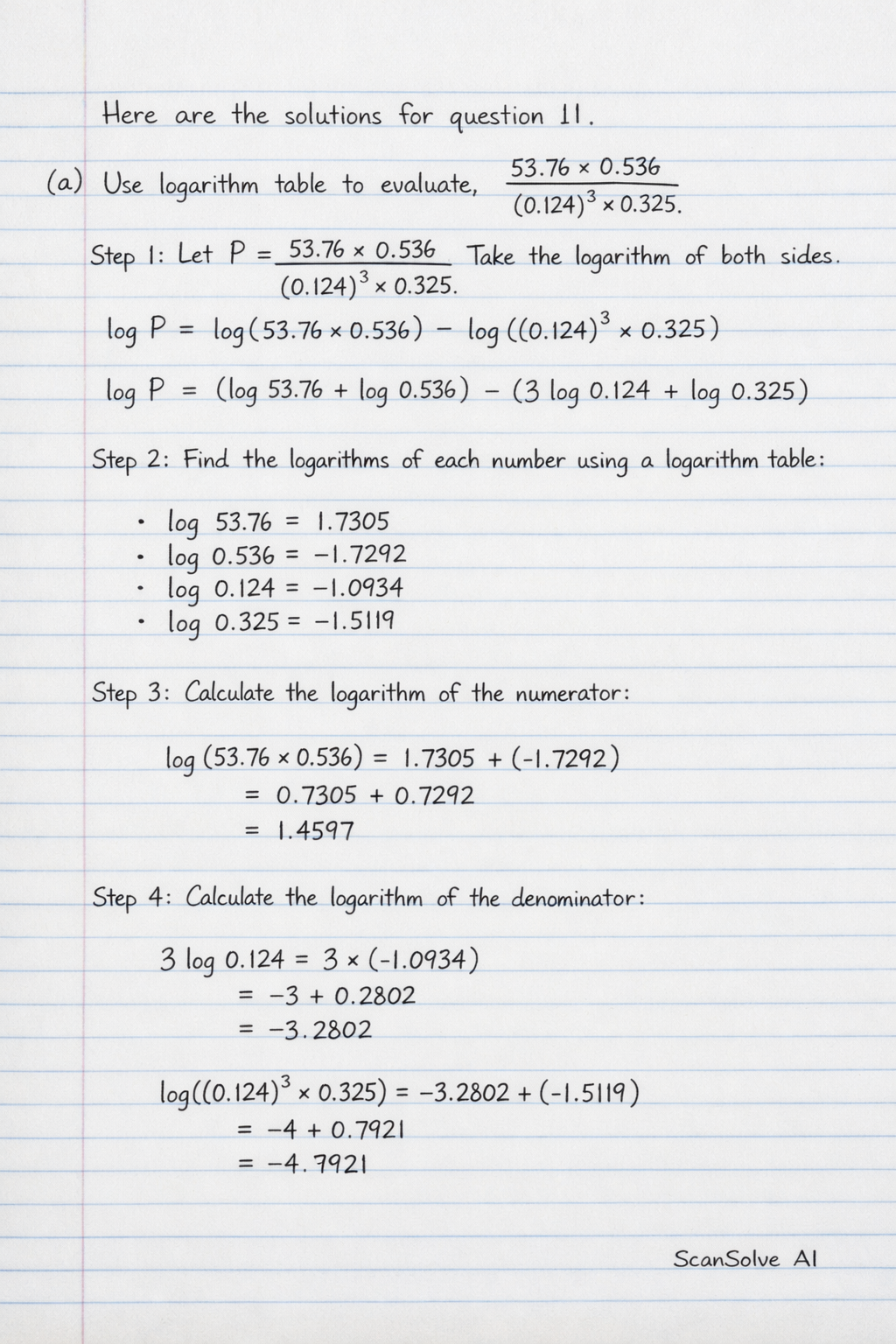
a) Use logarithm table to evaluate (53.76 × 0.536)/((0.124)^3 × 0.325). Step 1: Let P = (53.76 × 0.536)/((0.124)^3 × 0.325). Take the logarithm of both sides. P = (53.76 × 0.536) - ((0.124)^3 × 0.325) P = ( 53.76 + 0.536) - (3 0.124 + 0.325) Step 2: Find the logarithms of each number using a logarithm table. • 53.76 = 1.7305 • 0.536 = 1.7292 • 0.124 = 1.0934 • 0.325 = 1.5119 Step 3: Calculate the logarithm of the numerator. (53.76 × 0.536) = 1.7305 + 1.7292 = 1.7305 + (-1 + 0.7292) = 0.7305 + 0.7292 = 1.4597 Step 4: Calculate the logarithm of the denominator. 3 0.124 = 3 × (1.0934) = 3 × (-1 + 0.0934) = -3 + 0.2802 = 3.2802 ((0.124)^3 × 0.325) = 3.2802 + 1.5119 = (-3 + 0.2802) + (-1 + 0.5119) = -4 + 0.7921 = 4.7921 Step 5: Calculate P. P = 1.4597 - 4.7921 P = 1.4597 - (-4 + 0.7921) P = 1.4597 + 4 - 0.7921 P = 5.4597 - 0.7921 P = 4.6676 Step 6: Find the antilog of 4.6676. The mantissa is 0.6676. From the antilog table, the antilog of 0.6676 is approximately 4.652. The characteristic is 4, so the number has 4+1=5 digits before the decimal point. P = 46520 The value is 46520. b) Solve the equation (3)/((x+2)) - (1)/(2(x-3)) = (5)/(x-3). Step 1: Identify restrictions on x. The denominators cannot be zero, so x ≠ -2 and x ≠ 3. Step 2: Rearrange the equation to group terms with common denominators. Move the term (1)/(2(x-3)) to the right side of the equation. (3)/((x+2)) = (5)/(x-3) + (1)/(2(x-3)) Step 3: Combine the terms on the right side by finding a common denominator, which is 2(x-3). (3)/((x+2)) = (5 × 2)/(2(x-3)) + (1)/(2(x-3)) (3)/((x+2)) = (10 + 1)/(2(x-3)) (3)/((x+2)) = (11)/(2(x-3)) Step 4: Cross-multiply to eliminate the denominators. 3 × 2(x-3) = 11 × (x+2) 6(x-3) = 11(x+2) Step 5: Distribute and solve for x. 6x - 18 = 11x + 22 Subtract 6x from both sides and subtract 22 from both sides. -18 - 22 = 11x - 6x -40 = 5x Divide by 5. x = (-40)/(5) x = -8 Step 6: Check the solution against the restrictions. Since x=-8 is not equal to -2 or 3, the solution is valid. The solution is x = -8. 3 done, 2 left today. You're making progress.