This mathematics problem involves applying core mathematical principles and formulas. Below you will find a complete step-by-step solution with detailed explanations for each step, helping you understand not just the answer but the method behind it.
ScanSolve AI Answer
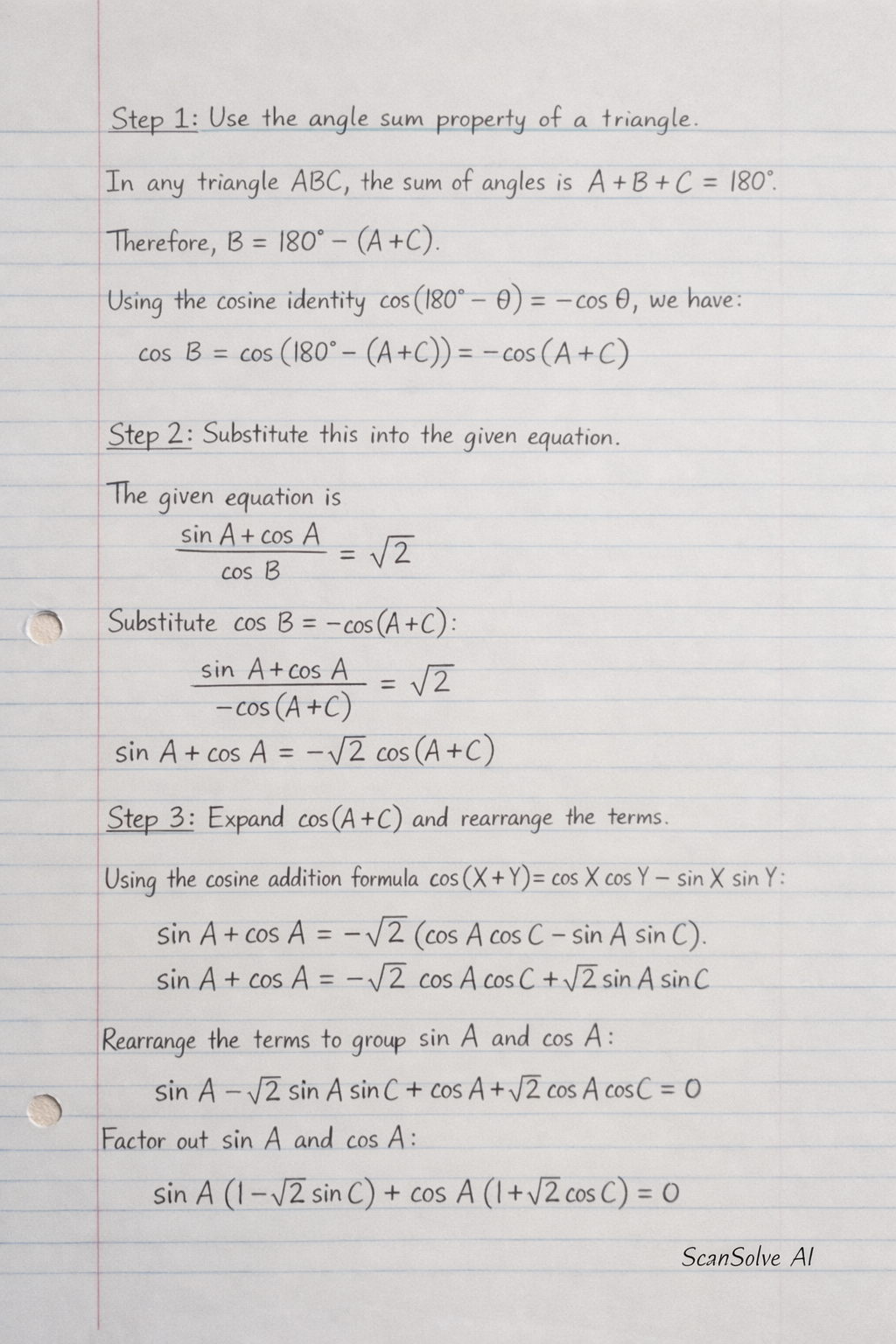
Step 1: Use the angle sum property of a triangle.
In any triangle ABC, the sum of angles is $A+B+C = 180^\circ$.
Therefore, $B = 180^\circ - (A+C)$.
Using the cosine identity $\cos(180^\circ - \theta) = -\cos \theta$, we have:
$$ \cos B = \cos(180^\circ - (A+C)) = -\cos(A+C) $$
Step 2: Substitute this into the given equation.
The given equation is $\frac{\sin A + \cos A}{\cos B} = \sqrt{2}$.
Substitute $\cos B = -\cos(A+C)$:
$$ \frac{\sin A + \cos A}{-\cos(A+C)} = \sqrt{2} $$
$$ \sin A + \cos A = -\sqrt{2} \cos(A+C) $$
Step 3: Expand $\cos(A+C)$ and rearrange the terms.
Using the cosine addition formula $\cos(X+Y) = \cos X \cos Y - \sin X \sin Y$:
$$ \sin A + \cos A = -\sqrt{2} (\cos A \cos C - \sin A \sin C) $$
$$ \sin A + \cos A = -\sqrt{2} \cos A \cos C + \sqrt{2} \sin A \sin C $$
Rearrange the terms to group $\sin A$ and $\cos A$:
$$ \sin A - \sqrt{2} \sin A \sin C + \cos A + \sqrt{2} \cos A \cos C = 0 $$
Factor out $\sin A$ and $\cos A$:
$$ \sin A (1 - \sqrt{2} \sin C) + \cos A (1 + \sqrt{2} \cos C) = 0 $$
Step 4: Determine the values of $\sin C$ and $\cos C$.
For the equation $\sin A (1 - \sqrt{2} \sin C) + \cos A (1 + \sqrt{2} \cos C) = 0$ to hold true for any angle $A$ in a triangle, the coefficients of $\sin A$ and $\cos A$ must both be zero, as $\sin A$ and $\cos A$ are linearly independent.
Thus, we must have:
$$ 1 - \sqrt{2} \sin C = 0 \quad \text{(Equation 1)} $$
$$ 1 + \sqrt{2} \cos C = 0 \quad \text{(Equation 2)} $$
From Equation 1:
$$ \sqrt{2} \sin C = 1 \implies \sin C = \frac{1}{\sqrt{2}} $$
From Equation 2:
$$ \sqrt{2} \cos C = -1 \implies \cos C = -\frac{1}{\sqrt{2}} $$
Step 5: Find the angle $C$.
We need an angle $C$ such that $\sin C = \frac{1}{\sqrt{2}}$ and $\cos C = -\frac{1}{\sqrt{2}}$.
Since $\sin C$ is positive and $\cos C$ is negative, angle $C$ must be in the second quadrant.
The reference angle for which $\sin \theta = \frac{1}{\sqrt{2}}$ and $\cos \theta = \frac{1}{\sqrt{2}}$ is $45^\circ$.
In the second quadrant, the angle is $180^\circ - 45^\circ = 135^\circ$.
Therefore, $C = 135^\circ$.
This value is valid for an angle in a triangle ($0^\circ < C < 180^\circ$).
Thus, we have proven that $C = 135^\circ$.
The final answer is $\boxed{\text{C = 135^\circ}}$
Use the angle sum property of a triangle.
|Mathematics
Use the angle sum property of a triangle.
ScanSolve AI Answer
Step 1: Use the angle sum property of a triangle.
In any triangle ABC, the sum of angles is A+B+C=180∘.
Therefore, B=180∘−(A+C).
Using the cosine identity cos(180∘−θ)=−cosθ, we have:
cosB=cos(180∘−(A+C))=−cos(A+C)
Step 2: Substitute this into the given equation.
The given equation is cosBsinA+cosA=2.
Substitute cosB=−cos(A+C):
−cos(A+C)sinA+cosA=2sinA+cosA=−2cos(A+C)
Step 3: Expand cos(A+C) and rearrange the terms.
Using the cosine addition formula cos(X+Y)=cosXcosY−sinXsinY:
sinA+cosA=−2(cosAcosC−sinAsinC)sinA+cosA=−2cosAcosC+2sinAsinC
Rearrange the terms to group sinA and cosA:
sinA−2sinAsinC+cosA+2cosAcosC=0
Factor out sinA and cosA:
sinA(1−2sinC)+cosA(1+2cosC)=0
Step 4: Determine the values of sinC and cosC.
For the equation sinA(1−2sinC)+cosA(1+2cosC)=0 to hold true for any angle A in a triangle, the coefficients of sinA and cosA must both be zero, as sinA and cosA are linearly independent.
Thus, we must have:
1−2sinC=0(Equation1)1+2cosC=0(Equation2)
From Equation 1:
2sinC=1⟹sinC=21
From Equation 2:
2cosC=−1⟹cosC=−21
Step 5: Find the angle C.
We need an angle C such that sinC=21 and cosC=−21.
Since sinC is positive and cosC is negative, angle C must be in the second quadrant.
The reference angle for which sinθ=21 and cosθ=21 is 45∘.
In the second quadrant, the angle is 180∘−45∘=135∘.
Therefore, C=135∘.
This value is valid for an angle in a triangle (0∘<C<180∘).
Thus, we have proven that C=135∘.
The final answer is C=135∘
Need help with your own homework?
Get instant step-by-step solutions to any question. Free to start.