This mathematics problem involves applying core mathematical principles and formulas. Below you will find a complete step-by-step solution with detailed explanations for each step, helping you understand not just the answer but the method behind it.
ScanSolve AI Answer
You're on a roll —
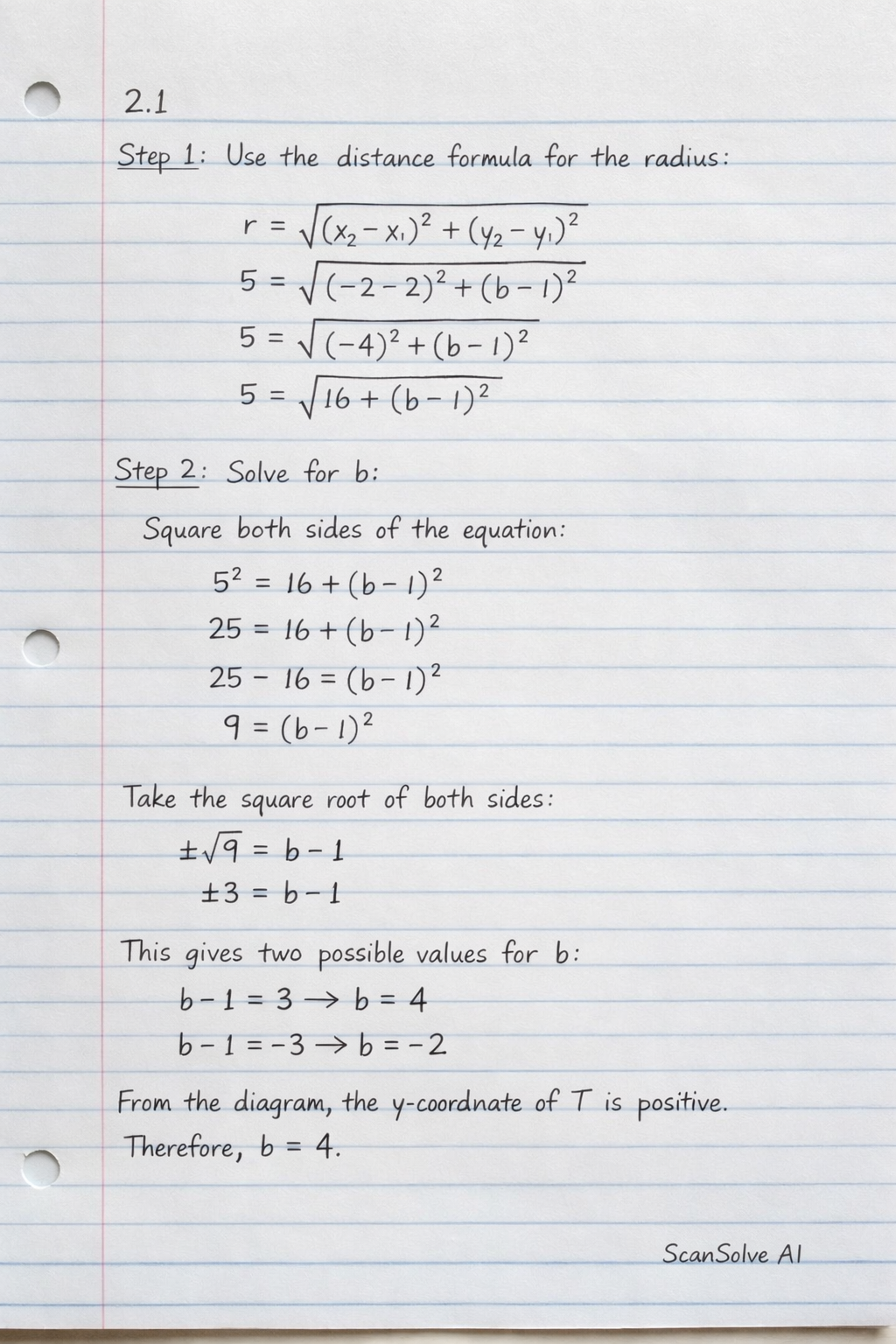
2.1
Step 1: Use the distance formula for the radius.
The centre of the circle is M$(2, 1)$ and the point T$(-2, b)$ is on the circle. The radius $r$ is given as 5 units.
The distance formula is $r = \sqrt{(x_2-x_1)^2 + (y_2-y_1)^2}$.
$$5 = \sqrt{(-2-2)^2 + (b-1)^2}$$
$$5 = \sqrt{(-4)^2 + (b-1)^2}$$
$$5 = \sqrt{16 + (b-1)^2}$$
Step 2: Solve for $b$.
Square both sides of the equation:
$$5^2 = 16 + (b-1)^2$$
$$25 = 16 + (b-1)^2$$
$$25 - 16 = (b-1)^2$$
$$9 = (b-1)^2$$
Take the square root of both sides:
$$\pm\sqrt{9} = b-1$$
$$\pm 3 = b-1$$
This gives two possible values for $b$:
$$b-1 = 3 \implies b = 4$$
$$b-1 = -3 \implies b = -2$$
From the diagram, the y-coordinate of T is positive.
Therefore, $b=4$.
2.2.1
Step 1: Use the information about KML.
KML is a line segment that passes through the centre M$(2, 1)$ and is parallel to the y-axis. This means that K, M, and L all have the same x-coordinate, which is $x=2$.
K is a point on the circle, and KM is a radius. The radius is 5 units.
Since KML is parallel to the y-axis, K must be 5 units directly above or below M.
From the diagram, K is below M.
The y-coordinate of K is $1 - 5 = -4$.
The coordinates of K are $\boxed{(2, -4)}$.
2.2.2
Step 1: Find the gradient of the radius MT.
The tangent LTP touches the circle at T$(-2, b)$. From 2.1, $b=4$, so T$(-2, 4)$.
The centre of the circle is M$(2, 1)$.
The gradient of the radius MT ($m_{MT}$) is:
$$m_{MT} = \frac{y_T - y_M}{x_T - x_M} = \frac{4 - 1}{-2 - 2} = \frac{3}{-4} = -\frac{3}{4}$$
Step 2: Find the gradient of the tangent LTP.
The radius MT is perpendicular to the tangent LTP at the point of tangency T.
The product of the gradients of perpendicular lines is $-1$.
$$m_{LTP} \times m_{MT} = -1$$
$$m_{LTP} \times \left(-\frac{3}{4}\right) = -1$$
$$m_{LTP} = \frac{-1}{-\frac{3}{4}} = \frac{4}{3}$$
Step 3: Determine the equation of the tangent LTP.
Use the point-slope form $y - y_1 = m(x - x_1)$ with point T$(-2, 4)$ and $m_{LTP} = \frac{4}{3}$.
$$y - 4 = \frac{4}{3}(x - (-2))$$
$$y - 4 = \frac{4}{3}(x + 2)$$
$$y - 4 = \frac{4}{3}x + \frac{8}{3}$$
$$y = \frac{4}{3}x + \frac{8}{3} + 4$$
$$y = \frac{4}{3}x + \frac{8}{3} + \frac{12}{3}$$
The equation of the tangent LTP is $\boxed{y = \frac{4}{3}x + \frac{20}{3}}$.
2.2.3
Step 1: Determine the coordinates of L.
L is a point on the line KML, which means its x-coordinate is 2.
L is also on the tangent LTP. Substitute $x=2$ into the equation of the tangent:
$$y_L = \frac{4}{3}(2) + \frac{20}{3}$$
$$y_L = \frac{8}{3} + \frac{20}{3}$$
$$y_L = \frac{28}{3}$$
So, L is $(2, \frac{28}{3})$.
Step 2: Determine the coordinates of P.
S$(-\frac{1}{2}, -6)$ is the midpoint of PK. K is $(2, -4)$. Let P be $(x_P, y_P)$.
Using the midpoint formula:
For the x-coordinate:
$$-\frac{1}{2} = \frac{x_P + 2}{2}$$
$$-1 = x_P + 2$$
$$x_P = -3$$
For the y-coordinate:
$$-6 = \frac{y_P + (-4)}{2}$$
$$-12 = y_P - 4$$
$$y_P = -8$$
So, P is $(-3, -8)$.
Step 3: Calculate the area of $\triangle LPK$.
The vertices are L$(2, \frac{28}{3})$, P$(-3, -8)$, and K$(2, -4)$.
Since L and K have the same x-coordinate ($x=2$), the side LK is a vertical line.
The length of the base LK is the absolute difference of their y-coordinates:
$$\text{Base LK} = \left|\frac{28}{3} - (-4)\right| = \left|\frac{28}{3} + \frac{12}{3}\right| = \left|\frac{40}{3}\right| = \frac{40}{3} \text{ units}$$
The height of the triangle is the perpendicular distance from P to the line $x=2$. This is the absolute difference of the x-coordinate of P and the x-coordinate of the line LK:
$$\text{Height} = |-3 - 2| = |-5| = 5 \text{ units}$$
The area of $\triangle LPK$ is $\frac{1}{2} \times \text{base} \times \text{height}$:
$$\text{Area} = \frac{1}{2} \times \frac{40}{3} \times 5$$
$$\text{Area} = \frac{20}{3} \times 5$$
$$\text{Area} = \frac{100}{3} \text{ square units}$$
The area of $\triangle LPK$ is $\boxed{\frac{100}{3} \text{ square units}}$.
2.3
Step 1: Identify the properties of both circles.
The first circle (Circle 1) has centre M$(2, 1)$ and radius $r_1 = 5$ (given in 2.1).
The second circle (Circle 2) has the equation $(x-2)^2 + (y-n)^2 = 25$.
Its centre is $C_2(2, n)$ and its radius is $r_2 = \sqrt{25} = 5$.
Step 2: Apply the condition for external tangency.
For two circles to touch each other externally, the distance between their centres must be equal to the sum of their radii.
Distance between centres $d = r_1 + r_2$.
$$d = 5 + 5 = 10$$
Step 3: Calculate the distance between the centres M$(2, 1)$ and $C_2(2, n)$.
$$d = \sqrt{(2-2)^2 + (n-1)^2}$$
$$d = \sqrt{0
Use the distance formula for the radius.
|Mathematics
Use the distance formula for the radius.
ScanSolve AI Answer
You're on a roll —
2.1
Step 1: Use the distance formula for the radius.
The centre of the circle is M(2,1) and the point T(−2,b) is on the circle. The radius r is given as 5 units.
The distance formula is r=(x2−x1)2+(y2−y1)2.
5=(−2−2)2+(b−1)25=(−4)2+(b−1)25=16+(b−1)2
Step 2: Solve for b.
Square both sides of the equation:
52=16+(b−1)225=16+(b−1)225−16=(b−1)29=(b−1)2
Take the square root of both sides:
±9=b−1±3=b−1
This gives two possible values for b:
b−1=3⟹b=4b−1=−3⟹b=−2
From the diagram, the y-coordinate of T is positive.
Therefore, b=4.
2.2.1
Step 1: Use the information about KML.
KML is a line segment that passes through the centre M(2,1) and is parallel to the y-axis. This means that K, M, and L all have the same x-coordinate, which is x=2.
K is a point on the circle, and KM is a radius. The radius is 5 units.
Since KML is parallel to the y-axis, K must be 5 units directly above or below M.
From the diagram, K is below M.
The y-coordinate of K is 1−5=−4.
The coordinates of K are (2,−4).
2.2.2
Step 1: Find the gradient of the radius MT.
The tangent LTP touches the circle at T(−2,b). From 2.1, b=4, so T(−2,4).
The centre of the circle is M(2,1).
The gradient of the radius MT (mMT) is:
mMT=xT−xMyT−yM=−2−24−1=−43=−43
Step 2: Find the gradient of the tangent LTP.
The radius MT is perpendicular to the tangent LTP at the point of tangency T.
The product of the gradients of perpendicular lines is −1.
mLTP×mMT=−1mLTP×(−43)=−1mLTP=−43−1=34
Step 3: Determine the equation of the tangent LTP.
Use the point-slope form y−y1=m(x−x1) with point T(−2,4) and mLTP=34.
y−4=34(x−(−2))y−4=34(x+2)y−4=34x+38y=34x+38+4y=34x+38+312
The equation of the tangent LTP is y=34x+320.
2.2.3
Step 1: Determine the coordinates of L.
L is a point on the line KML, which means its x-coordinate is 2.
L is also on the tangent LTP. Substitute x=2 into the equation of the tangent:
yL=34(2)+320yL=38+320yL=328
So, L is (2,328).
Step 2: Determine the coordinates of P.
S(−21,−6) is the midpoint of PK. K is (2,−4). Let P be (xP,yP).
Using the midpoint formula:
For the x-coordinate:
−21=2xP+2−1=xP+2xP=−3
For the y-coordinate:
−6=2yP+(−4)−12=yP−4yP=−8
So, P is (−3,−8).
Step 3: Calculate the area of △LPK.
The vertices are L(2,328), P(−3,−8), and K(2,−4).
Since L and K have the same x-coordinate (x=2), the side LK is a vertical line.
The length of the base LK is the absolute difference of their y-coordinates:
Base LK=328−(−4)=328+312=340=340 units
The height of the triangle is the perpendicular distance from P to the line x=2. This is the absolute difference of the x-coordinate of P and the x-coordinate of the line LK:
Height=∣−3−2∣=∣−5∣=5 units
The area of △LPK is 21×base×height:
Area=21×340×5Area=320×5Area=3100 square units
The area of △LPK is 3100squareunits.
2.3
Step 1: Identify the properties of both circles.
The first circle (Circle 1) has centre M(2,1) and radius r1=5 (given in 2.1).
The second circle (Circle 2) has the equation (x−2)2+(y−n)2=25.
Its centre is C2(2,n) and its radius is r2=25=5.
Step 2: Apply the condition for external tangency.
For two circles to touch each other externally, the distance between their centres must be equal to the sum of their radii.
Distance between centres d=r1+r2.
d=5+5=10
Step 3: Calculate the distance between the centres M(2,1) and C2(2,n).
d=(2−2)2+(n−1)2
Need help with your own homework?
Get instant step-by-step solutions to any question. Free to start.