
We read your photo as:
Use the distributive property of matrix multiplication.
ScanSolve AI Answer
Step-by-step solution
4 stepsHere are the solutions to the problems.
6. Prove that .
Use the distributive property of matrix multiplication.
Let . Then the expression becomes .
Applying the left distributive property, .Substitute back into the expression.
Apply the right distributive property to each term.
Combine the results.
Since matrix addition is commutative, the order of terms in a sum does not matter.
Therefore, .
7. If the matrix A in Example 5 had all its four elements nonzero, would still give a weighted sum of squares? Would the associative law still apply?
To answer this, we assume is a column vector, and is a matrix. Let and .
Then .-
Would still give a weighted sum of squares? If all four elements of are nonzero, then and are nonzero. This means the term will generally be present (unless ). A "weighted sum of squares" typically refers to a sum of terms of the form , without cross-product terms like . Therefore, if is not a diagonal matrix (i.e., or are nonzero), would be a quadratic form but not strictly a "weighted sum of squares" in the sense of only squared terms. ❌ No, it would generally be a quadratic form with cross-product terms, not solely a weighted sum of squares.
-
Would the associative law still apply? The associative law of matrix multiplication, , applies whenever the matrix dimensions are compatible for multiplication. The values of the elements (zero or nonzero) do not affect the validity of the associative law itself. ✅ Yes, the associative law of matrix multiplication always applies when the dimensions are compatible.
8. Name some situations or contexts where the notion of a weighted or unweighted sum of squares may be relevant.
- Least Squares Regression: In statistics, this method minimizes the unweighted sum of squared residuals to find the best-fitting line or curve for a set of data points.
- Weighted Least Squares (WLS): An extension of least squares where different data points are given different importance (weights) in the minimization process, leading to a weighted sum of squared residuals. This is used when observations have varying precision.
- Variance and Standard Deviation: These fundamental statistical measures are based on the sum of squared differences from the mean, representing the spread of data.
- Error Analysis and Measurement: When combining multiple measurements with different levels of uncertainty, a weighted sum of squares can be used to determine the most probable value, giving more weight to more precise measurements.
-
Still stuck on this one?
Ask a follow-up, and the answer starts from this question.
More Mathematics Questions
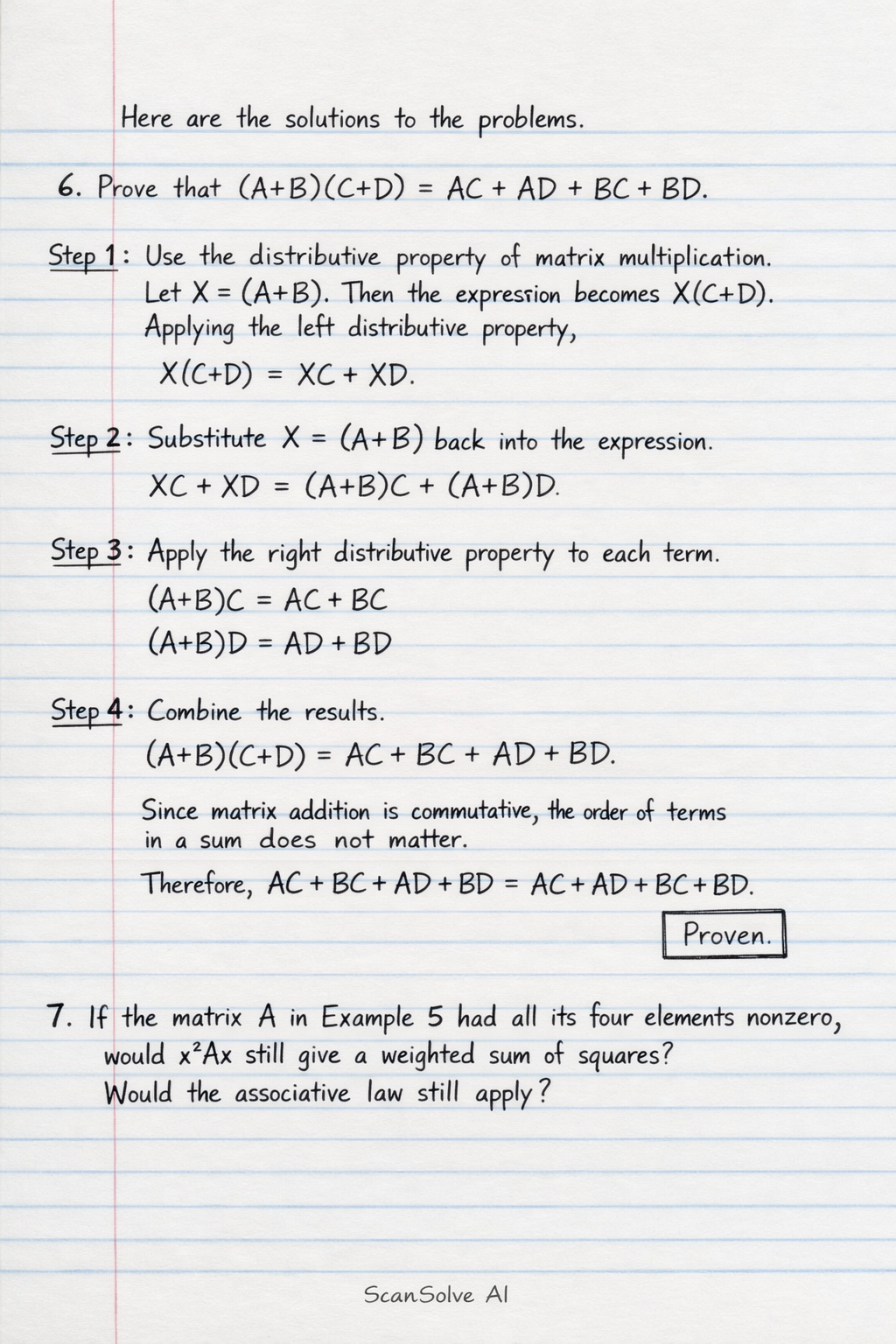
Handwritten Step-by-Step Solution
Get this as a handwritten image on WhatsApp — like a tutor wrote it for you.
Try on WhatsApp