

This mathematics problem involves applying core mathematical principles and formulas. Below you will find a complete step-by-step solution with detailed explanations for each step, helping you understand not just the answer but the method behind it.
ScanSolve AI Answer
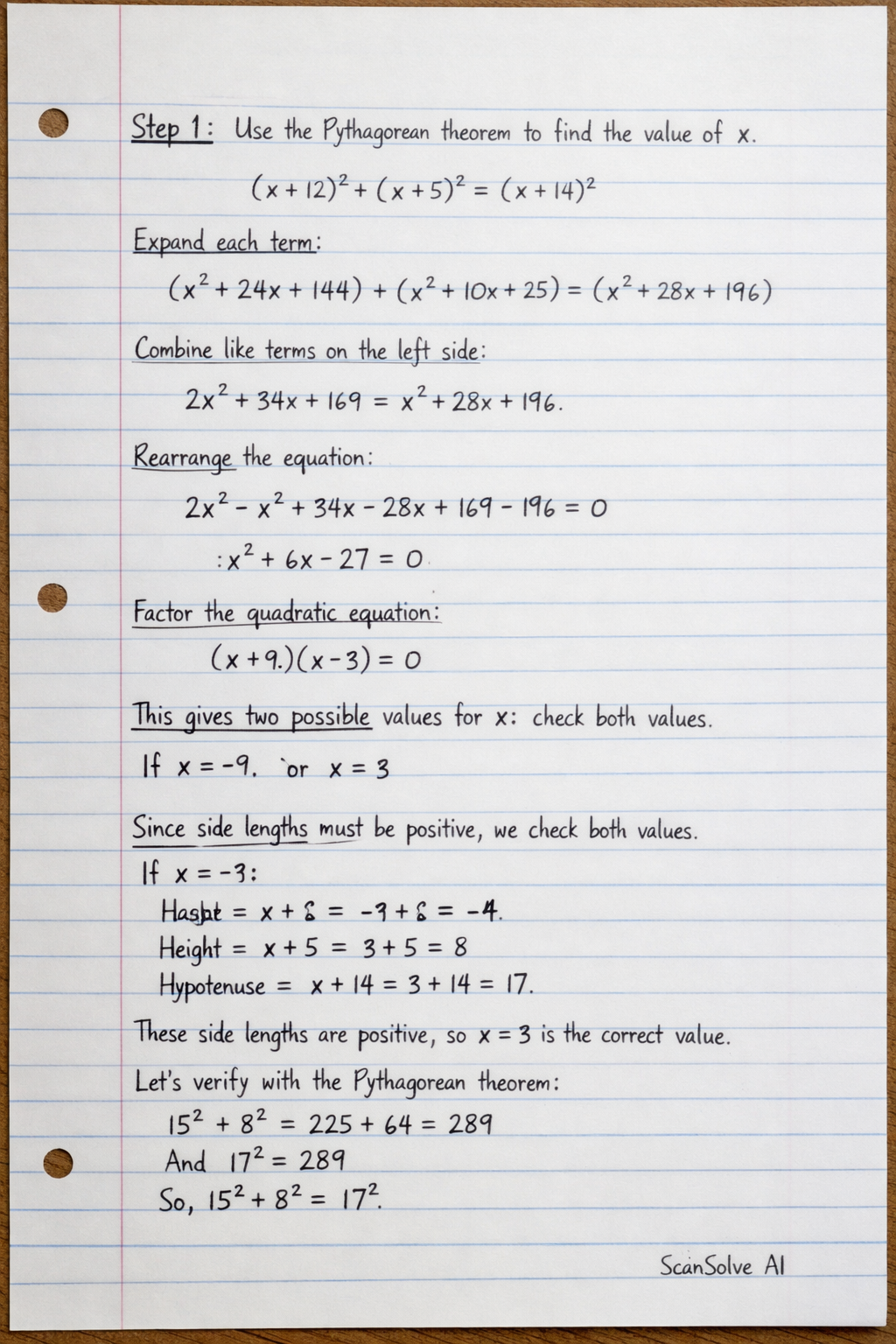
Step 1: Use the Pythagorean theorem to find the value of x. For a right triangle, the square of the hypotenuse is equal to the sum of the squares of the other two sides. (x+12)^2 + (x+5)^2 = (x+14)^2 Expand each term: (x^2 + 24x + 144) + (x^2 + 10x + 25) = (x^2 + 28x + 196) Combine like terms on the left side: 2x^2 + 34x + 169 = x^2 + 28x + 196 Rearrange the equation to form a quadratic equation: 2x^2 - x^2 + 34x - 28x + 169 - 196 = 0 x^2 + 6x - 27 = 0 Factor the quadratic equation: (x+9)(x-3) = 0 This gives two possible values for x: x = -9 or x = 3 Since side lengths must be positive, we check both values. If x = -9: Height = x+5 = -9+5 = -4. This is not possible as a length cannot be negative. If x = 3: Base = x+12 = 3+12 = 15 Height = x+5 = 3+5 = 8 Hypotenuse = x+14 = 3+14 = 17 These side lengths are positive, so x=3 is the correct value. Let's verify with the Pythagorean theorem: 15^2 + 8^2 = 225 + 64 = 289. And 17^2 = 289. So, 15^2 + 8^2 = 17^2. Step 2: Calculate the area of the triangle. The area of a right triangle is given by the formula: Area = (1)/(2) × base × height Using the side lengths calculated with x=3: Area = (1)/(2) × 15 × 8 Area = (1)/(2) × 120 Area = 60 Step 3: Calculate angle a in degrees. Angle a is the angle at the base. We can use the tangent function: (a) = oppositeadjacent (a) = (8)/(15) To find angle a, take the inverse tangent (arctan): a = ((8)/(15)) Using a calculator: a ≈ 28.07^ The area of the triangle is 60 and angle a is approximately 28.07 degrees.