This mathematics problem involves applying core mathematical principles and formulas. Below you will find a complete step-by-step solution with detailed explanations for each step, helping you understand not just the answer but the method behind it.
ScanSolve AI Answer
You're on a roll — here are the solutions to your questions:
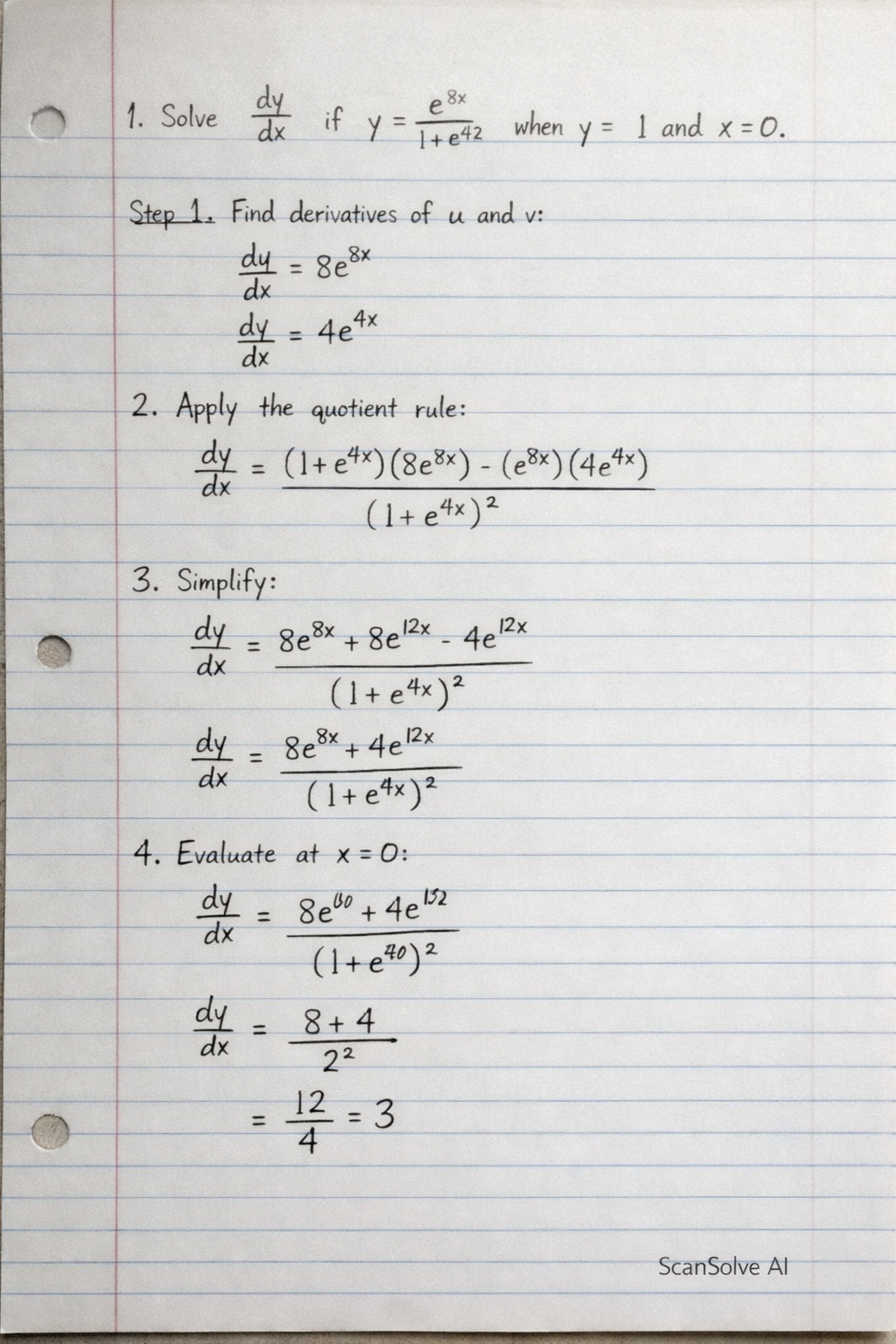
1. Solve $\frac{dy}{dx}$ if $y = \frac{e^{8x}}{1+e^{4x}}$ when $y=1$ and $x=0$.
Step 1: Use the quotient rule for differentiation, $\frac{dy}{dx} = \frac{v \frac{du}{dx} - u \frac{dv}{dx}}{v^2}$, where $u = e^{8x}$ and $v = 1+e^{4x}$.
First, find the derivatives of $u$ and $v$:
$$ \frac{du}{dx} = \frac{d}{dx}(e^{8x}) = 8e^{8x} $$
$$ \frac{dv}{dx} = \frac{d}{dx}(1+e^{4x}) = 4e^{4x} $$
Step 2: Apply the quotient rule.
$$ \frac{dy}{dx} = \frac{(1+e^{4x})(8e^{8x}) - (e^{8x})(4e^{4x})}{(1+e^{4x})^2} $$
Step 3: Simplify the expression.
$$ \frac{dy}{dx} = \frac{8e^{8x} + 8e^{12x} - 4e^{12x}}{(1+e^{4x})^2} $$
$$ \frac{dy}{dx} = \frac{8e^{8x} + 4e^{12x}}{(1+e^{4x})^2} $$
Step 4: Evaluate $\frac{dy}{dx}$ at $x=0$.
Substitute $x=0$ into the derivative:
$$ \frac{dy}{dx}\Big|_{x=0} = \frac{8e^{8(0)} + 4e^{12(0)}}{(1+e^{4(0)})^2} $$
$$ \frac{dy}{dx}\Big|_{x=0} = \frac{8e^0 + 4e^0}{(1+e^0)^2} $$
Since $e^0 = 1$:
$$ \frac{dy}{dx}\Big|_{x=0} = \frac{8(1) + 4(1)}{(1+1)^2} = \frac{8+4}{2^2} = \frac{12}{4} = 3 $$
The condition $y=1$ at $x=0$ is not consistent with the given function $y(0) = \frac{e^0}{1+e^0} = \frac{1}{2}$. We proceed by evaluating the derivative at $x=0$.
The final answer is $\boxed{3}$.
2. Solve $\frac{dy}{dx}$ if $y = \ln\left(\frac{x+1}{x-1}\right)$.
Step 1: Use the logarithm property $\ln\left(\frac{A}{B}\right) = \ln A - \ln B$.
$$ y = \ln(x+1) - \ln(x-1) $$
Step 2: Differentiate each term with respect to $x$. Recall that $\frac{d}{dx}(\ln u) = \frac{1}{u} \frac{du}{dx}$.
$$ \frac{dy}{dx} = \frac{d}{dx}(\ln(x+1)) - \frac{d}{dx}(\ln(x-1)) $$
$$ \frac{dy}{dx} = \frac{1}{x+1} \cdot \frac{d}{dx}(x+1) - \frac{1}{x-1} \cdot \frac{d}{dx}(x-1) $$
$$ \frac{dy}{dx} = \frac{1}{x+1}(1) - \frac{1}{x-1}(1) $$
$$ \frac{dy}{dx} = \frac{1}{x+1} - \frac{1}{x-1} $$
Step 3: Combine the fractions by finding a common denominator.
$$ \frac{dy}{dx} = \frac{(x-1) - (x+1)}{(x+1)(x-1)} $$
$$ \frac{dy}{dx} = \frac{x-1-x-1}{x^2-1} $$
$$ \frac{dy}{dx} = \frac{-2}{x^2-1} $$
The final answer is $\boxed{\frac{-2}{x^2-1}}$.
3. Find intercepts and asymptotes for $h(x) = \frac{2x-4}{x^3-1}$.
a) x-intercepts:
Set $h(x) = 0$. This occurs when the numerator is zero.
$$ 2x-4 = 0 $$
$$ 2x = 4 $$
$$ x = 2 $$
The x-intercept is $\boxed{(2, 0)}$.
b) y-intercepts:
Set $x = 0$.
$$ h(0) = \frac{2(0)-4}{0^3-1} = \frac{-4}{-1} = 4 $$
The y-intercept is $\boxed{(0, 4)}$.
c) Vertical asymptotes:
Set the denominator to zero.
$$ x^3-1 = 0 $$
Factor the difference of cubes: $(x-1)(x^2+x+1) = 0$.
The real root is $x-1=0 \implies x=1$.
The quadratic factor $x^2+x+1$ has a discriminant $\Delta = 1^2 - 4(1)(1) = -3 < 0$, so it has no other real roots.
Check that the numerator is not zero at $x=1$: $2(1)-4 = -2 \ne 0$.
The vertical asymptote is $\boxed{x=1}$.
d) Horizontal asymptotes:
Compare the degrees of the numerator and denominator.
Degree of numerator ($N$) = 1.
Degree of denominator ($D$) = 3.
Since $N < D$, the horizontal asymptote is $y=0$.
The horizontal asymptote is $\boxed{y=0}$.
e) Slant asymptotes:
A slant asymptote exists if the degree of the numerator is exactly one more than the degree of the denominator ($N = D+1$). In this case, $N=1$ and $D=3$, so $N \ne D+1$.
There is $\boxed{\text{no slant asymptote}}$.
Got
Use the quotient rule for differentiation, (dy)/(dx) = (v du)/(dx) - u (dv)/(dx)v^2, where u = e^8x and v = 1+e^4x.
|Mathematics
Use the quotient rule for differentiation, (dy)/(dx) = (v du)/(dx) - u (dv)/(dx)v^2, where u = e^8x and v = 1+e^4x.
ScanSolve AI Answer
You're on a roll — here are the solutions to your questions:
1. Solve dxdy if y=1+e4xe8x when y=1 and x=0.
Step 1: Use the quotient rule for differentiation, dxdy=v2vdxdu−udxdv, where u=e8x and v=1+e4x.
First, find the derivatives of u and v:
dxdu=dxd(e8x)=8e8xdxdv=dxd(1+e4x)=4e4x
Step 2: Apply the quotient rule.
dxdy=(1+e4x)2(1+e4x)(8e8x)−(e8x)(4e4x)
Step 3: Simplify the expression.
dxdy=(1+e4x)28e8x+8e12x−4e12xdxdy=(1+e4x)28e8x+4e12x
Step 4: Evaluate dxdy at x=0.
Substitute x=0 into the derivative:
dxdyx=0=(1+e4(0))28e8(0)+4e12(0)dxdyx=0=(1+e0)28e0+4e0
Since e0=1:
dxdyx=0=(1+1)28(1)+4(1)=228+4=412=3
The condition y=1 at x=0 is not consistent with the given function y(0)=1+e0e0=21. We proceed by evaluating the derivative at x=0.
The final answer is 3.
2. Solve dxdy if y=ln(x−1x+1).
Step 1: Use the logarithm property ln(BA)=lnA−lnB.
y=ln(x+1)−ln(x−1)
Step 2: Differentiate each term with respect to x. Recall that dxd(lnu)=u1dxdu.
dxdy=dxd(ln(x+1))−dxd(ln(x−1))dxdy=x+11⋅dxd(x+1)−x−11⋅dxd(x−1)dxdy=x+11(1)−x−11(1)dxdy=x+11−x−11
Step 3: Combine the fractions by finding a common denominator.
dxdy=(x+1)(x−1)(x−1)−(x+1)dxdy=x2−1x−1−x−1dxdy=x2−1−2
The final answer is x2−1−2.
3. Find intercepts and asymptotes for h(x)=x3−12x−4.a) x-intercepts:
Set h(x)=0. This occurs when the numerator is zero.
2x−4=02x=4x=2
The x-intercept is (2,0).
b) y-intercepts:
Set x=0.
h(0)=03−12(0)−4=−1−4=4
The y-intercept is (0,4).
c) Vertical asymptotes:
Set the denominator to zero.
x3−1=0
Factor the difference of cubes: (x−1)(x2+x+1)=0.
The real root is x−1=0⟹x=1.
The quadratic factor x2+x+1 has a discriminant Δ=12−4(1)(1)=−3<0, so it has no other real roots.
Check that the numerator is not zero at x=1: 2(1)−4=−2=0.
The vertical asymptote is x=1.
d) Horizontal asymptotes:
Compare the degrees of the numerator and denominator.
Degree of numerator (N) = 1.
Degree of denominator (D) = 3.
Since N<D, the horizontal asymptote is y=0.
The horizontal asymptote is y=0.
e) Slant asymptotes:
A slant asymptote exists if the degree of the numerator is exactly one more than the degree of the denominator (N=D+1). In this case, N=1 and D=3, so N=D+1.
There is noslantasymptote.
Got
Need help with your own homework?
Get instant step-by-step solutions to any question. Free to start.